
A software assistant may help a customer compare services or prepare an inquiry, but a moving job still contains decisions about access, inventory, timing and contractual scope. Website readiness should make those decisions clearer. It should not pretend that a form submission is a confirmed move or that every new assistant can book the company’s services autonomously.
 View full-size graphic ↗
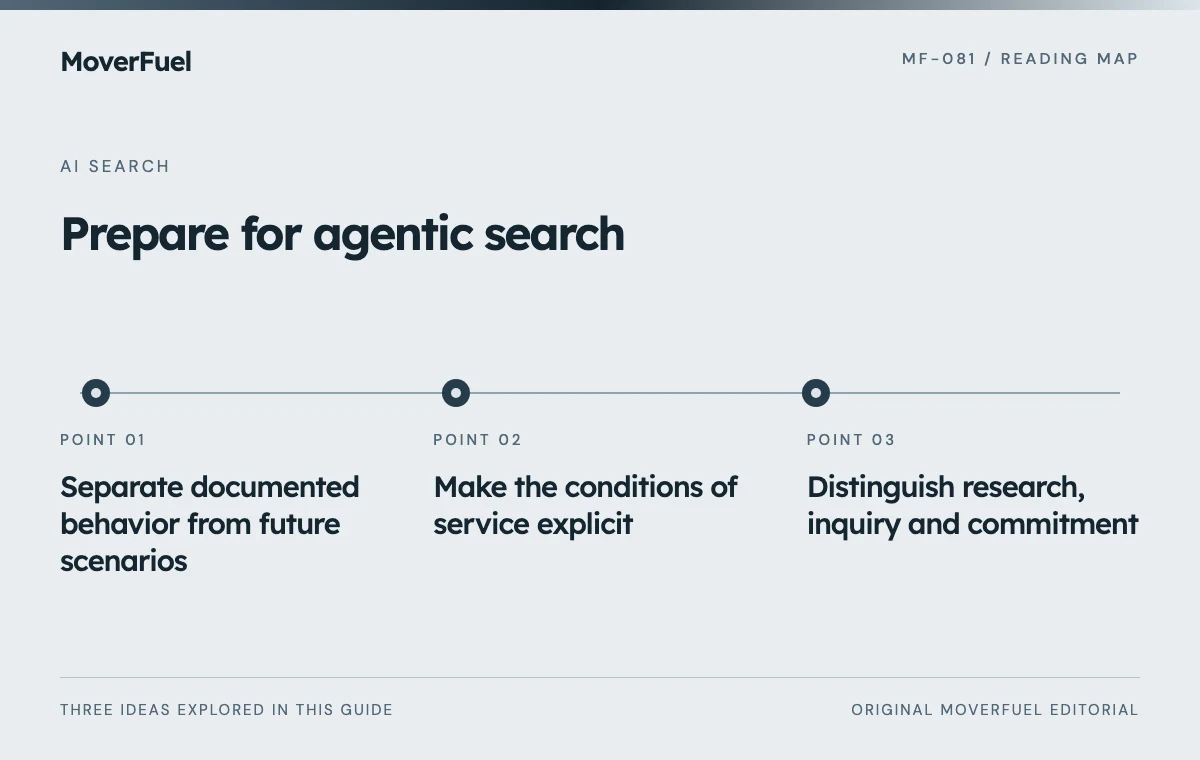
Separate documented behavior from future scenarios
Use ‘agentic’ carefully. It can describe systems that take steps toward a task, but the actual permissions and capabilities depend on the product and integration. A trend article should identify which behavior is documented and which is a planning scenario.
OpenAI documents a user agent for certain user-initiated page visits separately from automatic search crawling. That is evidence that some requested actions can involve fetching pages; it is not proof that a moving website has an autonomous booking integration. [1]
Scroll the table horizontally to compare all columns.
| Possible task | Website requirement | Human decision still needed |
|---|---|---|
| Compare service coverage | Clear public service and geography information | Confirm unusual route or access conditions |
| Prepare an estimate request | Understandable fields and required inputs | Customer approval of the submitted details |
| Check scheduling information | Accurate availability language | Company confirmation of actual capacity |
| Make a binding booking | Explicit terms and a supported transaction workflow | Authorized acceptance and any required review |
Make the conditions of service explicit
Publish what the company needs to know before it can evaluate a move: origin and destination, date flexibility, inventory, access and requested packing or storage. Explain which answers are provisional and which require an estimator’s review.
Avoid machine-readable overpromises
A page that says ‘available everywhere, anytime’ creates a problem for both a person and an automated assistant. Replace unsupported universality with real coverage and a clear confirmation step. If an advertised estimate is preliminary, state that near the action rather than burying it in a distant policy page.
Keep important facts in readable page content. An image of a service-area map can supplement a written explanation, but it should not be the only place a customer can determine coverage. The same applies to pricing conditions embedded in promotional graphics.
Distinguish research, inquiry and commitment
Scroll the table horizontally to compare all columns.
| Action | Expected outcome | Confirmation language |
|---|---|---|
| Read a service page | Information only | No booking implied |
| Submit an inquiry | Request delivered to the company | Explain what happens next |
| Schedule a consultation | Appointment recorded by the actual system | Confirm the appointment details |
| Accept an estimate or pay | A material transaction | Show the terms and require explicit authorization |
Do not use the same success message for these different actions. ‘Your move is booked’ is inaccurate when the backend has only stored a contact request. A future assistant reading that message could repeat the mistake to the customer.
Protect sensitive and consequential actions with the actual approval process the business requires. Avoid exposing private customer records or payment capabilities merely to make a speculative automation demo look seamless.
Test the ordinary customer journey first
A form with missing labels, inaccessible controls or unclear errors already fails some customers. Fix those issues before designing a special agent experience. W3C’s form guidance recommends feedback for both successful and unsuccessful submissions. [2]
Test keyboard access, field instructions, validation, loading states and genuine delivery failures. Preserve entered values when reasonable so a customer does not need to start again. Confirm that retrying a request does not create uncontrolled duplicate opportunities.
Use the moving quote form specification when defining the intake workflow. It applies whether a customer types each field or receives help preparing the information.
Evaluate new integrations against a concrete task
When a provider proposes an agent integration, ask what it can do today, what access it requires and how success is confirmed. Request a bounded demonstration using non-sensitive test data. Identify the point at which a human must approve the information or commitment.
Assess failure handling as carefully as the successful path. What happens if capacity changes, a field is misunderstood or the request cannot be delivered? A reliable handoff to staff is more useful than an impressive demonstration that cannot explain those cases.
Review emerging capabilities periodically without rebuilding the site around an unverified forecast. Clear service facts, stable links and trustworthy transaction states remain useful regardless of which assistant a customer eventually uses.
Common questions
Do movers need an autonomous booking agent now?
Not by default. Start with the actual customer task and evaluate a documented integration only when it can improve that task with appropriate controls.
Is a website inquiry the same as a confirmed booking?
No. The confirmation must describe what the system actually completed, and any further estimate or capacity review should be explicit.
Your next step
Prepare for assisted journeys by clarifying facts and action boundaries. Keep consequential commitments under explicit authorization and distinguish current capabilities from future scenarios.
Sources & editorial notes
Platform claims cite the documents below. Operating frameworks and labeled examples are MoverFuel editorial analysis, not client results or industry benchmarks.
- OpenAI: overview of crawlersUser-initiated page retrieval differs from automatic search crawling; does not establish a booking integration. Reviewed .
- W3C WAI: form user notificationsAccessible success and failure notifications. Agent scenarios are planning examples, not tested product capability claims. Reviewed .