A moving company cannot submit a preferred answer and require an assistant to recommend it. It can make its services easier to understand, keep public facts consistent and check whether relevant search systems can access useful pages. Those actions should be evaluated separately from the mentions and referrals that may follow.
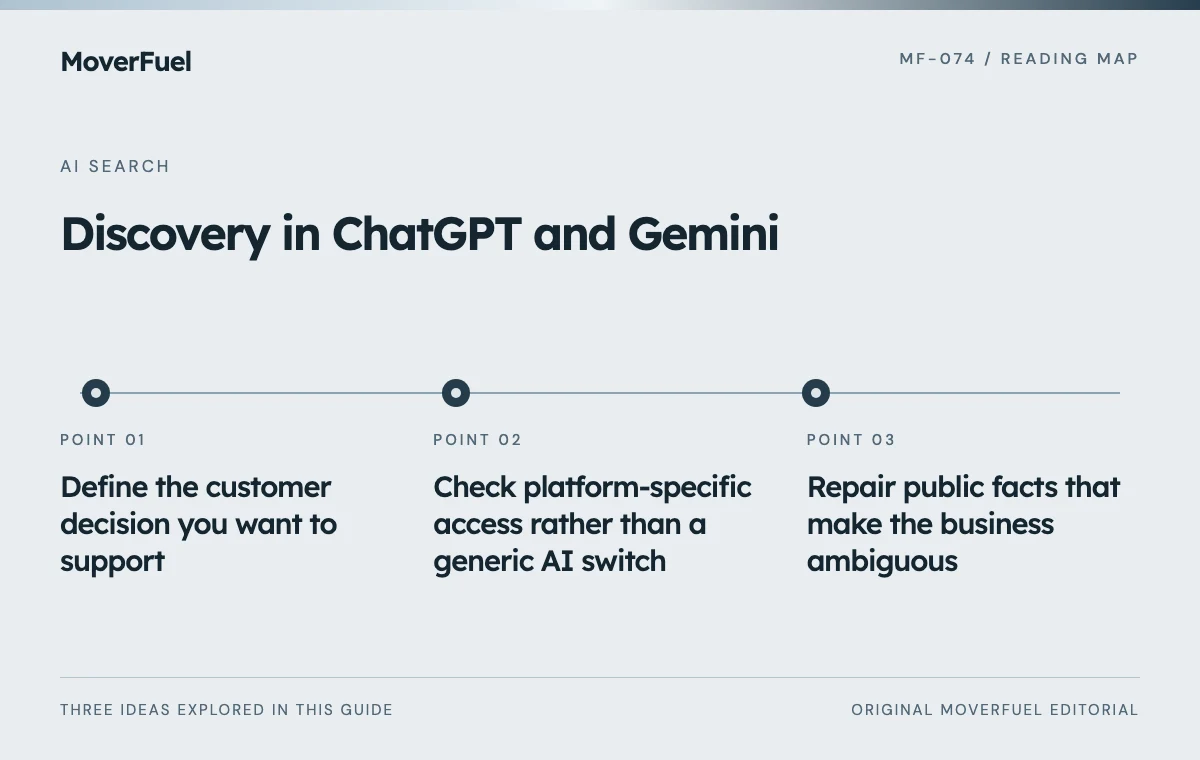 View full-size graphic ↗
Define the customer decision you want to support
Begin with the questions a real prospect could ask: finding a mover for an apartment with difficult access, comparing local packing options or planning an office relocation. Include the market, service and constraints. A broad question about ‘the best movers’ provides little direction for improving your actual offer.
Scroll the table horizontally to compare all columns.
| Customer question | Evidence the company can publish |
|---|---|
| Can this mover handle my pickup area? | Accurate service coverage and real branch information |
| What happens during an estimate? | The actual process and information required |
| Is packing available for my move? | Scope, exclusions and how it is quoted |
| Can the team manage an office relocation? | Specific capabilities and approved project evidence |
| How should I compare moving quotes? | A useful explanation of scope and decision criteria |
Keep customer discovery separate from research about marketing agencies. A mover’s website should answer questions about hiring the mover. An agency’s content should help moving-company operators make marketing decisions. Mixing those audiences can produce technically accessible pages that serve the wrong search intent.
Check platform-specific access rather than a generic AI switch
OpenAI documents OAI-SearchBot for ChatGPT search and GPTBot for potential model-training use; their robots.txt controls are independent. ChatGPT-User serves certain user-initiated actions and is not the control for automatic search crawling. Review the relevant crawler rules and infrastructure restrictions for the intended use. [1]
Have the site owner or developer inspect actual response codes, robots directives and firewall behavior for important public pages. Do not open private customer data or administrative routes to improve discovery. Access checks should focus on pages intentionally published for prospective customers.
For Gemini, do not assume that a setting documented for ChatGPT or Google Search describes every Gemini experience. Google’s Gemini guidance says location context can influence responses and that sources or related links are not supplied with every answer. Record the product surface and context when observing results. [2] [3]
Repair public facts that make the business ambiguous
Audit the company name, service descriptions, operating locations and contact paths across the website and important profiles. Resolve contradictions such as a closed branch on one page or storage services described differently in two places. This improves the information available to both people and systems without requiring a speculative ranking theory.
Publish answers with enough context to be useful
An estimate-process page should explain what the company asks for and what happens next. A service page should distinguish included work from optional work. If a capability varies by branch or route, say so. Short, direct answers can sit within detailed pages rather than becoming dozens of nearly identical question pages.
Use authentic evidence where available: approved photographs, named operating procedures and real customer feedback with appropriate permission. Do not invent awards, affiliations or case-study numbers to make the business appear more authoritative. Missing proof is a research task, not an invitation to fill a template.
The broader AI search readiness guide separates access, useful evidence and commercial outcomes.
Keeping those facts consistent wherever the business appears is also part of our AEO and GEO work.
Observe each assistant with a repeatable protocol
Scroll the table horizontally to compare all columns.
| Record | Reason |
|---|---|
| Exact prompt and follow-ups | Preserve the question actually answered |
| Product surface and visible mode | Avoid combining unlike experiences |
| Date and location context | Make later comparisons interpretable |
| Fresh or continuing conversation | Identify context supplied by earlier messages |
| Business mention | Record whether the company appears and in what role |
| Linked source and claim | Check what the citation actually supports |
| Accuracy issue | Identify a specific public-information correction |
Keep a stable core question set and a separate exploratory set. Do not keep rewriting a prompt until the company appears, then report that result as normal visibility. If the prompt itself names the company, label it as a branded test rather than evidence of unprompted discovery.
This article describes a testing method; it does not report a live benchmark of MoverFuel or any moving company in either assistant. Actual testing requires saved observations and the context necessary to interpret them.
Choose corrections that remain useful beyond one answer
Prioritize a broken public page, contradictory service fact or weak customer explanation over a one-off absence from an answer. If an assistant repeats an outdated address and a public source still contains it, correct the source and record the change. Recheck later without promising a particular refresh time.
Track identifiable referrals and ask customers how they discovered the company, preserving self-reported answers separately from observed source data. A mention without a visit may still be interesting, but it is not a lead. Use the distinction when allocating effort between AI discovery and established acquisition channels.
Common questions
Must we allow model training to appear in ChatGPT search?
OpenAI documents separate controls for search crawling and GPTBot. Review the current official crawler guidance and your site’s actual configuration rather than treating all AI access as one setting.
Does a citation mean the assistant recommends our company?
No. Inspect the surrounding statement. The link may support a fact, provide related reading or appear in a comparison without endorsing the business.
Your next step
Make the business accessible and understandable, then observe each assistant honestly. Useful public evidence and accurate measurement are durable improvements even when a particular generated answer changes.
Sources & editorial notes
Platform claims cite the documents below. Operating frameworks and labeled examples are MoverFuel editorial analysis, not client results or industry benchmarks.
- OpenAI: overview of crawlersDistinct OpenAI search, training and user-action crawler roles and controls. Reviewed .
- Google: Gemini Apps privacy hubGemini location context; not a ranking specification. Reviewed .
- Google: view related sources from Gemini AppsGemini may show sources or related links, but not every response contains them. Observation protocol is original guidance. Reviewed .