Call tracking is useful only if it preserves a dependable customer calling experience. A number that identifies the campaign but sends callers to the wrong branch has failed the business. Design the path from advertisement or website to telephone routing and then to the opportunity record before connecting conversion reports.
 View full-size graphic ↗
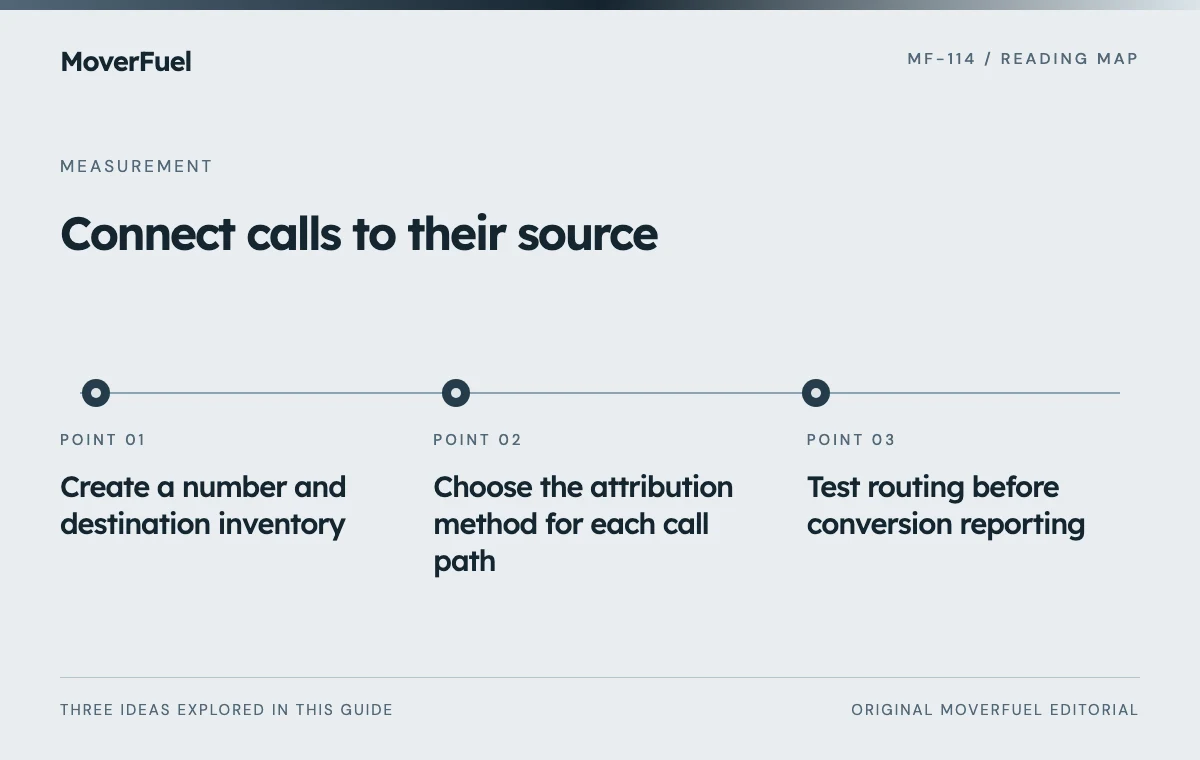
Create a number and destination inventory
List every number customers can encounter: website numbers, ad call assets, branch pages, profiles and offline materials. Record the destination, business owner, purpose and what happens outside staffed hours. Identify old numbers that remain published before adding new ones.
Scroll the table horizontally to compare all columns.
| Entry point | Tracking decision | Routing decision |
|---|---|---|
| Campaign landing page | Visitor-level or source-level attribution need | Relevant sales team |
| General website | How source context is maintained | Central intake or branch selection |
| Call directly from an ad | Supported ad-call measurement path | Advertised service team |
| Branch contact page | Branch identity and attribution approach | Correct local destination |
| After-hours call | Missed-call and callback record | Honest voicemail or approved overflow |
Check who controls each number and the process for transferring or retiring it. A campaign change should not disconnect a number customers saved from an earlier estimate. Maintain a documented fallback when a tracking provider or integration is unavailable.
Choose the attribution method for each call path
A source-specific number can distinguish a known placement, while visitor-level website tracking can associate a call with a browsing session when correctly implemented. These methods answer different questions. Confirm the provider's requirements and limitations before choosing the configuration.
CallRail's Google Ads integration requires its website script, visitor tracking for call reporting and Ads auto-tagging. Its documentation distinguishes website-pool calls from source trackers and treats calls from ad assets through a separate forwarding path. [1]
That is one documented vendor example, not a claim that your account or MoverFuel has the integration enabled. Verify the exact product, plan, account permissions and supported path in the current setup. Do not assume a generic ‘Google Ads connected’ badge covers every type of call.
Keep displayed numbers and telephone links synchronized
When website numbers change dynamically, test both visible digits and the telephone link destination. Include the header, footer, sticky mobile control and embedded forms. A visitor should not see one number while tapping through to another.
Test routing before conversion reporting
Place controlled calls through each published path with the receiving team aware of the test. Check ringing, answer location, transfers, voicemail and overflow. Confirm that the customer does not encounter unnecessary menus or an unrelated business greeting.
Scroll the table horizontally to compare all columns.
| Scenario | Required observation |
|---|---|
| Staffed hours | Correct team receives the call |
| Busy line | Defined overflow or callback path |
| Closed office | Accurate message and realistic next step |
| Branch transfer | Context reaches the receiving person |
| Provider issue | Documented operational fallback |
Review any recording or transcription configuration under the applicable requirements before enabling it. Restrict access and retention to the business need. Do not assume that purchasing a tracking tool settles the rules for recording every caller.
The mobile click-to-call guide covers the website interaction that precedes the tracked conversation.
Prevent overlapping conversion paths
Inventory native ad-call conversions, vendor imports, analytics imports and CRM outcomes. Decide which actions represent contact, qualification and booking. Do not count the same initial call through several paths as several independent opportunities.
CallRail documents that its imported calls appear separately from Google's native Calls from Ads action and that its integration does not retroactively capture interactions before activation or update. Those distinctions matter when comparing reports after installation. [1]
Choose bidding inputs deliberately. A platform's default recommendation may not match your established outcome model. Check the current account goals and avoid giving several overlapping contact actions unintended optimization weight.
Connect conversations to unique moving opportunities
Store the call reference, source context, timestamp and resulting opportunity relationship in the appropriate system. A customer who calls twice and submits a form may still represent one move. Preserve the contact history without multiplying the acquired-opportunity count.
Use a small outcome vocabulary: new suitable inquiry, needs clarification, unsupported service, existing customer, non-sales contact and unknown. Assign an owner to unresolved calls. The marketing report should reflect what the conversation produced rather than only its length or source label.
Reconcile a permitted sample from the phone log to the CRM and advertising report. Document missing records, delayed imports and duplicates. After launch, repeat checks when numbers, routing, tags or account permissions change. Call tracking is an operating connection that needs maintenance, not a one-time installation badge.
Common questions
Does one tracking number identify every campaign?
Not necessarily. Source-level and visitor-level methods have different capabilities. Choose a documented configuration that answers the attribution question you actually have.
Can call counts be used as booked moves?
No. Calls must be reconciled to unique opportunities and actual booking evidence. Repeated or non-sales calls should not inflate acquired work.
Your next step
Inventory numbers, verify routing and define conversion ownership before relying on attribution. The complete call path must work for customers and reconcile to real moving opportunities.
Sources & editorial notes
Platform claims cite the documents below. Operating frameworks and labeled examples are MoverFuel editorial analysis, not client results or industry benchmarks.
- CallRail: Google Ads integrationDocumented Google Ads integration prerequisites, separate ad-call path, website-pool limitations and non-retroactive reporting. Vendor-neutral routing workflow is original. Reviewed .