A tap on the profile’s call button is not a booked move, and two calls about the same relocation are not necessarily two leads. To measure Google Maps commercially, connect observable interactions to unique moving opportunities, then follow those opportunities through qualification, estimates and booking.
 View full-size graphic ↗
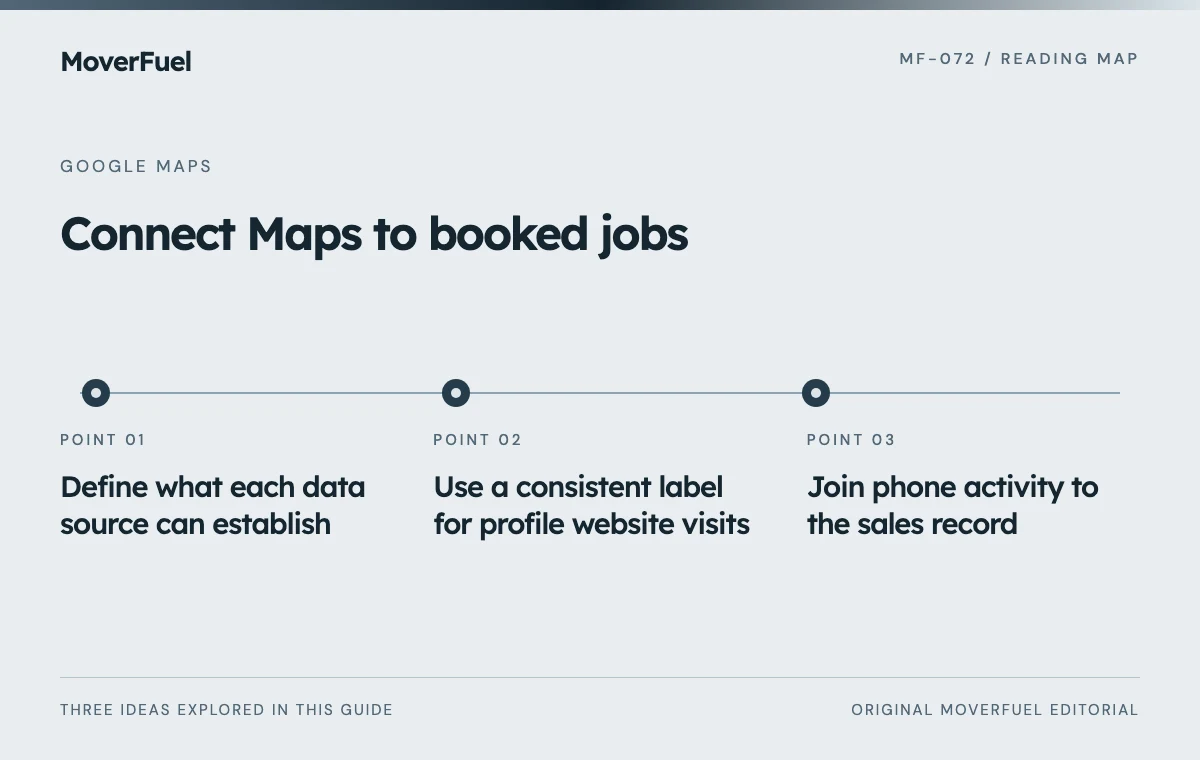
Define what each data source can establish
Google defines the Business Profile calls metric as call-button clicks and website clicks as clicks on the website link. Performance data can include Search and Maps interactions from organic results and Google Ads, and only applicable metrics appear. Do not label the entire report as organic Maps leads. [1]
Scroll the table horizontally to compare all columns.
| Layer | What it establishes | What it does not establish |
|---|---|---|
| Profile interaction | A recorded action on the profile | A connected conversation or qualified move |
| Website session or call record | An observable visit or telephone event | A unique sales opportunity by itself |
| Qualified opportunity | A request fitting the company’s agreed criteria | An accepted estimate or booking |
| Booked move | A confirmed outcome under the company’s definition | Completed revenue if the job can still cancel |
Write these definitions into the report before calculating rates. If one team counts every call and another counts unique households, they can produce different answers from the same month without either spreadsheet containing an arithmetic error.
Use a consistent label for profile website visits
A practical tagging convention is utm_source=google, utm_medium=organic and utm_campaign=gbp, with a stable branch identifier in utm_content when needed. This is an example convention, not a Google-required naming scheme. Confirm how your analytics system interprets the fields before adopting it.
Test the complete journey from the live profile link to the landing page and form. Check that redirects preserve the intended parameters and that the submitted inquiry receives the source context your implementation is designed to capture. Keep personal information out of URL parameters.
A tagged profile visit is not proof of Maps-only discovery
The same profile link may be reached through different Google surfaces. Label the result as a tagged Business Profile visit unless you have evidence supporting a narrower origin. Do not create precision in the dashboard that the collection method cannot justify.
Join phone activity to the sales record
If using a profile-specific tracking number, document ownership, routing, provider access and the fallback plan. Confirm the arrangement against current profile rules and test calls from a customer device. A measurement setup that loses calls is defeating its commercial purpose.
Separate missed calls, repeat contacts, wrong numbers and existing-customer questions from new moving opportunities. An answered call can still be unqualified because the pickup area, date or service does not fit. Record the reason rather than treating every exclusion as a sales failure.
Use the company’s approved privacy and recording practices. Call tracking and call recording are different decisions; useful source attribution does not automatically require recording every conversation. Keep access to customer details limited to the people who need them.
Create one opportunity for one moving decision
Scroll the table horizontally to compare all columns.
| Field | Purpose |
|---|---|
| Opportunity ID | Deduplicate calls, forms and follow-up contacts |
| Created date | Define the acquisition cohort |
| Source evidence | Tagged visit, dedicated call route or customer report |
| Confidence | Observed, self-reported, inferred or unknown |
| Service and pickup market | Evaluate fit and operating responsibility |
| Qualification and estimate | Track meaningful progress |
| Booking and completion status | Separate planned work from realized outcomes |
A household may submit a form, call later and ask a spouse to confirm details. Join those contacts when the evidence supports one move. Conversely, a repeat customer booking a genuinely separate relocation should not disappear into the old opportunity merely because the phone number matches.
Preserve uncertainty. ‘Customer mentioned Google’ is useful self-reported information, but does not prove that Maps was the acquisition surface. Keep that record separate from a directly observed tagged visit rather than forcing both into a falsely precise category.
Calculate outcomes using a consistent cohort
Illustrative example: 40 unique opportunities created in a month have reliable Business Profile source evidence. Thirty fit the company’s qualification criteria, and 12 of those are booked by the chosen review date. The qualified share is 30 ÷ 40 = 75%; qualified-to-booked conversion is 12 ÷ 30 = 40%; opportunity-to-booked conversion is 12 ÷ 40 = 30%. These are invented teaching inputs, not benchmarks or MoverFuel results.
Do not divide this month’s bookings by this month’s new inquiries if many bookings came from earlier cohorts. Keep a created-date cohort for acquisition analysis and a separate move-date view for operating capacity. Mark immature cohorts whose estimates are still open.
The same discipline applies to organic traffic quality and broader lead tracking and automation. Explain attribution gaps alongside the result.
Common questions
Are Business Profile calls the number of connected calls?
No. Google defines that metric as clicks on the call button. Use telephone and sales records to determine which interactions became conversations and opportunities.
Can every Google-sourced booking be assigned to Maps?
No. Preserve the evidence level and surface uncertainty. A general customer statement about Google is less specific than an observed acquisition path.
Your next step
Measure interactions, opportunities and outcomes separately, then join them with documented source evidence. Clear definitions are more valuable than a precise-looking Maps revenue number built on uncertain assumptions.
Sources & editorial notes
Platform claims cite the documents below. Operating frameworks and labeled examples are MoverFuel editorial analysis, not client results or industry benchmarks.
- Google: Business Profile performance and insightsCall-click and website-click definitions, applicable metrics and mixed Search/Maps organic/Ads coverage. Tag convention, worksheet and numerical example are original explanatory models. Reviewed .