
An exclusive lead can still be a poor fit, and a shared lead can still become a useful job. The label describes a distribution arrangement, not a guaranteed level of intent or profitability. Before paying a premium, establish exactly what exclusivity means and compare the resulting opportunities under the same intake process.
 View full-size graphic ↗
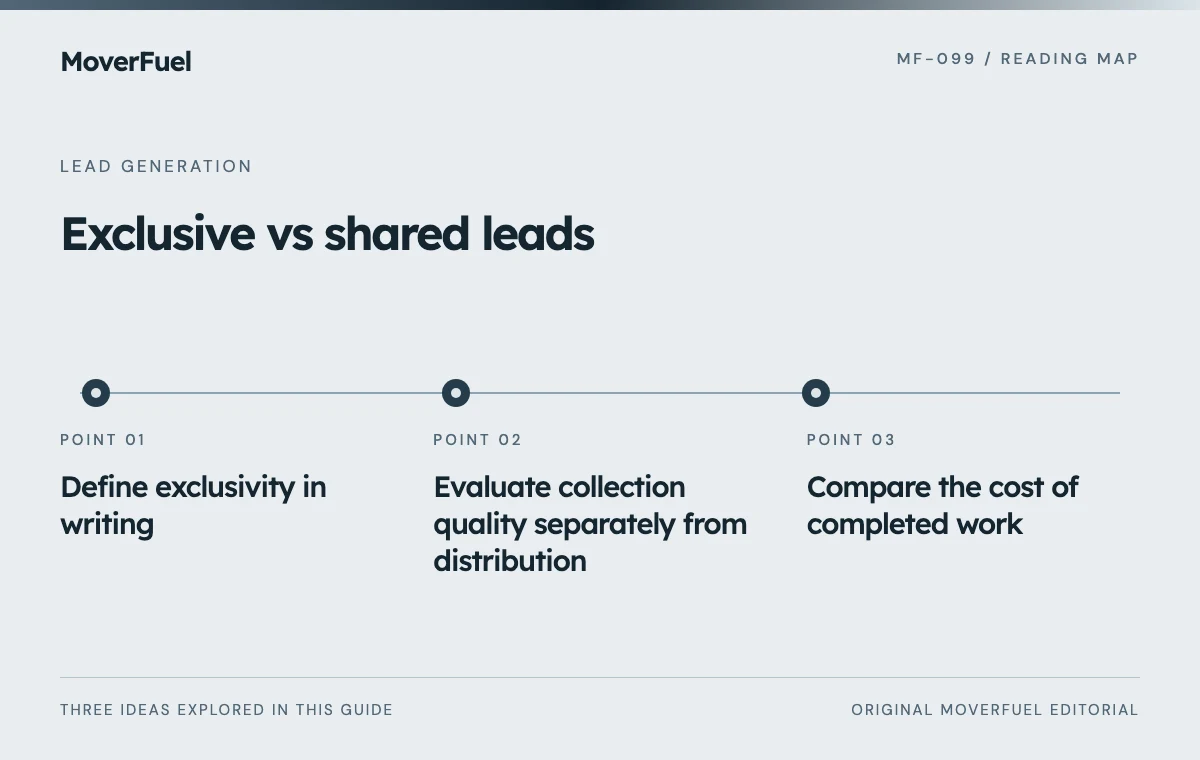
Define exclusivity in writing
Ask whether exclusivity applies to a specific inquiry record, a geographic area, a service category or a period of time. Clarify whether the supplier, its affiliates or other intermediaries may redistribute the same information. A salesperson's broad promise is not a substitute for the agreement.
Scroll the table horizontally to compare all columns.
| Term | Clarification to request |
|---|---|
| Exclusive | Exclusive to whom, for which record and for how long? |
| Shared | How many recipients and when are they notified? |
| Duplicate | How are repeat forms, calls and resubmissions identified? |
| Resale | Can affiliates or downstream partners distribute the record? |
| Territory | Does coverage refer to origin, destination or customer location? |
Even a genuinely exclusive supplier record does not mean the customer has contacted only one moving company. They may have independently requested other estimates. Keep that distinction clear when forecasting sales effort or discussing competition with the team.
Evaluate collection quality separately from distribution
Inspect the page and advertisement that produced the inquiry. What did the customer believe they were requesting? Were service type, geography and timing clear? A record collected through a misleading promise remains problematic even if only one buyer receives it.
The FTC's lead-generation guidance emphasizes truthful statements about identity, affiliations, use of consumer information and what a person receives for submitting it. Distribution terminology does not resolve those collection questions. [1]
Ask how contact information and move details are checked, and distinguish validation from qualification. A working phone number does not establish a serviceable move. A complete form does not prove that the customer understands which company will contact them.
Check timing and duplicates
Record the original inquiry time and delivery time where available. A delayed record may behave differently from a recent request. Reconcile repeated submissions against your existing opportunities so the same customer is not treated as several independent acquisition successes.
Compare the cost of completed work
Use a controlled, bounded trial and evaluate comparable move types. Keep the same qualification definitions and intake standards for both sources. If one source is handled by a staffed team and the other sits unanswered overnight, the result does not isolate the distribution model.
Scroll the table horizontally to compare all columns.
| Measure | Exclusive example | Shared example |
|---|---|---|
| Purchased records | 100 | 100 |
| Fee per record | $60 | $25 |
| Total lead fees | $6,000 | $2,500 |
| Completed jobs | 15 | 5 |
| Lead-fee cost per completed job | $400 | $500 |
The example shows why the cheaper record is not always the cheaper completed job. It excludes sales labor, management, credits and job contribution. Different completion counts could reverse the comparison; the numbers are invented solely to explain the calculation.
Add incremental handling cost and use net fees after valid credits are resolved. Then examine the contribution from completed work. Do not describe revenue minus lead fees as profit when labor, travel and other relevant costs remain unaccounted for.
Read the credit rules before judging the price
Understand which records qualify for a credit, the evidence required and the submission deadline. A broad headline guarantee may exclude the exact problems your business encounters. Ask how out-of-area requests, duplicates, unreachable contacts and unsupported services are treated.
Maintain a reason-coded record of disputed leads and final decisions. Do not assume a rejected estimate qualifies for a credit: a legitimate inquiry can choose another provider. Separate supplier defects from normal sales losses and from your own handling failures.
The lead-vendor due diligence guide provides a broader procurement checklist for collection, distribution and trial terms.
A credit process also has an administrative cost. Include the time required to document and reconcile disputes when comparing arrangements. A lower nominal fee can be less attractive if every batch requires extensive manual correction.
Choose the arrangement that fits your operating model
Shared distribution may require a different response process and competitive conversation, but it does not justify pressure or repeated unwanted contact. Exclusive distribution may provide more control over the initial handoff, yet still requires disciplined qualification and transparent communication.
Set stop conditions for a trial, such as repeated collection concerns, unserviceable volume or costs that exceed the business's defined economics. Preserve customer-level evidence and review enough mature outcomes to avoid making a decision from one unusually good or bad day.
The final decision may be to use one model, combine them selectively or buy neither. Exclusivity is one contract attribute among several; it should earn its premium through observed value rather than branding.
Common questions
Does exclusive mean the customer is not shopping elsewhere?
No. It may restrict a supplier's distribution of a record, but the customer can independently contact other movers.
Are shared leads always lower quality?
No. Collection, service fit, timing and handling all matter. Compare mature outcomes rather than assuming the distribution label determines quality.
Your next step
Define distribution precisely, verify collection quality and calculate the cost of completed work. An exclusivity premium is justified only by the value your own evidence supports.
Sources & editorial notes
Platform claims cite the documents below. Operating frameworks and labeled examples are MoverFuel editorial analysis, not client results or industry benchmarks.
- FTC: lead-generation transparency and MediaAlpha settlementFTC guidance on truthful lead-collection representations. Contract questions and illustrative economics are original analysis, not legal conclusions. Reviewed .