
Buying inquiries and running your own advertising solve different operating problems. A supplier can provide a defined stream of records, while an owned advertising program gives you more responsibility for the message, landing page and measurement. Neither removes the need to qualify prospects and book the work. Compare the whole system before choosing.
 View full-size graphic ↗
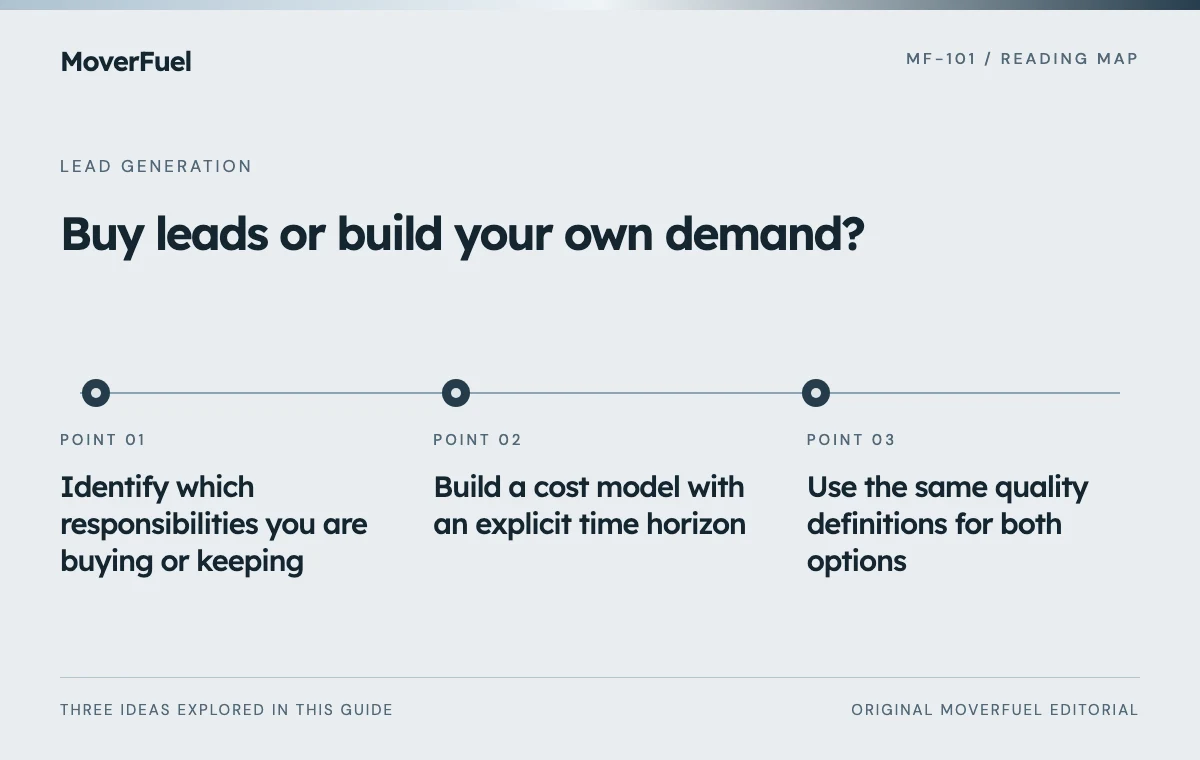
Identify which responsibilities you are buying or keeping
With purchased leads, the supplier usually controls some combination of advertising, collection and distribution. Your team still owns its response, estimate process and customer experience. With company-controlled advertising, you or your agency must operate the campaigns and conversion path as well as the intake process.
Scroll the table horizontally to compare all columns.
| Decision | Purchased inquiry program | Company-controlled advertising |
|---|---|---|
| Collection message | Review the supplier's actual experience | Create and maintain your own offer |
| Distribution | Defined by supplier agreement | Route inquiries through your systems |
| Optimization | Change buying specification or supplier | Adjust campaigns, pages and outcome signals |
| Ownership | Verify record and account rights | Keep business access to accounts and assets |
| Operational work | Qualify and handle delivered inquiries | Manage acquisition plus qualification and handling |
An agency can operate your advertising without owning your business accounts. Clarify access and handoff rights in either model. ‘We handle everything’ is not enough detail to establish who controls the assets or can audit the results.
Build a cost model with an explicit time horizon
Include one-time setup, recurring management, media or lead fees, creative and incremental intake work. Use a horizon long enough to expose recurring obligations and initial investment. Do not hide setup on one side while including it on the other.
Scroll the table horizontally to compare all columns.
| Cost | Purchased leads | Owned advertising |
|---|---|---|
| One-time setup | $600 | $3,000 |
| Monthly lead fees or media | $3,000 | $3,000 |
| Monthly management and creative | $0 in this scenario | $1,000 |
| Monthly incremental intake labor | $600 | $400 |
| Six-month total | $22,200 | $29,400 |
The totals are $600 plus six times $3,600, and $3,000 plus six times $4,400. All values are hypothetical assumptions. A zero management line does not imply that purchased leads are universally management-free; replace every line with your real costs.
If the first scenario produced 60 completed jobs and the second produced 84, their modeled acquisition costs would be $370 and $350 per completed job. Those completion counts are illustrative, not forecasts. Fewer completions or different job economics could reverse the conclusion.
Use the same quality definitions for both options
A delivered lead record and a website conversion event are different raw measurements. Reconcile them into unique opportunities with the same service, geography and timing criteria. Deduplicate repeat forms and calls so an owned campaign is not rewarded for recording the same customer several times.
Google distinguishes qualified leads from converted leads so advertisers can represent deeper stages of their own lead process. That capability depends on correctly defined and supplied outcome data; it does not make every tracked inquiry a booked move. [1]
Control for the way inquiries are handled
Compare staffed hours, assignment, contact attempts and estimate availability. If purchased records are delivered during an unstaffed period while ad inquiries are handled promptly, the result combines source quality with an operating difference. That difference matters commercially, but it should be explained honestly.
Track reasons for disqualification and lost work. Out-of-area demand, unsupported services, unavailable dates and price objections suggest different repairs. A single blended close rate hides the decisions that make the comparison useful.
Account for learning, control and concentration risk
An owned program can build reusable landing pages, campaign history and a clearer understanding of customer intent. Those assets are valuable only if the business has access and someone maintains them. They do not guarantee cheaper acquisition over time.
A purchased program may be useful for a bounded capacity need or a market test, but supply terms and collection quality can change. Maintain independent outcome records and avoid assuming that today's volume or pricing will continue indefinitely.
Before testing a supplier, use the vendor due diligence checklist to establish collection, distribution and credit terms.
A mixed approach can reduce dependence on one source when the business has enough capacity to operate both. It can also create duplicate inquiries and attribution confusion, so plan identity matching and source reporting before adding volume.
Make a decision with stop conditions and an owner
Choose the approach that fits available expertise, cash flow, service capacity and the desired level of control. Document the assumptions that would make it worthwhile. If the business cannot handle existing inquiries reliably, fix intake before expanding either option.
Set review dates, spending limits and stop conditions. Evaluate mature outcomes, not just the first week's activity. Keep unresolved data visible and avoid extrapolating a small trial into a guaranteed annual return.
Revisit the choice as the business grows. Buying leads is not inherently a failure, and running ads is not inherently an asset-building success. The evidence should show whether the arrangement produces suitable work at economics the company can sustain.
Common questions
Are owned ads always cheaper than purchased leads?
No. Include setup, operation, intake and completed outcomes. The answer depends on the actual program and market.
Can we test both at the same time?
Yes, if you can handle the volume and reconcile duplicate opportunities. Use comparable qualification and outcome definitions, with separate cost records.
Your next step
Compare total responsibility and completed-work economics over a defined period. The right acquisition model is the one your business can operate, measure and sustain.
Sources & editorial notes
Platform claims cite the documents below. Operating frameworks and labeled examples are MoverFuel editorial analysis, not client results or industry benchmarks.
- Google: qualified and converted leadsGoogle's distinction between qualified and converted lead stages. Cost scenarios and decision framework are original illustrative calculations. Reviewed .