
The best lead source for an open local-moving schedule may be different from the best source for a commercial relocation pipeline. Channels differ in how demand is created, who controls the customer experience and what the moving company must do to turn interest into work. Compare those mechanics before comparing a headline cost per lead.
 View full-size graphic ↗
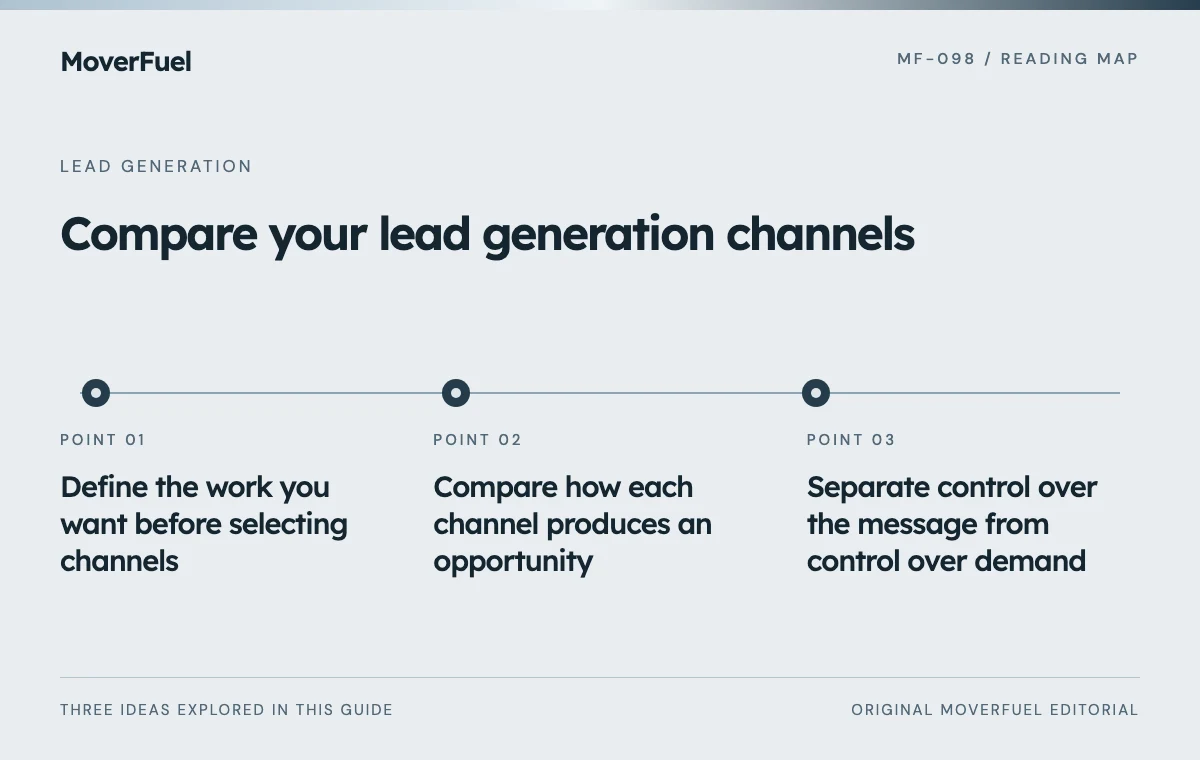
Define the work you want before selecting channels
Specify the service, geography, timing and capacity you want marketing to support. ‘More leads’ is too broad for a company that needs weekday local jobs but already has full weekends. It is also too broad for a business seeking larger office projects with longer planning cycles.
Choose a common qualification definition and record the reason an inquiry does not fit. Otherwise a source delivering many unserviceable requests can appear stronger than one producing fewer credible opportunities.
Scroll the table horizontally to compare all columns.
| Decision | Example planning question |
|---|---|
| Service | Local households, long-distance routes or commercial projects? |
| Coverage | Which origins and destinations are feasible? |
| Timing | Which move windows need additional demand? |
| Capacity | Can intake and estimating handle the expected volume? |
| Success | Qualified opportunities, estimates or completed profitable work? |
Compare how each channel produces an opportunity
Scroll the table horizontally to compare all columns.
| Channel | Useful role | Main operating requirement | Important limitation |
|---|---|---|---|
| Search advertising | Reach people expressing relevant search intent | Campaign, landing page and outcome tracking | Paid traffic does not guarantee serviceable inquiries |
| Local Services Ads | Capture eligible local service demand | Current eligibility, profile and lead handling | Availability and requirements vary |
| Maps and Business Profile | Help local customers evaluate the business | Accurate profile and legitimate reputation | Visibility varies with search context and distance |
| Organic service content | Explain services and answer research questions | Useful pages and ongoing site maintenance | Publishing alone does not guarantee traffic |
| Paid social | Introduce an offer or re-engage an audience | Creative, audience and follow-up discipline | Interest may be earlier than active move planning |
| Customer referrals | Use existing relationships and experience | A good service and clear referral path | Volume is not fully controllable |
| Professional partnerships | Develop relevant referral relationships | Relationship ownership and transparent arrangements | Fit and timing differ by partner |
| Purchased leads | Test supplied inquiry volume | Vendor diligence and fast, appropriate intake | Control over collection and distribution may be limited |
These are planning characteristics, not universal rankings. Actual economics depend on your market, offer, execution and ability to serve the work. Avoid assigning an invented average close rate to a channel simply to complete a comparison chart.
Google describes local ranking through relevance, distance and prominence and says businesses cannot pay for better local ranking. Treat Maps as a distinct visibility system rather than an organic benefit automatically purchased with advertising. [1]
Separate control over the message from control over demand
With your own campaign and landing page, you can usually change the offer, qualification questions and destination experience. You still do not control market demand, platform decisions or whether a customer chooses you. Purchased leads may offer faster access to inquiry records while leaving collection and distribution decisions with the supplier.
Include the assets built along the way
Useful service content, customer relationships, account history and a well-maintained website can support future acquisition. Evaluate those assets separately from this month's inquiries. Do not call them permanent or free: they require maintenance and may lose effectiveness as the business or market changes.
Ask who owns the accounts, content, phone numbers and inquiry data under each arrangement. A source that performs well but cannot be independently audited creates a different risk from one with accessible records and clear handoff rights.
Use the same funnel and cost scope for every source
Record delivered contacts, unique opportunities, qualified inquiries, estimates, bookings and completed work. Keep duplicates and existing-customer contacts from inflating new acquisition. Match costs and outcomes to comparable cohorts rather than dividing this month's spend by bookings from older inquiries.
Include the costs relevant to the decision: media or lead fees, management, creative, landing pages and incremental intake effort. State whether one-time setup is included or reported separately. A media-only cost per booking should not be compared with a fully loaded vendor acquisition cost without adjustment.
Use a consistent moving lead qualification process before drawing conclusions about channel quality.
Build a channel portfolio your team can operate
Start with a small number of channels that match the acquisition brief and can be measured properly. A local mover might prioritize a reliable website, accurate local presence and a controlled search campaign. A commercial specialist may also need relationship development and project-specific content. These are examples, not prescribed allocations.
Set a bounded test with an owner, budget, qualification rules and review date. Keep capacity constraints visible so a successful campaign does not create a poor customer experience. Expand only when the team can explain both the results and the operational load.
Review concentration risk. Depending entirely on one supplier, platform or referral partner can leave the business exposed to changes outside its control. Diversification should add useful resilience, not scatter a small budget across channels that cannot each receive adequate attention.
Common questions
Which channel produces the cheapest moving leads?
There is no dependable universal answer. Compare serviceable opportunities and booked-work economics using your own consistent cost and outcome definitions.
Should we use every channel at once?
No. Select channels that fit the work you want and the team's operating capacity, then expand after a measurable test.
Your next step
Choose channels by service fit, controllable execution and completed-work economics. A balanced acquisition plan connects demand generation to the moving operation that must fulfill it.
Sources & editorial notes
Platform claims cite the documents below. Operating frameworks and labeled examples are MoverFuel editorial analysis, not client results or industry benchmarks.
- Google: local rankingGoogle local-ranking factors and the inability to pay for better local ranking. Channel comparison and operating framework are original strategic analysis. Reviewed .