
A fast greeting does not help much if the customer then waits indefinitely for an estimator. Reliable LSA response means that a real person owns the inquiry, understands the next step and follows through. Improve the whole handoff, from the first ring to a useful estimate conversation.
 View full-size graphic ↗
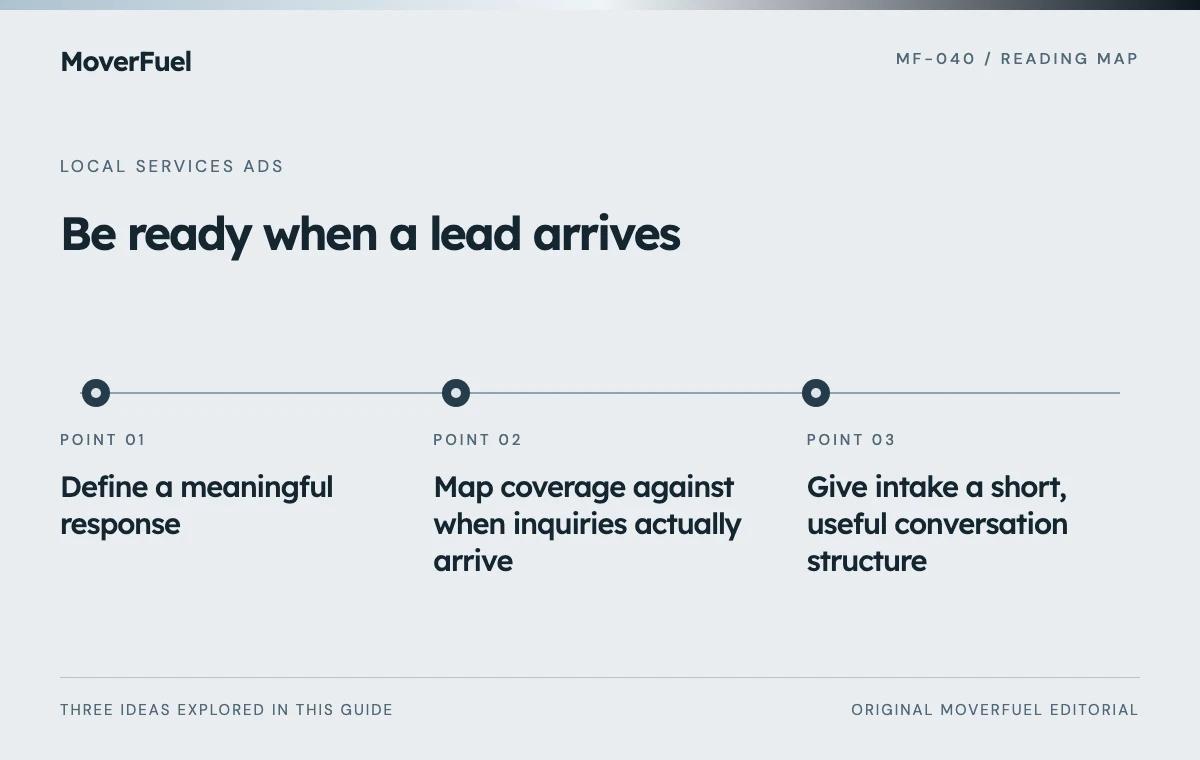
Define a meaningful response
Google lists responsiveness as one factor in Local Services ad ranking and notes that missed calls may hurt it. The documentation does not justify a universal claim that a particular response time guarantees a position or booking. Build your internal standard around what your staff can reliably deliver. [1]
Distinguish acknowledgment, contact and resolution. An automated receipt confirms that a system received a message. A meaningful response addresses the request or establishes the information needed to proceed. Resolution might be an estimate appointment, a completed quote or a clear explanation that the service is unavailable.
Use those distinctions in reporting. If a system timestamps an automatic acknowledgment as the sales response, the dashboard can appear excellent while customers still wait for help. Keep automation events visible without letting them replace the human service measure.
Map coverage against when inquiries actually arrive
Scroll the table horizontally to compare all columns.
| Period or situation | First owner | Backup | Required handoff |
|---|---|---|---|
| Normal staffed hours | Assigned intake team | Named overflow person | Qualified request accepted by estimator |
| Lunch or shift transition | Designated covering colleague | Sales lead | Open calls and messages transferred |
| After-hours contact | Approved on-call or next-opening workflow | Manager for exceptions | Clear expectation for next response |
| Primary system failure | Documented alternate contact path | Operations manager | Restore records when service returns |
Use actual inquiry timestamps to find coverage gaps. A daily average can hide one busy period when every caller reaches voicemail. Review workload by receiving branch and channel, especially when the same person answers dispatch, existing-customer and sales calls.
Do not promise around-the-clock personal response unless it exists. If a third-party answering service is involved, document what it can say, what it may schedule and when it must escalate. It should not invent prices, available crews or service capabilities.
Give intake a short, useful conversation structure
Confirm the requested service and collect the essential routing facts: origin, destination, date, approximate scope and preferred contact method. Explain what happens next. The caller should understand whether the next step is a survey, a detailed inventory review or an estimate discussion.
Require the next owner to accept the task
A handoff needs a recipient, a due point and enough context to avoid asking the customer to start over. The receiving estimator should acknowledge ownership in the operating system. Escalate tasks that remain unaccepted rather than assuming a forwarded message has been handled.
Give the intake team clear limits. If the request involves unusual handling, unsupported geography or uncertain availability, route it for review instead of promising an answer beyond their authority. Speed should not create inaccurate expectations.
Create a recovery path for missed conversations
Place unanswered inquiries in a visible queue with an owner and next action. Use the company’s approved contact permissions and applicable communication rules for callbacks or messages. Do not treat repeated automated outreach as a substitute for a relevant response.
Scroll the table horizontally to compare all columns.
| Situation | Useful next action | Avoid |
|---|---|---|
| No answer from customer | Record an appropriate next attempt or follow-up | Marking the lead unsuitable without facts |
| Customer asks for a later call | Schedule ownership and preserve context | Restarting a generic sequence |
| Wrong department receives the call | Transfer with context and verify acceptance | Sending the customer through repeated menus |
| Team cannot serve the request | Explain the limitation accurately | Promising unavailable work to retain the lead |
Inspect failure patterns before buying another tool. If nobody is assigned to clear the queue, a new notification channel may only create more unattended alerts. Establish the responsibility first, then automate the reminder or routing step that supports it.
Measure reliability through the next completed step
Track missed contacts, time to meaningful response, unresolved handoffs, estimate scheduling and eventual retained bookings. Show the distribution of response times or the count beyond your internal standard; an average can conceal a small group waiting much longer.
Compare like-for-like cohorts when evaluating a staffing change. A weekend group with different service requests may not be comparable to weekday office hours. Record which hours and branches changed, then inspect whether more suitable inquiries actually reached estimates.
Combine these measures with the lead disposition worksheet so service-fit problems remain separate from response failures.
Review the unresolved queue at each shift change and the outcome patterns at a regular management review. The most valuable improvement is often a small ownership rule that is followed consistently, rather than an ambitious speed target nobody can sustain.
Common questions
Will answering faster guarantee better LSA ranking?
No. Responsiveness is one documented factor among several. Improve response for the customer and business while avoiding guaranteed placement claims.
Can an automated reply count as the whole response process?
It can acknowledge receipt and set expectations, but it does not establish that the request was understood or moved toward an estimate. Track the meaningful next interaction separately.
Your next step
Make ownership visible at every transition. A reliable response system connects the inquiry to a competent next action and identifies any conversation left unresolved.
Sources & editorial notes
Platform claims cite the documents below. Operating frameworks and labeled examples are MoverFuel editorial analysis, not client results or industry benchmarks.
- Google: About Local Services ad rankingsResponsiveness and missed calls are ranking factors; no universal timing or placement guarantee. Reviewed .