
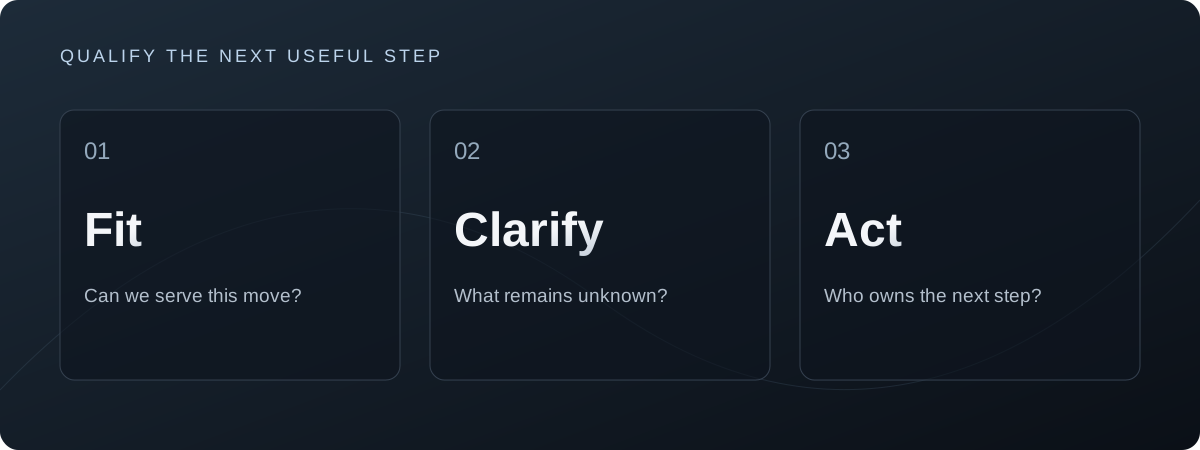
A moving lead is qualified when the business has enough information to take a useful next step—not when the customer has already agreed to buy. Qualification should establish whether you can help, what remains unknown and who owns the next conversation. Keep those decisions separate from sales readiness. A serviceable customer comparing several estimates may still be a valuable opportunity.
 View full-size graphic ↗
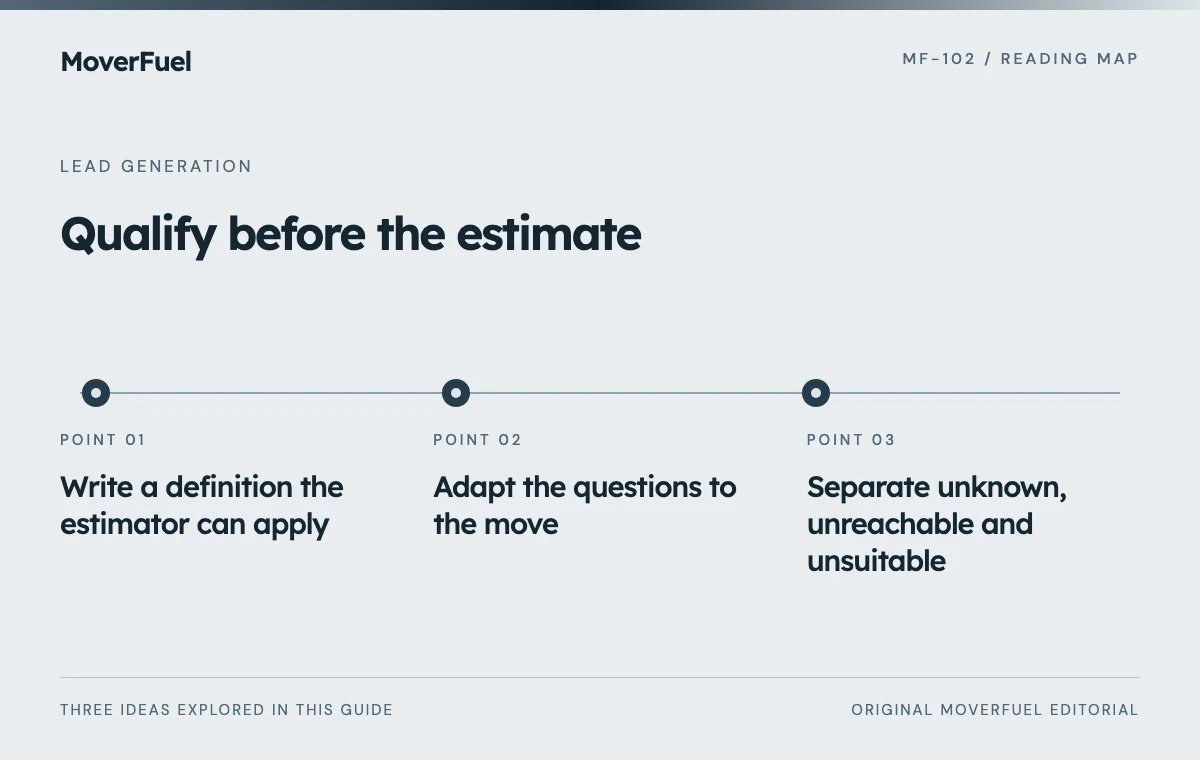
Write a definition the estimator can apply
Align your intake team on the definitions in lead versus qualified moving opportunity before comparing source performance.
Start with the operation's acceptance criteria: service offered, origin and destination coverage, date or timing flexibility, and enough scope to choose the right estimate process. Add legitimate restrictions that materially affect fulfillment. Then define what happens when a detail is unknown. A missing destination address may call for clarification; it should not automatically become evidence of a poor lead.
Google distinguishes qualified leads from later converted leads, with the advertiser supplying its business criteria. Your intake process should make that distinction observable. A request can fit the service and still be lost after an estimate. That outcome belongs in the sales analysis rather than being retroactively relabeled unqualified. [1]
Scroll the table horizontally to compare all columns.
| Check | Useful question | Possible next action |
|---|---|---|
| Service fit | What help does the customer need? | Accept for discussion, clarify scope or explain an unsupported service |
| Route fit | Where does the move start and end? | Confirm coverage or investigate an exception |
| Timing | What date is preferred, and is it flexible? | Check capacity before promising availability |
| Scope | What information is needed for the next estimate step? | Schedule the appropriate conversation or survey |
| Contactability | Can the team reach the customer using the supplied details? | Continue contact attempts under the approved process |
Adapt the questions to the move
A single exhaustive form is rarely a good first step for every service. Local household moves, interstate relocations and office projects need different context. Use a shared core of contact, route and timing information, then branch when the answer changes what the estimator needs to do.
Local household inquiries
Confirm origin and destination coverage, the preferred date, home size or basic inventory, and any access issue that changes the next step. An elevator reservation, long carry or specialty item may require follow-up. Intake should collect enough context to route the opportunity, not imply that a few fields establish the final price.
Interstate and commercial inquiries
An interstate conversation needs both ends of the journey and timing expectations; the current location of the person making the request may not be the origin. A commercial project may require facilities, phasing, downtime constraints and the relevant decision-makers. Ask what matters to the service instead of judging every prospect against the same household-moving script.
For interstate moves, use the operator's approved estimate and customer-information process. FMCSA's consumer guidance distinguishes carrier and broker roles and explains information customers should receive. Qualification is not a substitute for the applicable estimate obligations. [2]
Separate unknown, unreachable and unsuitable
These labels describe different problems. ‘Outside coverage’ can inform targeting. ‘Unable to reach’ can reflect contact details, timing or the follow-up process. ‘Date unavailable’ may reveal a capacity problem. ‘Lost after estimate’ can involve price, confidence or scheduling. Combining them into one bad-lead field prevents a useful diagnosis.
Scroll the table horizontally to compare all columns.
| Record status | Meaning | Do not assume |
|---|---|---|
| Needs clarification | One or more fit details are missing | The customer is low quality |
| Unable to reach | Contact has not yet succeeded | The advertising source sent an unsuitable move |
| Not serviceable | A documented operational requirement is not met | Every future inquiry with a similar keyword will fail |
| Qualified, estimate pending | Enough fit is established for the next estimate step | The sale is guaranteed |
Record a short reason alongside the status when it helps another team member act. Keep the notes factual and limited to the business task. Avoid personal judgments or inferences about sensitive characteristics. The purpose is to serve the inquiry appropriately and improve the acquisition process.
Collect information without making the first step a survey
Ask for information in the order it becomes useful. A short initial request can establish service and route, followed by a more detailed inventory or survey. If a required field is necessary, explain it. If the customer cannot answer yet, provide an appropriate alternative rather than forcing them to invent a value.
Use explicit field labels, helpful instructions and errors that explain how to recover. W3C's forms guidance covers these fundamentals. For a moving inquiry, clear validation is especially useful around dates, contact details and location inputs, where an unexplained failure can end the conversation. [3]
- Test the complete path on a phone, including the keyboard and error recovery.
- Confirm the submission creates one usable record and reaches the correct person.
- Show an honest confirmation explaining the next step and expected contact process.
- Make it possible to ask a question when the move does not fit the standard form.
If customers can express a suitable need but cannot complete the request, investigate website conversion improvements before tightening qualification rules.
Use qualification to diagnose channels fairly
Review a sample of inquiry records with marketing and sales together. Check whether the recorded reason matches the actual conversation and operating policy. A supposedly out-of-area request may be a valid long-distance move. A ‘price shopper’ may simply need a credible explanation of the estimate. Correct the classification before optimizing around it.
For a hypothetical cohort of 50 unique inquiries, suppose 30 meet the agreed fit criteria and 20 do not. The qualification rate is 30 divided by 50, or 60%. If 15 of those qualified opportunities receive estimates, investigate the gap before concluding the company needs more inquiries. The example is arithmetic, not a moving-industry benchmark.
Keep the denominator stable and disclose exclusions. Removing all unreachable records from one source while retaining them for another creates a misleading comparison. Separate source quality from response coverage and from later sales performance. Compare mature cohorts when one service takes longer to reach an estimate.
Turn dispositions into specific improvements
Repeated unsupported-service inquiries suggest a review of ad terms, page language and form choices. Repeated unavailable-date requests suggest a scheduling or capacity discussion. Suitable inquiries that never reach an estimator suggest a handoff problem. Each pattern has a different owner; a general instruction to ‘get better leads’ is not enough.
Where advertising integrations support later-stage outcomes, send only events that match the documented definition and applicable data permissions. Keep a stable lead identifier and reconcile duplicates. A change to the qualification policy should be logged because it can change reported performance without changing the underlying customers.
Treat prioritization as a later decision. Once service fit is established, the team can decide which opportunity needs attention first based on timing, missing information and workload. That is lead scoring or queue management. It should not erase a viable customer's eligibility for a useful response.
The Google Ads campaign guide explains how these distinctions affect conversion goals and campaign reviews.
Common questions
Is someone comparing prices an unqualified moving lead?
Not necessarily. Comparison is compatible with genuine buying intent. Determine service fit and what the customer needs to evaluate the estimate. Record a pricing loss only when the evidence supports that outcome.
Should incomplete inquiries be rejected automatically?
Use a needs-clarification state when the missing information can reasonably be obtained. Automatic rejection can discard suitable moves. Set an appropriate contact process and close unresolved records consistently.
What is the difference between qualification and lead scoring?
Qualification asks whether the business can help and take the next step. Scoring prioritizes attention among opportunities, using transparent criteria. Keep a low priority separate from a documented reason that the service cannot be provided.
Your next step
Agree on a small set of fit criteria, preserve an explicit unknown state and give each disposition a next action. Review actual records with the estimator before changing targeting. Better qualification should improve both the customer's next step and the company's understanding of demand.
Sources & editorial notes
Platform claims cite the documents below. Operating frameworks and labeled examples are MoverFuel editorial analysis, not client results or industry benchmarks.
- Google: qualified and converted leadsQualified and converted lead stages; the intake decision framework is MoverFuel editorial analysis. Reviewed .
- FMCSA: tips for a successful moveInterstate customer information and carrier/broker context, without substituting for applicable estimate rules. Reviewed .
- W3C: accessible formsAccessible form labels, instructions and validation. Reviewed .