
Giving every branch the same LSA budget is simple, but it ignores differences in job value, demand, staffing and available crews. A useful allocation starts with the work each market can accept and the cost it can support. The platform budget is the implementation of that decision, not the strategy itself.
 View full-size graphic ↗
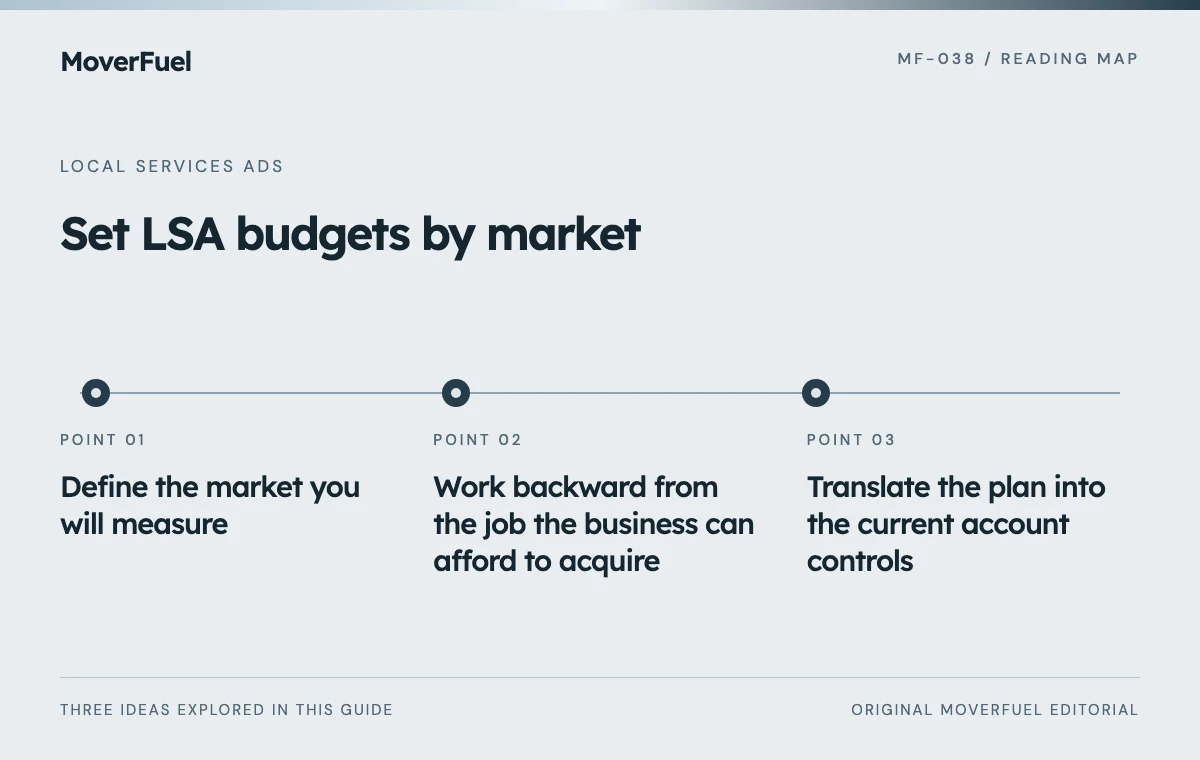
Define the market you will measure
Choose a unit with a responsible team and distinguishable outcomes: a branch, a service territory or a meaningful service segment. Avoid overlapping reporting groups that count the same inquiry twice. If one central team handles all calls, retain the destination branch and eventual delivery responsibility in the record.
Document pickup coverage, offered services, available dates, estimator capacity and crew capacity. A market can have plentiful demand and still be a poor candidate for more spend if its suitable jobs cannot be delivered. Another market may need more qualified inquiries but have insufficient phone coverage to use them.
Keep temporary operating restrictions visible in the budget sheet. A two-week staffing shortage should not silently become a permanent conclusion that the market has poor advertising potential.
Work backward from the job the business can afford to acquire
Set the acceptable job acquisition cost using the company’s own delivery economics and overhead requirements. Do not use gross revenue as though it were available advertising margin. Include uncertainty when cancellations, job mix or variable delivery costs are not well understood.
Scroll the table horizontally to compare all columns.
| Input | Market A | Market B |
|---|---|---|
| Acceptable ad cost per retained booking | $240 | $360 |
| Observed retained-booking rate per unique lead | 25% | 20% |
| Illustrative allowable lead cost | $60 | $72 |
| Additional retained jobs the operation can handle | 10 | 6 |
| Indicative lead requirement at that rate | 40 | 30 |
| Illustrative ad allocation at the allowance | $2,400 | $2,160 |
The arithmetic does not mean either market will supply that many leads at those prices. It creates a boundary for evaluating delivery. If actual cost exceeds the allowance, investigate fit, conversion or economics before raising the allocation. If the booking-rate estimate is unstable, test a range rather than a single precise forecast.
Translate the plan into the current account controls
Google currently describes Maximize leads, optional target cost-per-lead bidding and manual maximum-per-lead bidding in its LSA documentation. Availability and settings should be checked in the actual account. A target is not a guaranteed price for each individual contact. [1]
The budget framework uses an average weekly amount and a monthly maximum. A particular week can spend above its average, so verify the displayed monthly limit and billing expectations before launch. [2]
Keep a budget instruction, not just a number
Record the approved period, account or branch, average budget setting, displayed monthly boundary, chosen bidding approach and reviewer. Include the capacity assumption and the date it must be checked again. This prevents a temporary growth test from becoming an unattended permanent spend increase.
Do not import a Search campaign’s daily-budget rule into an LSA worksheet. Use the documentation and interface for the specific product you are managing.
Reallocate from mature performance and current capacity
Scroll the table horizontally to compare all columns.
| Signal | Investigate before changing spend |
|---|---|
| Many leads but low qualification | Service coverage, job types and intake classification |
| Qualified leads but few estimates | Response coverage and survey scheduling |
| Estimates but few retained bookings | Offer fit, sales process and cancellations |
| Good mature outcomes but unused crew capacity | Whether additional demand remains available |
| Strong reported results but incomplete matching | Measurement reliability before scaling |
Review recent delivery frequently, but do not judge booking economics before the sales cycle has had time to develop. Keep an operational view of this week’s calls alongside a mature cohort view of earlier inquiries. They support different decisions.
The LSA lead-quality guide provides reason codes that help explain whether a market needs more budget or a different repair.
Set conditions for expansion and reduction
Increase an allocation when the evidence supports acceptable retained-job cost, the sales team can handle more contacts and delivery capacity exists. Write the increment and review point in advance. If added spend brings a less suitable service mix, the historical average may no longer describe the marginal result.
Reduce or pause when capacity disappears, the account cannot be handled responsibly or the agreed test boundary is reached. Record whether the decision reflects demand quality, staffing or temporary operations. That distinction determines what must change before restarting.
Treat credits still under review as uncertain. Build the operating budget from actual charges and posted adjustments, with pending items shown separately. A plan that works only if every unwanted lead is refunded is not a dependable budget.
Common questions
Should every location have the same lead-cost target?
No. Suitable job mix, contribution, booking rates and capacity can differ. Use comparable definitions while allowing economically justified market differences.
Can the worksheet predict how many leads Google will deliver?
No. It translates business assumptions into planning boundaries. Demand, competition, eligibility and actual account performance determine what is available.
Your next step
Budget by the work a market can absorb and the acquisition cost it can support. Revisit both assumptions as the branch’s capacity and evidence change.
Sources & editorial notes
Platform claims cite the documents below. Operating frameworks and labeled examples are MoverFuel editorial analysis, not client results or industry benchmarks.
- Google: About bidding for Local Services AdsCurrent LSA bidding approaches and target-versus-price distinction. Reviewed .
- Google: How leads work in Local Services AdsAverage weekly budget and monthly maximum behavior. Market examples are hypothetical. Reviewed .