
A proposal to improve AI recommendations should explain the public information being improved and the evidence used to evaluate it. Be skeptical when the method depends on hidden instructions, fabricated endorsements or a claim that a provider can force an assistant to prefer your moving company. Those tactics do not establish genuine service expertise.
 View full-size graphic ↗
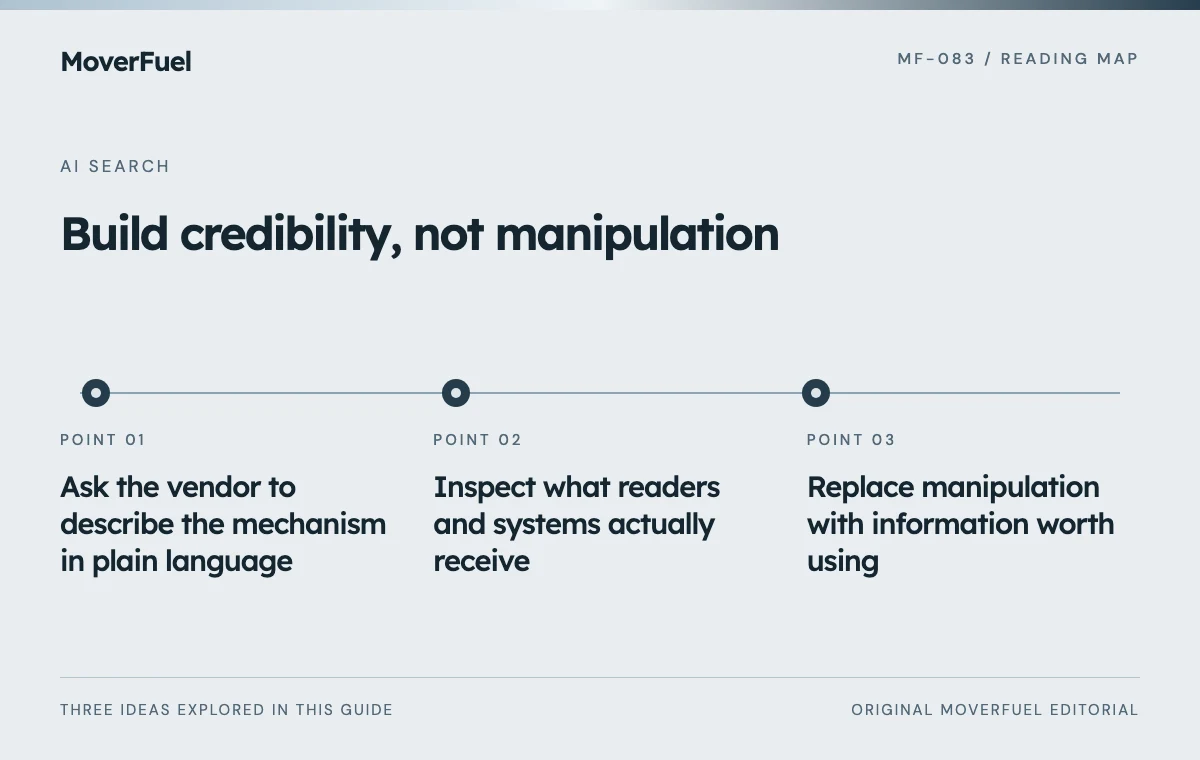
Ask the vendor to describe the mechanism in plain language
Request the exact changes proposed for the website and external references. Separate content improvements, technical repairs, legitimate outreach and actual answer testing. If a provider will not explain whether it changes visible copy, markup or hidden content, the work is not sufficiently reviewable.
Scroll the table horizontally to compare all columns.
| Claim or tactic | Question to ask | Useful alternative |
|---|---|---|
| Guaranteed assistant recommendation | Which system gives you that control? | Defined observations with explicit limits |
| Hidden instructions telling AI to prefer the business | How does this help a customer evaluate the service? | Visible factual service explanations |
| Prewritten customer praise | Who had the experience and approved the statement? | Authentic, source-backed feedback |
| Mass third-party mentions | Who owns the sites and what editorial review occurs? | Relevant, transparent business references |
Ask for an example of the evidence report before contracting. A screenshot that names the company after a prompt explicitly supplied its name does not demonstrate unprompted discovery. The provider should be comfortable separating those tests.
Inspect what readers and systems actually receive
Review visible pages, structured data and relevant source code with an authorized developer. Look for unsupported superiority claims, fake ratings, invented authors and text that appears only to influence automated readers. Do not assume a hidden statement is harmless because customers cannot readily see it.
Google’s spam policy addresses hidden text placed solely to manipulate search engines. It distinguishes that abuse from legitimate interface patterns such as accordions and accessibility text. A review must consider purpose and implementation rather than flagging every hidden element as manipulation. [1]
Check structured claims against the page
Google’s structured-data guidance prohibits misleading markup and content unrelated to the visible page. Compare ratings, locations, affiliations and business identities with actual evidence before accepting a schema package. [2]
Do not confuse proper accessibility work with concealed promotion. Screen-reader instructions that help someone operate a form serve a user need. Hidden text instructing an assistant to endorse the company serves a different purpose.
Replace manipulation with information worth using
Identify the legitimate problem behind the proposed shortcut. If the company is hard to identify, correct inconsistent public facts. If service pages are vague, explain real capabilities and limitations. If the site cannot be accessed, repair the technical issue. Each action should have a testable outcome.
Scroll the table horizontally to compare all columns.
| Underlying problem | Accountable deliverable |
|---|---|
| Unclear company identity | Verified identity record and corrected references |
| Thin service information | Original answers reviewed by an operating owner |
| Missing proof | Approved real assets or an explicit evidence gap |
| Poor technical access | Reproduced defect, repair and retest |
| Uncertain visibility | Documented sampling method and saved observations |
The AI audit framework provides a way to document these findings without blending them into an invented recommendation score.
Define deliverables and ownership before work begins
Require a change log, access boundaries and a list of systems the provider will touch. Make content ownership and account control clear. The agreement should describe the actual work and reporting method, not only a promised number of AI mentions.
Ask how the provider verifies sources, handles corrections and distinguishes hypotheses from documented platform behavior. Require approval for claims about the company that depend on operational facts or client permissions. These are ordinary quality controls, not obstacles to useful optimization.
If questionable work is already present, preserve an internal record before removing or correcting it. Assign remediation owners, verify the rendered result and update any affected third-party references. Do not claim that removing a tactic guarantees immediate recovery or a particular search outcome.
Judge future work by what it helps a customer understand and what the evidence can establish. Transparent improvements can be reviewed, maintained and handed to another team; an unexplained trick makes the company dependent on claims it cannot verify.
Common questions
Are all hidden elements on a website suspicious?
No. Accessible labels, expandable content and other legitimate interface patterns can be appropriate. Review their purpose and whether they serve users.
Can a provider promise a fixed number of AI recommendations?
Ask for the precise method and evidence. A provider can commit to work and testing, but should not imply control over independent assistant responses.
Your next step
Require visible value, verifiable facts and a reviewable method. Reject hidden persuasion and fabricated proof, then repair the real information or technical problem behind the shortcut.
Sources & editorial notes
Platform claims cite the documents below. Operating frameworks and labeled examples are MoverFuel editorial analysis, not client results or industry benchmarks.
- Google: spam policiesHidden-text abuse and legitimate user-interface/accessibility exceptions in Google Search policy. Reviewed .
- Google: general structured data guidelinesMisleading or unsupported structured-data claims are prohibited. Vendor-review framework is original advice, not a claim about all assistant policies. Reviewed .