
A screenshot showing your moving company in an AI answer proves that it appeared in that captured answer. It does not establish a stable market-wide ranking, a share of all customer conversations or revenue generated. Before using an AI visibility report to guide spending, inspect exactly what was measured and which conclusions the evidence supports.
 View full-size graphic ↗
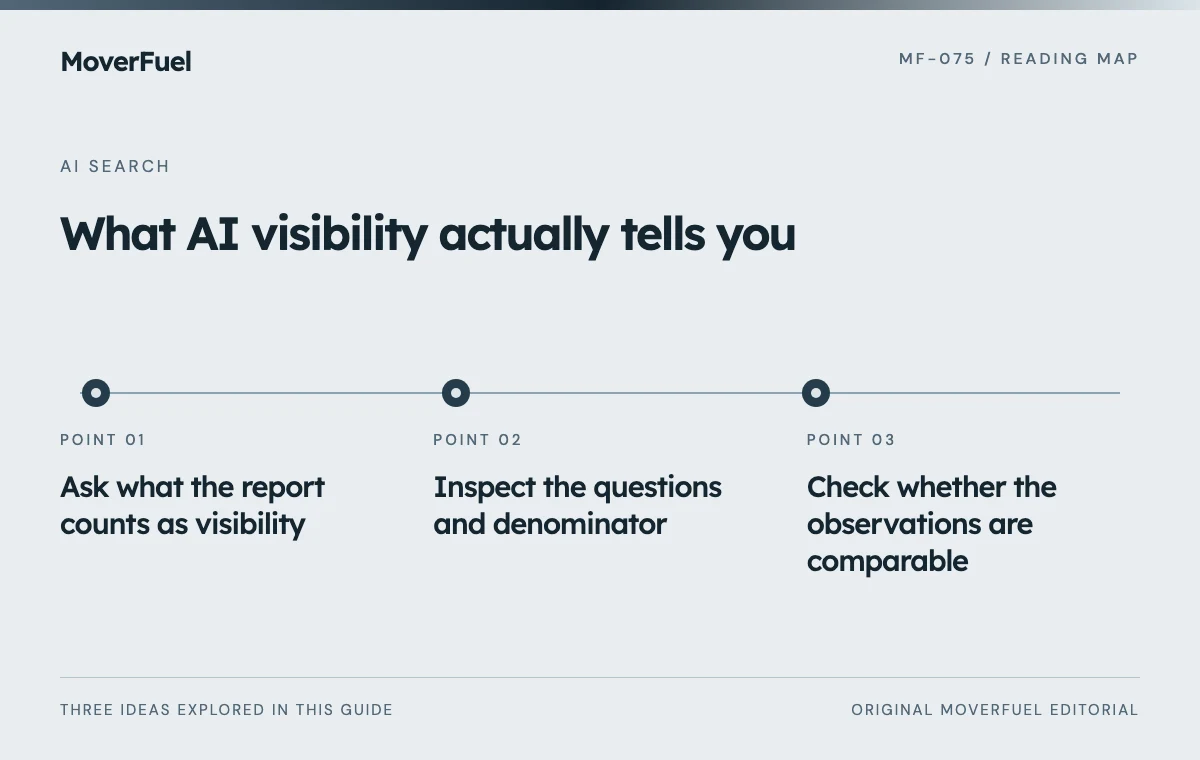
Ask what the report counts as visibility
Scroll the table horizontally to compare all columns.
| Observation | Defensible interpretation | Unsupported leap |
|---|---|---|
| Company named in an answer | A mention in that response | Universal recommendation |
| Website linked | A source or related link was displayed | The company was endorsed |
| First name in a list | First listed in that captured answer | Permanent number-one position |
| Identifiable referral visit | A tracked visit from that source | A qualified moving lead |
| Attributed booked move | A booking under a documented attribution rule | Proof that AI was the sole cause |
Ask the vendor to define each metric in plain language and show a raw observation behind it. A blended ‘AI authority’ score is difficult to evaluate if mentions, citations, sentiment and technical checks are combined without visible weights.
Google explains that Gemini may display sources and related links, but not every response includes them. A missing citation is therefore not sufficient to conclude that no information about the company influenced an answer, and a displayed link must be examined in context. [1]
Inspect the questions and denominator
Request the full prompt inventory, not only the successful examples. Check whether prompts represent the services and markets you want, whether they name your company and how many valid observations were collected. A branded prompt answers a different question from unprompted customer discovery.
A sample share is not market share
Suppose a report contains 20 predefined, successfully completed observations and the company appears in eight. The observed mention share is 8 ÷ 20 = 40% for that sample. This hypothetical calculation says nothing about the percentage of all local customers who see the company. If five failed observations are omitted, disclose them and the exclusion rule rather than hiding the collection problem.
Keep the denominator stable when comparing periods. Adding easier prompts, removing poorly performing markets or changing the services being tested can improve a score without any underlying change in discovery. Ask for a comparison using the unchanged core sample.
Check whether the observations are comparable
Scroll the table horizontally to compare all columns.
| Question for the report provider | Why it matters |
|---|---|
| Which product, mode and interface were used? | Different surfaces should not be silently combined |
| Was the conversation fresh or continued? | Earlier messages may supply business context |
| What location context was present? | Local discovery depends on the question’s geography |
| When was each observation captured? | Dates support change analysis and source review |
| Were failed or empty runs retained? | Selective exclusion can distort the result |
| Can the raw answers be inspected? | Allows verification of labels and claims |
Gemini’s documentation describes the use of general and, with permission, precise location information. Record the known location context rather than assuming that typing a city name makes every session equivalent. [2]
Repeat a sample of observations to understand stability under the chosen method. Preserve changed answers rather than selecting the most flattering one. Report the result as an observation under defined conditions, especially when the sample is small.
Read the answer and inspect its evidence
Open cited pages and check the specific claim. A directory might list the company but contain an old address; an article might mention a similarly named business elsewhere. A citation is useful evidence only after identity and relevance are checked.
Google warns that Gemini can produce inaccurate information, including explanations of its own operation. Asking an assistant why it ranked a company is not a substitute for independently verified documentation of the system or a supported causal explanation. [3]
Separate factual corrections from ranking speculation. If the response describes a service you do not offer, inspect public sources for the same error. If all public facts are accurate but the company is absent, the report may not identify a specific fix. It should say so rather than invent a proprietary factor.
Require a report that leads to useful decisions
A practical report has four parts: the collection method, the observations, verified information problems and recommended actions. Add referral and sales evidence where available, with attribution limitations. Keep technical readiness scores separate from observed answer outcomes.
Use platform-specific discovery checks for implementation work. This reporting review evaluates evidence quality rather than prescribing a universal assistant-ranking formula.
Ask what decision would change if the score rose or fell. A report that identifies a broken service page or an inaccurate branch listing can justify a repair. A report that only announces a composite score needs further explanation before it should influence a substantial budget change.
Retain raw records so a new provider can understand the historical method. If the method changes, begin a clearly labeled series or show the old and new calculations side by side. Continuity is more useful than a smooth chart assembled from incompatible measurements.
Common questions
Is there one AI ranking for our moving company?
A report should describe a particular set of observed responses, products and questions. A single universal ranking claim requires evidence that a collection of screenshots does not provide.
Can an AI visibility score be useful?
Yes, when its inputs, weights, sample and limitations are clear and it supports a decision. It should not be presented as market share or a revenue measure without the necessary evidence.
Your next step
Judge the report by its method, raw evidence and practical implications. A transparent sample with clear limitations is more useful than a confident ranking claim whose denominator cannot be inspected.
Sources & editorial notes
Platform claims cite the documents below. Operating frameworks and labeled examples are MoverFuel editorial analysis, not client results or industry benchmarks.
- Google: view related sources from Gemini AppsGemini sources and related links are not included with every response. Reviewed .
- Google: Gemini Apps privacy hubLocation context can affect Gemini responses. Reviewed .
- Google: learn about responses from Gemini AppsGenerated information and self-explanations may be inaccurate. Reporting rubric and arithmetic example are original editorial analysis. Reviewed .