
An AI-assisted draft can sound confident while getting the company’s services, a platform policy or an estimate condition wrong. The production advantage comes from organizing work faster, not from removing accountability. Build a review process that can reject a fluent draft when it has no distinct purpose or reliable evidence.
 View full-size graphic ↗
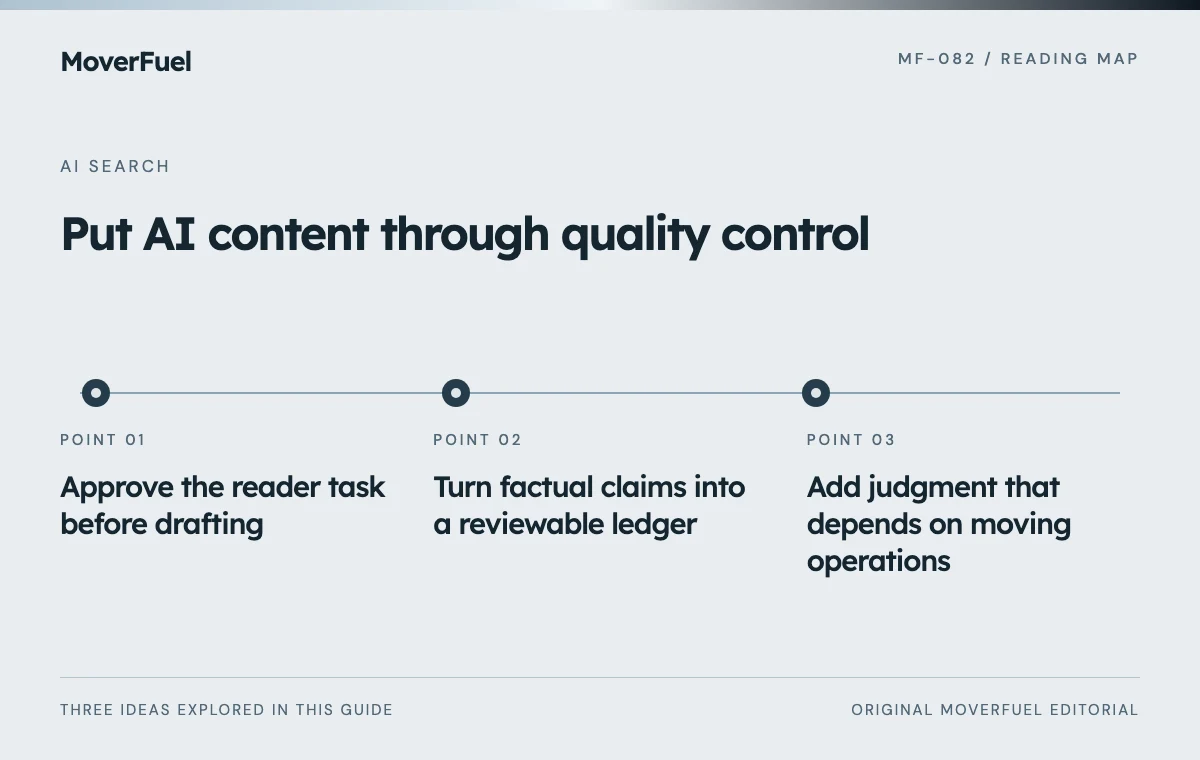
Approve the reader task before drafting
Write the problem the article will solve, who needs the answer and what practical artifact the reader should leave with. Compare it with existing pages. If the proposed article only changes the wording of an already answered question, improve the existing page or establish a genuinely different task.
Google’s generative-AI guidance recognizes research and structure as useful applications, while warning that producing many pages without added user value may violate scaled-content policies. Volume is therefore an output count, not an editorial quality measure. [1]
Scroll the table horizontally to compare all columns.
| Question | Evidence needed to proceed |
|---|---|
| Who needs this? | A defined moving-company operator or customer task |
| What is different? | A scope boundary compared with nearby articles |
| What will be useful? | A decision, worksheet, explanation or worked example |
| What must be researched? | Specific claims and authoritative source requirements |
| Who can verify operating facts? | An accountable company reviewer |
For example, lead qualification and lead scoring can justify separate articles only if one defines fit and the other explains prioritization among inquiries. Repeating the same list of questions under both titles does not create a differentiated library.
Turn factual claims into a reviewable ledger
Extract claims about platform behavior, rules, costs, statistics and business capabilities. For each, record the source, date checked and the exact proposition it supports. A source about customer photography cannot substantiate a claim about call attribution simply because both concern moving companies.
Distinguish facts, recommendations and examples
Scroll the table horizontally to compare all columns.
| Type | Review standard |
|---|---|
| Current platform rule | Check current official documentation |
| Company capability | Confirm with the responsible operator |
| Numerical benchmark | Verify source, population and applicability or remove it |
| Editorial recommendation | Explain the reasoning and conditions |
| Hypothetical calculation | Label inputs as illustrative and verify arithmetic |
Open the source and read the relevant section. A plausible title or working URL is not enough. Keep unresolved claims out of publication until verified; if a claim is unnecessary, remove it rather than adding a weak citation.
Pay particular attention to invented proof: client results, named experts, testimonials, credentials and proprietary technology. A draft must not turn an example account into a verified case study or create a person to fill an author field.
Add judgment that depends on moving operations
Ask what changes when the service is local household moving, interstate work, commercial relocation or storage. Consider origin and destination fit, access, date flexibility, crew capacity and estimate requirements. Use those constraints to explain when a recommendation applies.
Have the reviewer challenge broad statements such as ‘every mover needs this campaign’ or ‘a shorter form always converts better.’ Identify the tradeoff and the evidence needed to choose. A helpful article should make the reader’s decision more precise, not merely sound familiar with industry vocabulary.
Use customer-question research to find the details that generic drafts tend to miss.
Review the whole article and the rendered page
Read introductions, conclusions and FAQs across related articles together. Remove recurring paragraphs that add no new value. Similarity tools can flag shared language, but a low score cannot prove originality or distinct intent. Compare the actual decisions each article helps the reader make.
Check metadata, heading hierarchy, links, tables, citations and the CTA in the rendered page. Confirm that scheduled related articles are not exposed as broken links and that drafts stay out of public archives and sitemaps. Content quality includes the experience of reading and acting on it.
Use a real author or an honest organizational byline, with accurate publication and update dates. Preserve review records and identify which editor checked which claims. Do not imply firsthand experience or interviews that did not occur.
After publication, maintain a revision queue for date-sensitive material. A later policy change can invalidate a formerly accurate article. Prioritize updates by the importance of the affected decision rather than refreshing dates across the entire library without substantive review.
Common questions
Can AI-assisted articles be useful for SEO?
They can be useful when they serve a real reader need and receive factual, editorial and technical review. The tool used to draft them does not establish quality.
Does a plagiarism score prove an article is original?
No. It may identify matching language, but it cannot establish that the article adds a distinct idea, uses relevant evidence or serves a different search intent.
Your next step
Treat every assisted draft as unverified work. Approve a distinct task, verify claims, add moving-specific judgment and test the published experience before marking the article ready.
Sources & editorial notes
Platform claims cite the documents below. Operating frameworks and labeled examples are MoverFuel editorial analysis, not client results or industry benchmarks.
- Google: generative AI content guidanceGoogle guidance on useful generative-AI assistance and scaled content without added user value. Editorial gates and examples are original recommendations. Reviewed .