A moving company entering a new service area may have operating experience without a local portfolio. The honest response is to explain how the area is served and show relevant evidence in its true context. Inventing a nearby office or relabeling another market's reviews can create a misleading impression that the business cannot sustain.
 View full-size graphic ↗
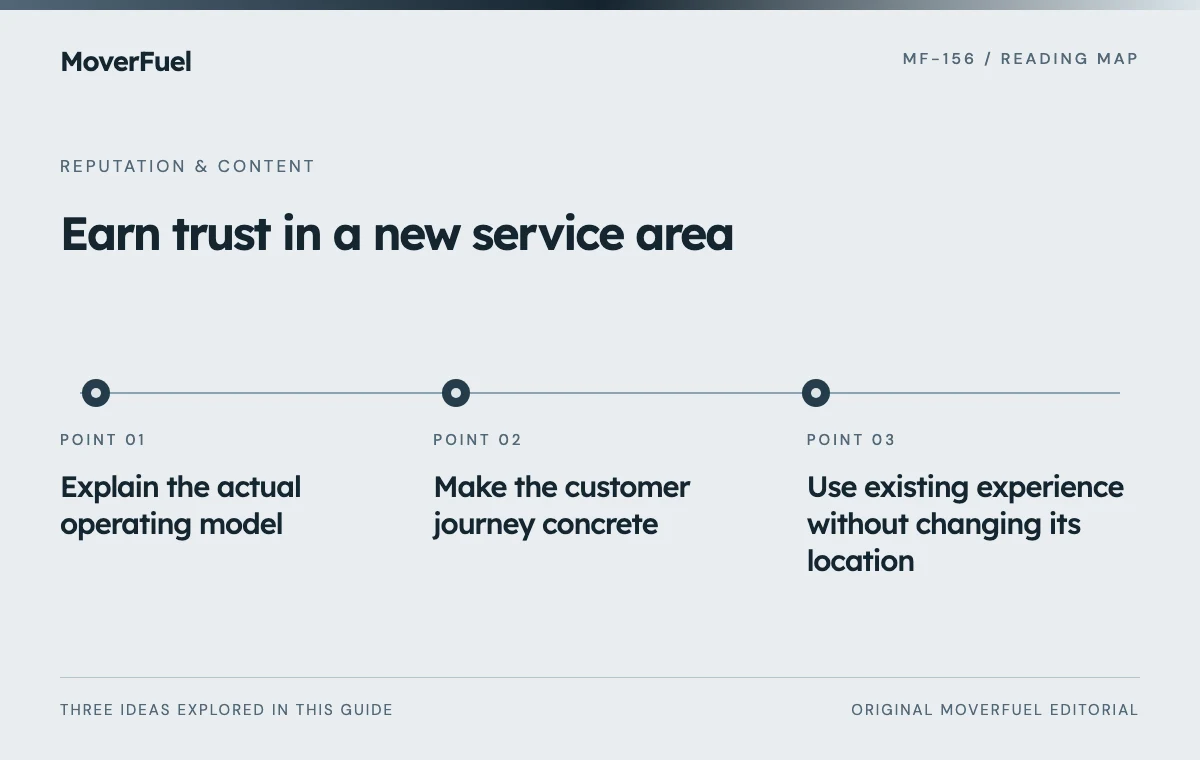
Explain the actual operating model
State whether the area is served from an existing base, a new verified location or a defined route arrangement. Explain what customers need to know about service availability, assessment and coordination. Do not imply that every neighborhood has a staffed office because a website lists it.
Google Business Profile eligibility and representation rules require accurate business information and legitimate locations. Service-area businesses also have specific address-display rules. A marketing expansion does not by itself justify a new profile or a fabricated storefront. [1] [2]
Scroll the table horizontally to compare all columns.
| Question | Evidence to prepare |
|---|---|
| Can the company serve the area? | Verified route, staffing and service capability |
| Where is the operation based? | Accurate business/location information |
| What services are offered? | Actual scope and exclusions |
| How does assessment work? | Clear estimate or survey process |
| What proof is available? | Approved experience with honest context |
| Who handles questions? | A monitored contact and ownership path |
Use the checklist before writing local copy. The page should describe a real service capability, not create the appearance of one through repeated place names.
Make the customer journey concrete
Explain how a customer in the new area requests an assessment, what information is needed and how service fit is confirmed. Discuss access or travel considerations only when they are relevant and verified. Avoid making broad claims about local regulations without current authoritative support.
Be precise about what is confirmed
A service-area page can state that the company accepts inquiries for the area while still requiring date and scope confirmation. Do not turn an inquiry form into an implied reservation. Staff should be able to explain the same process the page describes.
Provide practical next steps for uncertain routes or dates. If the company cannot serve a request, explain that promptly instead of keeping the customer in a generic sales sequence. Clear boundaries can build more confidence than a promise to handle every move.
Use existing experience without changing its location
A real approved project from another market can demonstrate a relevant service process when its context is clear. Do not change the city, hide a material difference or imply the customer used a new branch that did not exist. A comparable service example is useful without pretending it is local proof.
Scroll the table horizontally to compare all columns.
| Available material | Honest use |
|---|---|
| Experienced team | Describe verified experience without invented local tenure |
| Approved project elsewhere | Explain relevant work and actual context |
| Process photography | Show how the company prepares or performs the service |
| No local testimonials yet | Use clear service information and earn genuine future feedback |
| Illustrative concept | Label the concept and keep it separate from verified results |
Add local information only when it helps the task
Useful local context might concern how to prepare access questions or which service constraints the company needs to review. Verify it and identify the source where appropriate. A paragraph listing landmarks does little to help a customer decide whether the mover can handle the work.
Google's spam policies address doorway and scaled-content abuse. Avoid creating many near-identical area pages whose only meaningful difference is the city name. Give a page a distinct customer purpose or use a broader service-area explanation. [3]
Keep partner relationships and community involvement accurate. Do not display a local organization's logo as an endorsement without permission. A legitimate relationship should have a defined role, not simply provide borrowed credibility.
The local PR guide explains how genuine community work can be documented without manufacturing independent praise.
Use early inquiries to find trust gaps
Ask intake staff which questions recur: where the crew comes from, how estimates work, whether a date is available or what services are included. Use those questions to improve the page and handoff. Do not treat every hesitation as a need for more promotional claims.
Track suitable inquiries, completed assessments and mature outcomes by the actual market served. Review complaints and misunderstandings as well as bookings. If customers repeatedly expect a local office visit that the business does not offer, correct the representation immediately.
Update the evidence as the operation develops. Add approved local examples only after they exist, keep profile eligibility accurate and retire claims that no longer match capacity. Trust in a new area should grow with the service, not precede it through fiction.
Coordinate local SEO and multi-location marketing around the verified operating footprint.
Common questions
Does a new service area require a new Google Business Profile?
No. Eligibility depends on Google's rules and the real operating location, not simply a desire to target another area. Use accurate service-area and address information.
Can a mover show reviews from another city?
Use approved material with its true context and without implying a different location or branch. Relevant experience can be useful without being relabeled as local proof.
Your next step
Explain how the new area is actually served and use evidence in its true context. Clear logistics and honest boundaries build a stronger foundation than fabricated local presence.
Sources & editorial notes
Platform claims cite the documents below. Operating frameworks and labeled examples are MoverFuel editorial analysis, not client results or industry benchmarks.
- Google: representing your businessGoogle Business Profile guidance requires accurate business representation and eligible real locations. Reviewed .
- Google: service areasGoogle service-area business guidance covers service areas and address-display rules. Reviewed .
- Google: spam policiesGoogle policies address doorway and scaled-content abuse, relevant to repetitive area pages. Reviewed .