
Changing a city name in a generic moving page does not explain why the company is relevant to that customer. A location page earns its place when it helps someone understand real coverage, local service considerations and the next step for their move. If it cannot do that, a stronger regional page may be the better answer.
 View full-size graphic ↗
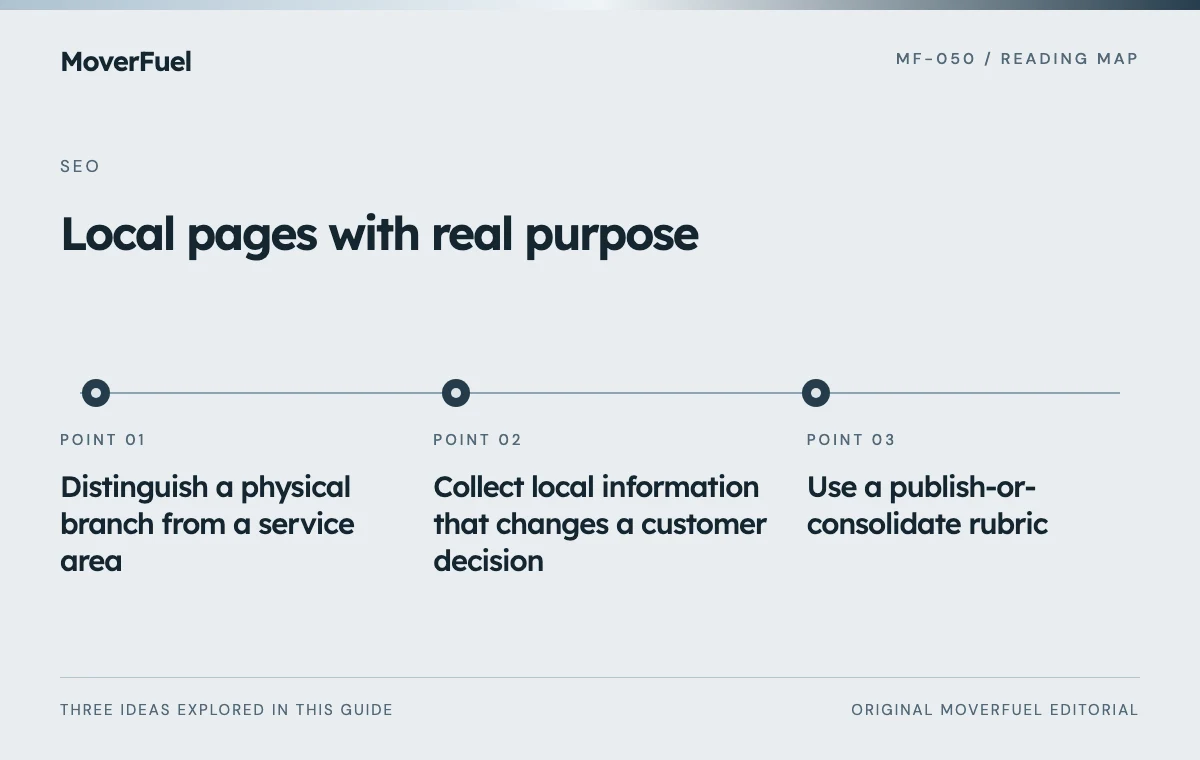
Distinguish a physical branch from a service area
State whether the company has a real branch in the location or serves it from elsewhere. Do not invent an office address, staff presence or local history to make the page look established. Customers need an accurate expectation of who will handle their request.
Google Business Profile guidance distinguishes eligible business locations and service-area operations. A website coverage page does not create eligibility for a separate profile or turn a virtual location into a staffed branch. [1]
Have operations approve the coverage statement, including relevant service and route limits. A city can fall within pickup coverage for one service but outside another. Explain the distinction when it affects whether the customer can obtain an estimate.
Collect local information that changes a customer decision
Scroll the table horizontally to compare all columns.
| Possible information | Evidence required | Customer value |
|---|---|---|
| Actual service coverage | Operations-approved locations and scope | Confirms whether to inquire |
| Building-access planning | Verified company process and current building details when specific | Explains information needed for the survey |
| Approved local project example | Permission and accurate project facts | Shows relevant experience without invented results |
| Pickup or route limitations | Responsible operations review | Avoids an unsuitable request |
| Local regulatory or parking instruction | Current official authority source | Supports accurate planning where genuinely needed |
Do not add trivia merely to make the page appear unique. A paragraph about local landmarks may do little to help someone choose a mover. Useful specificity explains the work, preparation or availability that matters to the proposed move.
Verify local rules before presenting instructions
Permit, parking and building procedures can differ by authority and property. If the page discusses a specific requirement, verify it from the responsible source and record the review date. Otherwise, explain that the estimator will confirm access arrangements instead of publishing a guessed rule.
Use a publish-or-consolidate rubric
Scroll the table horizontally to compare all columns.
| Question | If yes | If no |
|---|---|---|
| Does this market have a distinct customer task or service explanation? | Define it in the brief | Consider the broader coverage page |
| Can the company provide real, useful local information? | Collect and verify the evidence | Do not manufacture detail |
| Will the page stand alone as a useful destination? | Build a complete inquiry journey | Avoid an intermediate funnel page |
| Can someone maintain the facts? | Assign an owner and review trigger | Reduce scope to what can stay accurate |
Google describes doorway abuse as pages created for similar queries that funnel people toward more useful destinations. Its examples include substantially similar geographic pages. The concern is not simply mentioning a city; it is publishing an unhelpful intermediate page primarily to capture search traffic. [2]
Make the page useful without forcing another search
Explain the offered services, actual coverage and estimate process on the page itself. Link to deeper service details when helpful, but do not make the page a thin introduction whose only purpose is to push everyone to a generic homepage.
Use an appropriate contact path that reaches the responsible team. If a central office handles inquiries, say so accurately. Avoid creating the impression of a separate local team through a decorative address or unsupported local phone presentation.
Add related guidance only when it helps the local moving decision. A packing checklist can be useful; an indiscriminate list of every city and every article usually makes the page harder to navigate.
The service-page structure guide provides a complementary framework for explaining the work itself.
Review existing city pages before adding more
Inventory current URLs, their promises, internal links and known inquiry outcomes. Identify pages that answer the same task with little distinct evidence. Keep genuinely useful pages; consolidate only when the reader benefit and implementation plan are clear.
Before retiring a URL, choose the most relevant destination and update the links that point to it. Preserve useful local information in the surviving page rather than deleting it wholesale. A blanket redirect of every city page to the homepage can discard context the customer still needs.
After changes, inspect response codes, final destinations, canonicals and sitemap entries. Then monitor search and inquiry behavior over time without promising that a consolidation will preserve every ranking. The goal is a clearer, more useful coverage architecture that the company can maintain.
Common questions
Are all city pages doorway pages?
No. A page can serve a legitimate local decision with real coverage and useful information. The problem is a thin or substantially duplicated intermediate page built mainly to capture similar searches.
Can I describe a city where I do not have an office?
You can accurately explain genuine service coverage. Clearly distinguish serving an area from maintaining a physical branch, and do not invent an address or local presence.
Your next step
Publish local pages only when they add a useful, supportable answer. Real service relevance is more durable than multiplying place-name variations.
Sources & editorial notes
Platform claims cite the documents below. Operating frameworks and labeled examples are MoverFuel editorial analysis, not client results or industry benchmarks.
- Google: representing your businessBusiness-location and service-area eligibility distinctions. Reviewed .
- Google: spam policiesDoorway abuse and substantially similar geographic page examples. Reviewed .