
A new service-area campaign should begin with a serviceable offer and a decision plan. Buying traffic before confirming travel costs, staffing and intake ownership can turn apparent demand into work the company cannot deliver profitably. Use explicit launch gates so each investment follows evidence rather than enthusiasm alone.
 View full-size graphic ↗
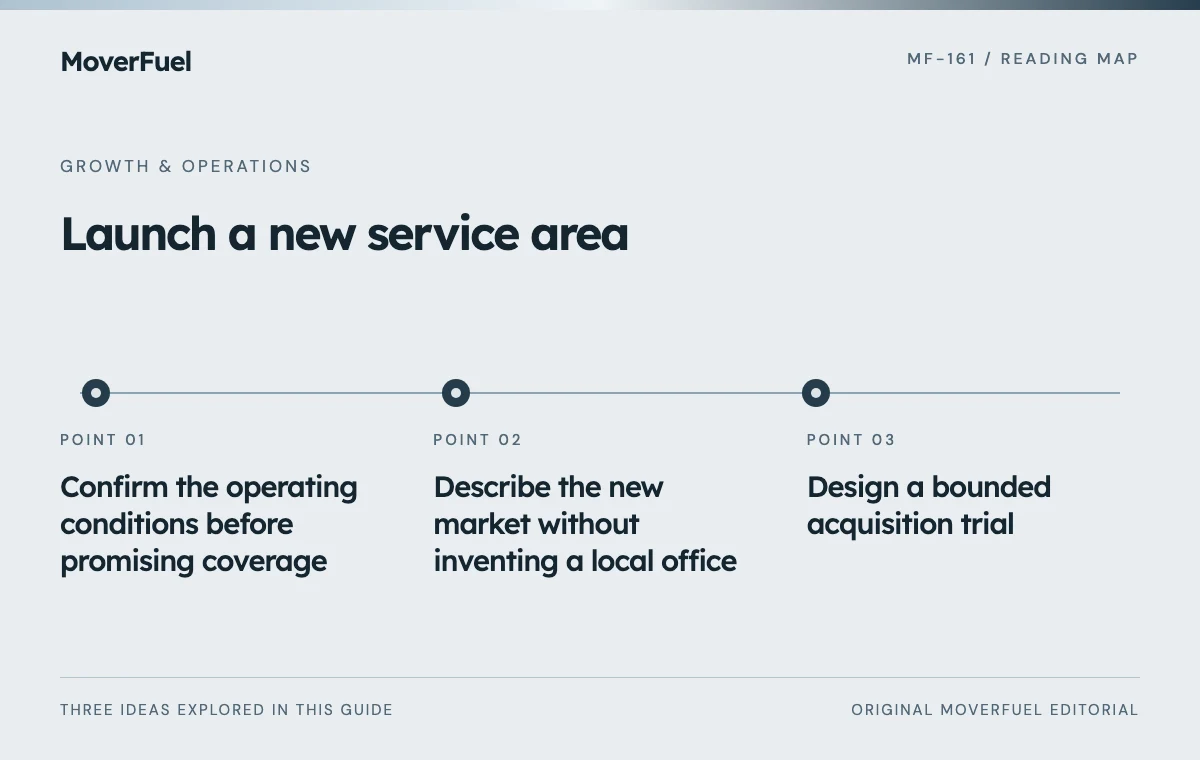
Confirm the operating conditions before promising coverage
Scroll the table horizontally to compare all columns.
| Gate | Evidence required | Decision owner |
|---|---|---|
| Service feasibility | Actual coverage, travel assumptions and available crews | Operations |
| Offer accuracy | Scope, exclusions and estimate process | Sales and operations |
| Local representation | Real locations and eligible profiles | Business owner |
| Acquisition readiness | Working pages, calls, forms and source capture | Marketing |
| Economic review | Relevant costs and acceptable outcome range | Finance and leadership |
Specify which work is supported: local moves within the area, moves into or out of it, packing, storage or another service. A broad coverage claim can attract requests that look geographically relevant but do not fit the operating model.
Confirm applicable operating requirements with qualified advisers before advertising the work. Marketing materials should describe the business's verified role and capabilities; a campaign cannot create authority or capacity that the company does not have.
Write down what would block launch. An unresolved dispatch plan, untested phone route or misleading location claim is a reason to repair the setup before spending, not an item to hide in a post-launch checklist.
Describe the new market without inventing a local office
Google's Business Profile guidelines distinguish eligible business locations from virtual offices and other ineligible representations. Service-area settings describe where an eligible business works; they do not authorize a fabricated branch or guarantee visibility throughout that area. [1] [2]
A useful service page can explain actual coverage, the estimate process, relevant access considerations and how the existing team fulfills work there. Use honest examples and approved images. Do not invent local customers, neighborhood expertise or a history of completed jobs.
Use the new service-area trust guide for the evidence customers need. This launch plan focuses on when and how to test acquisition.
Design a bounded acquisition trial
Define the question the trial must answer. For example: can the company attract suitable local-moving requests in a specific territory and convert them into work that meets its operating criteria? That is more actionable than asking whether the new market is good.
Set a spending limit and an observation window
Choose a test budget the business can afford, a maximum exposure and a review window that allows customers to progress through estimates and bookings. There is no universal launch budget or number of leads that proves a market. Document the assumptions instead of borrowing a benchmark from a different city.
SBA marketing planning guidance connects goals, activities, budgets and measurement. Use those elements to assign responsibility and define the decisions that the trial will support. [3]
Limit the number of simultaneous changes. A campaign that launches several services, multiple offers and a new intake process at once can produce activity without showing which part worked.
Align targeting, page copy and intake
Review Google Ads location options carefully. Presence and interest settings serve different purposes, and geographic detection is best effort rather than perfectly precise. Monitor actual inquiry origins and destinations rather than assuming the targeting setting guarantees service fit. [4]
The landing page should state the intended service and coverage clearly. The intake team needs the same definitions, including how to handle nearby but unsupported requests. Record the reason an inquiry is unsuitable so campaign adjustments are based on evidence.
Test calls and forms through to the correct team using non-production test data where appropriate. Confirm source capture, duplicate handling and a clear owner for follow-up. A working button alone does not prove that the business can receive and act on the request.
Coordinate Google Ads, website conversion and lead tracking before launch.
Evaluate mature outcomes and operational friction
Review spend, suitable inquiries, estimates, bookings and completed work separately. A market can generate inexpensive inquiries that fail to produce useful jobs. Another may have fewer inquiries but better service fit. Preserve the distinction rather than declaring success from cost per lead alone.
Include travel, scheduling and fulfillment issues in the review. Marketing reports may not reveal that jobs in the new area leave crews unavailable for existing profitable work. Ask operations what the additional volume changed.
Allow undecided estimates to mature before comparing booking rates. Label the cohort and date range, and distinguish preliminary outcomes from completed-job evidence. Do not quietly remove cancellations or unsuitable requests to improve the result.
Choose expand, repair or stop
Scroll the table horizontally to compare all columns.
| Decision | Reason | Next action |
|---|---|---|
| Expand carefully | Service fit and economics support additional exposure | Increase within confirmed capacity |
| Repair and retest | A specific correctable bottleneck obscures the result | Change one priority and set a new review |
| Pause or stop | Operating or economic requirements are not met | Document learning and limit further exposure |
Keep the decision reversible where possible. Expansion can proceed by service, date range or geographic segment instead of an immediate market-wide commitment. Record what would cause the team to reconsider so the campaign does not continue solely because it has already consumed effort.
Common questions
Should a mover launch SEO and paid ads at the same time in a new area?
They can support different time horizons, but both need an accurate service offer and working conversion paths. Prioritize the activities that answer the launch question and fit the available resources.
When is a new market ready to scale?
When mature acquisition outcomes, service delivery and relevant economics support more exposure within real capacity. An early lead count alone is insufficient.
Your next step
Treat market entry as a sequence of evidence-backed gates. Confirm serviceability, represent the business accurately and use a bounded trial to decide what deserves expansion.
Sources & editorial notes
Platform claims cite the documents below. Operating frameworks and labeled examples are MoverFuel editorial analysis, not client results or industry benchmarks.
- Google: representing your businessBusiness Profile guidelines govern eligible real-world locations and prohibit misleading representations. Reviewed .
- Google: service areasService-area profile settings describe coverage and do not create eligibility for fictional branches. Reviewed .
- SBA: marketing and salesMarketing plans should connect goals, actions, budgets and measurement. Reviewed .
- Google: advanced location optionsGoogle Ads location options differ and location detection is not perfectly accurate. Reviewed .