
The right call-tracking provider must preserve the customer's ability to reach the mover while producing useful measurement. A polished dashboard is secondary to reliable routing, clear event definitions and access to the records the business needs. Evaluate providers with realistic scenarios before committing numbers and workflows to them.
 View full-size graphic ↗
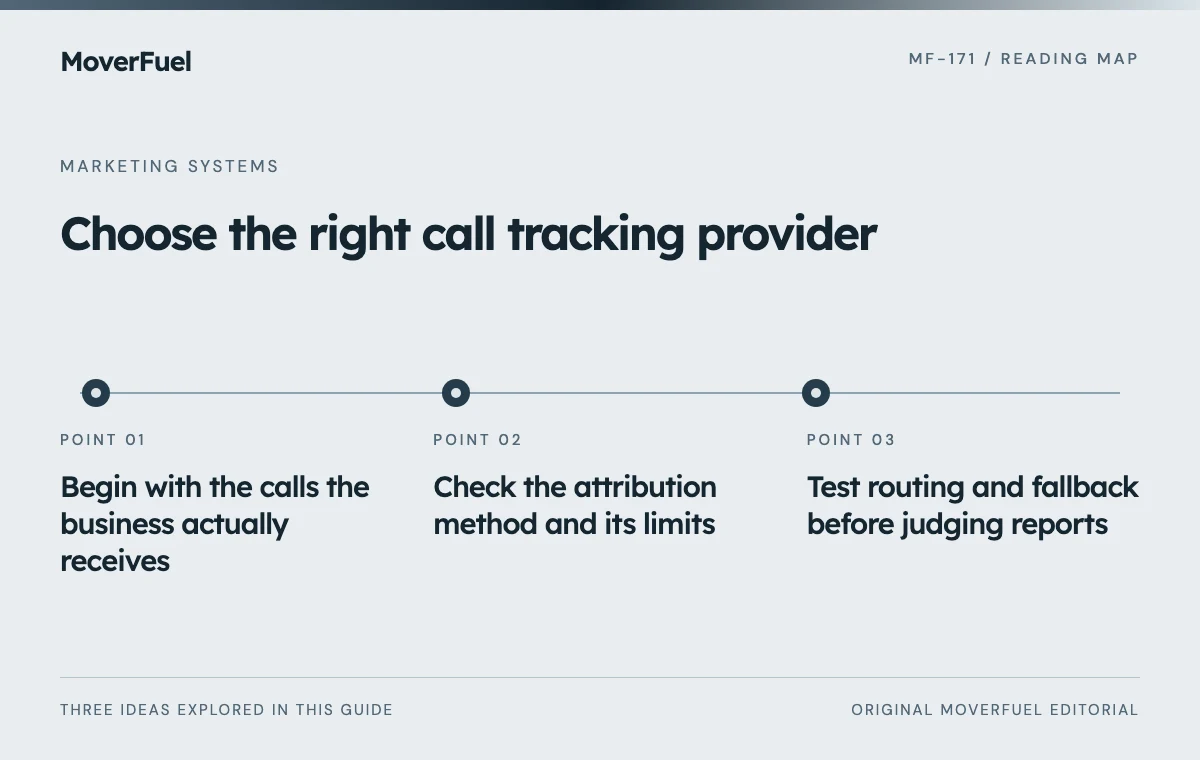
Begin with the calls the business actually receives
Scroll the table horizontally to compare all columns.
| Scenario | Capability to verify | Why it matters |
|---|---|---|
| Website visitor calls | Supported visitor/source attribution | Connects the call to the intended acquisition context |
| Ad call interaction | Appropriate platform-specific setup | Avoids assuming website tracking covers it |
| Repeat customer call | Identity and opportunity association | Prevents every conversation becoming a new lead |
| After-hours request | Reliable routing and fallback | Protects customer access |
| Branch transfer | Clear ownership and call history | Keeps the inquiry from being counted or lost twice |
List the existing numbers, destinations and routing rules in a controlled inventory. Identify which numbers the company must retain and who controls them. Do not move critical phone paths before understanding the operational consequences.
Ask sales and operations which call failures are most costly: unanswered requests, incorrect transfers, voicemail handling or lost context. Those requirements should shape the evaluation more than a vendor's feature count.
Check the attribution method and its limits
Distinguish source-level tracking numbers from visitor-level website tracking. Ask what identifies the session, how number pools are sized and what happens when a session cannot be matched. A report should expose unknowns rather than assign a convenient source without evidence.
CallRail's Google Ads integration documents specific prerequisites, including supported website visitor tracking and account configuration. Other call paths can require separate arrangements. Use this as an example of why integration claims need technical confirmation, not as a universal specification for every provider. [1]
Ask what counts as a lead
CallRail's API distinguishes answer status from lead status. An answered call, a good-lead label and a booked job are different concepts. Require the provider to explain its own definitions and how your team can connect the call to the actual moving opportunity. [2]
Avoid choosing a provider solely because it classifies long calls as valuable. Duration can help triage, but it does not establish service fit or a booking.
Test routing and fallback before judging reports
Use an approved test plan covering normal hours, after hours, unavailable destinations and branch transfers. Verify the customer experience as well as the record in the dashboard. A correctly attributed call that never reaches the team is an operational failure.
Ask how outages, number changes and forwarding failures are detected and communicated. Confirm support responsibilities and escalation routes. The business should know what it can control directly and what requires vendor intervention.
Review recording, access and retention separately
Call recording and transcription introduce obligations beyond basic attribution. Review the applicable consent, disclosure and retention requirements with qualified guidance for the locations and use cases involved. A vendor feature does not establish permission to use it.
FTC business guidance emphasizes data minimization, appropriate access and secure disposal. Ask who can access recordings, how permissions are controlled, what providers retain and how deletion or export works. [3]
Do not assume every employee or agency partner needs recording access. Define the purpose, approved users and retention process. Use redacted or synthetic material for demonstrations whenever possible.
If AI summaries or scoring are offered, evaluate their errors with representative, permitted records. Keep a review path for incorrect classifications rather than allowing a model label to overwrite the sales team's evidence automatically.
Request evidence through a short acceptance test
Scroll the table horizontally to compare all columns.
| Test | Pass condition | Evidence |
|---|---|---|
| Known website source | Expected attribution or clearly explained limitation | Session and call record |
| Repeat interaction | Correct association without false new opportunity | Linked CRM record |
| Integration retry | No unintended duplicate delivery | Delivery log |
| Routing failure | Documented fallback and alert | Observed test result |
| Export and exit | Usable data and confirmed number process | Sample export and contract terms |
Ask for a sample export before purchase. Confirm that IDs, dates, source details and outcome fields remain usable outside the vendor's dashboard. A screenshot is not an adequate substitute for the underlying records.
The CRM integration guide explains how call records should connect to moving opportunities and jobs.
Compare total ownership cost and exit conditions
Include number charges, usage, recording or transcription, integration access, staff administration and migration effort in the comparison. Verify current pricing and contract terms directly; do not rely on a generic published plan name.
Confirm number ownership or portability arrangements, export rights and cancellation steps in writing. The cheapest subscription can be expensive if leaving it disrupts customer calls or loses essential attribution history.
Use lead tracking and automation to define the requirements first. Select the provider that can demonstrate those requirements within the company's budget and operating model.
Common questions
Is call duration enough to identify a qualified moving lead?
No. It does not establish geography, service fit, timing or booking outcome. Combine call records with a consistent qualification and opportunity process.
Should a mover record every call?
That depends on a legitimate need and the applicable requirements. Review consent, disclosure, access and retention before enabling recording; attribution alone does not always require it.
Your next step
Choose call tracking through operational and measurement tests. Reliable routing, transparent definitions, controlled data access and a workable exit plan are essential selection criteria.
Sources & editorial notes
Platform claims cite the documents below. Operating frameworks and labeled examples are MoverFuel editorial analysis, not client results or industry benchmarks.
- CallRail: Google Ads integrationCallRail's Google Ads integration documents prerequisites and specific supported tracking paths. Reviewed .
- CallRail API v3 documentationCallRail API answer-status and lead-status fields represent different concepts and do not themselves establish booked jobs. Reviewed .
- FTC: protecting personal informationFTC guidance supports minimizing stored data, limiting access and disposing of information securely. Reviewed .