
An integration badge does not prove that marketing can see which inquiries became moving jobs. Start with the data journey: where a request originates, how it becomes a CRM opportunity and how its outcome reaches reporting. Then evaluate connectors against those requirements rather than buying a collection of tools that happen to exchange records.
 View full-size graphic ↗
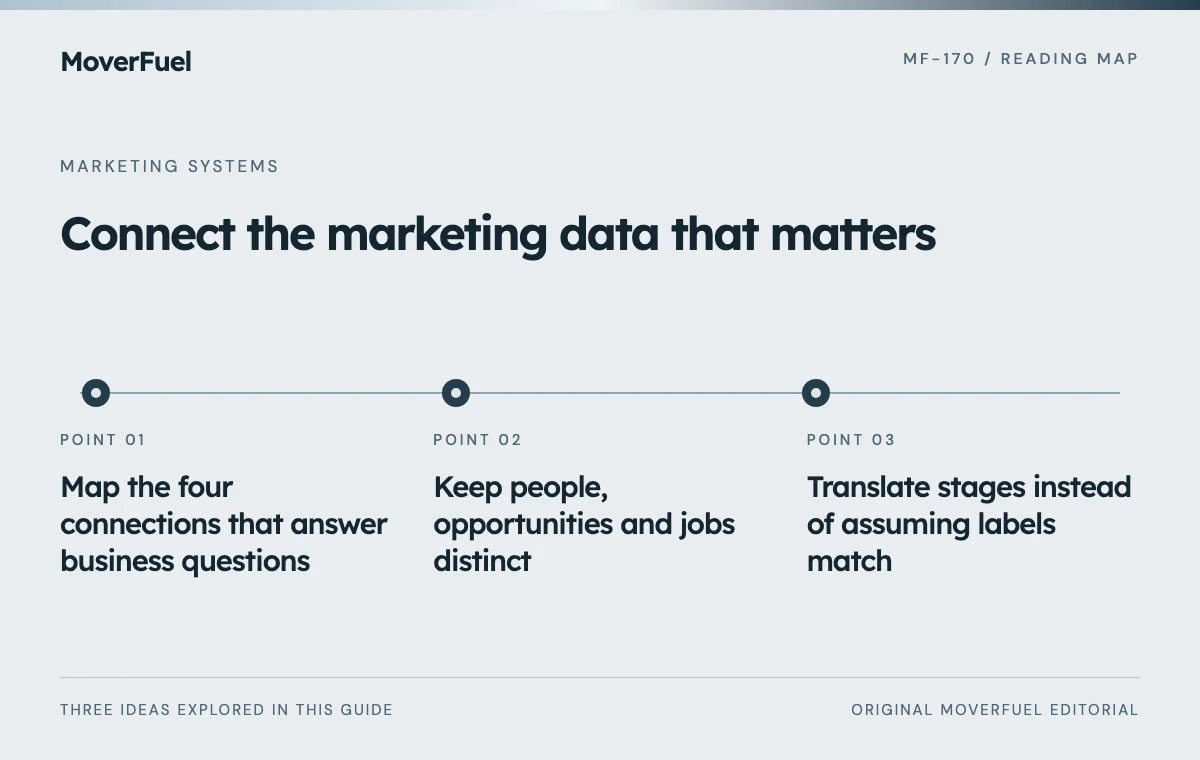
Map the four connections that answer business questions
Scroll the table horizontally to compare all columns.
| Connection | Required information | Question it should answer |
|---|---|---|
| Website to CRM | Request identity, relevant source and submission time | Which acquisition path produced the inquiry? |
| Calls to CRM | Call identity and associated opportunity | Was the interaction new demand or follow-up? |
| CRM to reporting | Defined stages, dates and job values | What happened after the inquiry? |
| Outcomes to ad platform | Eligible event, stable identity and required matching data | Can the platform receive the intended outcome reliably? |
Not every company needs every connection immediately. Prioritize the missing link that prevents a useful decision. A dependable form-to-job chain can be more valuable than an ambitious integration project with no agreed definitions.
Document the source of truth for each field. If two systems can overwrite the booking date or acquisition source, determine which one is authoritative and how corrections propagate.
Keep people, opportunities and jobs distinct
One customer may request more than one move over time. One opportunity may involve several calls and messages. A booking may later create multiple operational records. Preserve those relationships rather than treating an email address as the universal identity for every event.
Use stable identifiers at the correct level
Assign a persistent inquiry or opportunity ID and retain the relevant job linkage. Store external system IDs in dedicated fields. A connector should not create a new opportunity every time an existing record is updated or a delivery is retried.
Define merge rules and retain provenance. When duplicate records are combined, the team should be able to understand which acquisition information was kept and why. Silent overwrites can make attribution appear cleaner while destroying its history.
Translate stages instead of assuming labels match
CRM products distinguish concepts differently. HubSpot's documentation separates lifecycle stages from Lead Status, which describes sub-stages within its sales-qualified context. A label in one system should not be mapped to a similarly named field without checking its meaning. [1]
Write an explicit mapping for qualified, estimate provided, booked, completed and lost states as the business uses them. Specify the evidence required and which timestamp records the transition. An integration cannot correct inconsistent staff definitions by itself.
Supermove milestone reporting also distinguishes creation, booking and job timing. Preserve the date basis when exporting data so a booking-month report is not accidentally compared with a job-month report. [2]
The lead-source field guide defines source provenance separately from sales stages.
Verify what the connector actually supports
Ask whether the connection is real-time, scheduled or manual; one-way or bidirectional; and which plan, permissions or identifiers it requires. Confirm supported fields, historical backfill and failure behavior in the current vendor documentation.
CallRail's Google Ads integration, for example, has specific tracking and account prerequisites and distinguishes website visitor tracking from other call paths. The existence of that integration does not prove that every call source or historical record is supported by the same setup. [3]
Require a named owner for monitoring failures. A connector that silently stops delivering events can undermine both reports and bidding inputs long before someone notices a missing row.
Test the whole journey with controlled records
Scroll the table horizontally to compare all columns.
| Test | Expected behavior | Evidence to save |
|---|---|---|
| New valid inquiry | One opportunity with appropriate source | Record IDs and timestamps |
| Repeated delivery | No unintended duplicate opportunity | Retry and receipt log |
| Stage update | Correct outcome and date reach destination | Mapping and destination result |
| Temporary failure | Visible failure and controlled retry | Error and recovery record |
| Correction or cancellation | Defined handling without silent corruption | Before/after audit trail |
Use synthetic test data in approved test environments where possible. Do not send fabricated customer outcomes into live advertising optimization merely to demonstrate a connection. Coordinate any production test with the actual account owner and destination rules.
Reconcile counts at each step. A successful API response may establish receipt without proving that the destination attributed or used the event as intended. Keep delivery, acceptance and reporting status separate.
Limit data and maintain the connection
FTC data-security guidance recommends knowing what information is held, keeping only what is needed and controlling access. Apply those principles to connector permissions, exported records and retained logs rather than copying entire customer files by default. [4]
Review mappings after CRM fields, website forms or platform requirements change. Maintain a small test suite and an integration inventory with owner, purpose and recovery process. This makes the system maintainable when staff or agencies change.
A tracking and automation review should begin with these requirements and the business decision they enable.
Common questions
Does a native CRM integration guarantee accurate attribution?
No. Accuracy still depends on identity, field mappings, stage definitions, permissions and reliable delivery. Test the complete inquiry-to-job path.
Should every customer field be sent to every marketing tool?
No. Share only information needed for the defined purpose under the applicable permissions and policies. Broad data copying increases risk and maintenance without necessarily improving decisions.
Your next step
Specify the data journey before selecting connectors. Reliable identity, stage meaning and acceptance evidence matter more than the number of integrations in the stack.
Sources & editorial notes
Platform claims cite the documents below. Operating frameworks and labeled examples are MoverFuel editorial analysis, not client results or industry benchmarks.
- HubSpot: contact and company lifecycle stagesHubSpot distinguishes lifecycle stages and Lead Status, illustrating the need for explicit semantic mapping. Reviewed .
- Supermove: Marketing Milestones SummarySupermove milestone reporting distinguishes creation, booking and job-date events. Reviewed .
- CallRail: Google Ads integrationCallRail's Google Ads integration has defined prerequisites and supported tracking paths. Reviewed .
- FTC: protecting personal informationFTC guidance supports data minimization, access control and responsible handling by service providers. Reviewed .