
A mover serves routes, not just dots on a map. A customer may search from a new home while arranging pickup in the company’s service area, or request a destination the crew cannot support. Good LSA coverage joins platform geography with an operational definition of the jobs the business can accept.
 View full-size graphic ↗
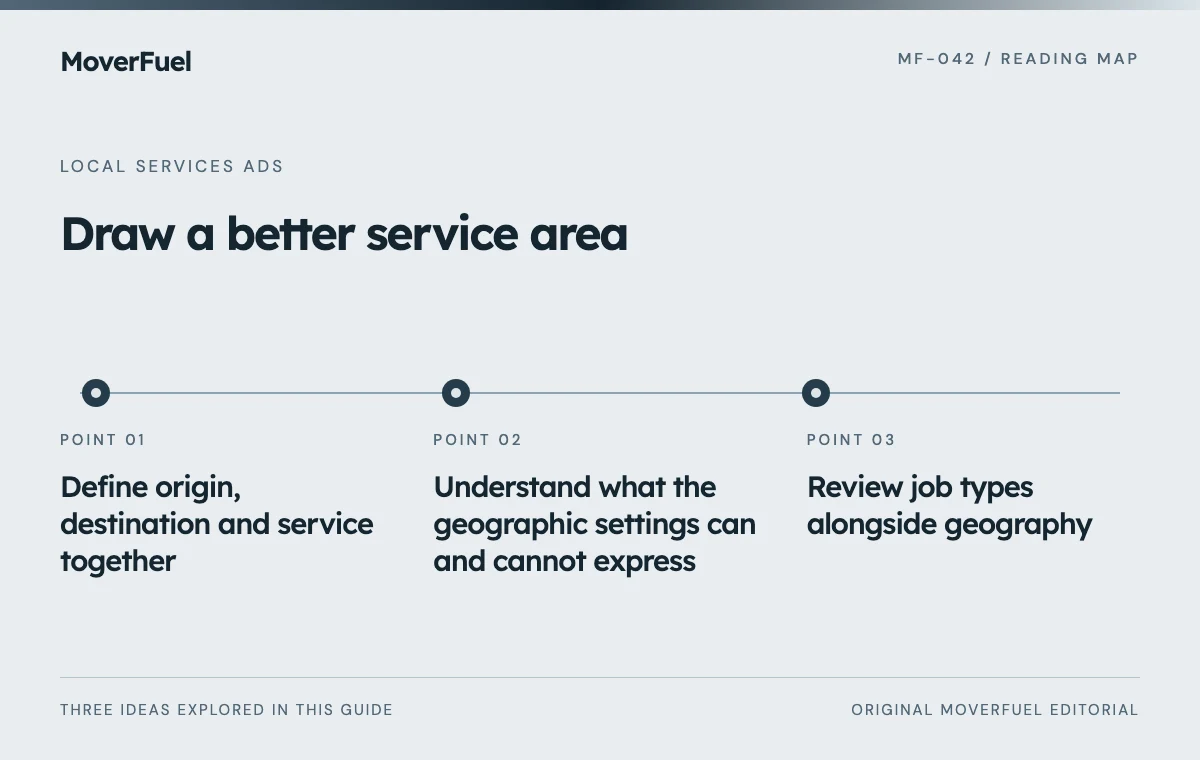
Define origin, destination and service together
Start with the pickup locations the branch can serve, then document the destination and service constraints that matter. Local household moves, long-distance work and commercial relocations can have different boundaries. A single large radius may hide those differences.
Scroll the table horizontally to compare all columns.
| Dimension | Example planning question | Responsible reviewer |
|---|---|---|
| Pickup | Where can crews begin work sustainably? | Branch operations |
| Destination | Which routes and jurisdictions are supported? | Operations and responsible compliance contact |
| Service | Does the branch offer packing, storage or labor-only work? | Service manager |
| Timing | Which dates or time windows have capacity? | Dispatch |
| Access | Which equipment or access constraints require review? | Estimator |
Use real operating capabilities rather than a marketing wish list. If a route requires an unavailable resource or authorization, it should not become an advertising promise simply because customers search for it. Record exceptions that need an estimator’s review rather than pretending every job in an area is identical.
Understand what the geographic settings can and cannot express
Google allows service-area selections such as cities and postal areas, with location estimation and interest signals affecting reach. Its documentation warns that postal areas and city boundaries can overlap, and that city-level estimates can still produce exposure outside a selected postal subset. Treat settings as controls, not a perfect geographic fence. [1]
Compare the selected areas with the coverage matrix before launch. If a broad city selection includes locations the branch routinely declines, investigate whether more suitable supported controls exist. Then review actual inquiries to see whether the change solves the problem.
Avoid drawing conclusions from one unusual inquiry. Look for repeated patterns with enough detail to distinguish an inaccurate coverage choice from a legitimate customer searching from another location.
Review job types alongside geography
Google’s job-type selections help determine relevant searches, but general category searches can also make an ad eligible. Selecting a service is therefore not a guarantee that every contact describes exactly that task. [1]
An in-area request for an unsupported service is a scope problem, not a map problem. Removing the entire area may eliminate useful household moves without addressing the advertised service description. Review both dimensions in the lead ledger.
Use the profile to clarify the work
Explain the core offer accurately and avoid broad wording that suggests services the team does not provide. Align the description, selected services and intake script. If they disagree, a customer can reasonably expect work the business later rejects.
Use rejected inquiries to improve coverage carefully
Scroll the table horizontally to compare all columns.
| Pattern | Verify | Possible action to test |
|---|---|---|
| Repeated unsupported origins | Actual pickup locations and settings | Refine supported area selections |
| Suitable origins with unsupported destinations | Route rules and customer intent | Clarify qualification and service scope |
| Good locations but unavailable dates | Capacity at inquiry time | Align advertising with operational availability |
| Unsupported work inside a strong market | Job types and profile language | Repair the offer before excluding the market |
| Mixed outcomes from an adjacent area | Retained jobs and delivery economics | Evaluate value before narrowing reach |
Have the branch review proposed exclusions. A marketing report may see travel distance as waste while operations sees a useful route combination. Conversely, a high-value booking may require costs that the advertising report does not capture.
Change a defined part of the coverage and record the date. Review both the reduction in unsuitable contacts and any loss of suitable bookings. A cleaner lead mix is not automatically a better commercial result if it removes too much useful demand.
Maintain the coverage plan as operations changes
Revisit the matrix when a branch opens, equipment changes, seasonal capacity tightens or a service is added. Keep the person who approves the operational scope distinct from the person who enters the advertising setting. Both should confirm the final result.
Do not assume an update to one Google surface changes every other surface. Review LSA, Business Profile information, website coverage and Search campaigns in their own interfaces. Consistent customer expectations require coordination across them.
Use the LSA lead disposition guide to retain specific route and scope reasons rather than collapsing all rejected contacts into “outside area.”
The aim is a defensible coverage plan that the company can deliver, with a feedback loop for exceptions. Perfect geographic filtering is not a realistic substitute for competent qualification.
Common questions
Will selecting postal codes prevent every out-of-area contact?
No. Google documents location-estimation and postal/city overlap limitations. Confirm actual job locations and monitor patterns rather than treating the selection as a perfect boundary.
Should I remove an area after one poor lead?
Usually investigate first. Compare the reason, recurring pattern and suitable jobs from that area. One contact may not justify losing a productive market.
Your next step
Build coverage from real routes and services, then use actual inquiries to refine it. Keep geographic controls and sales qualification working together.
Sources & editorial notes
Platform claims cite the documents below. Operating frameworks and labeled examples are MoverFuel editorial analysis, not client results or industry benchmarks.
- Google: Reaching customers with Local Services AdsCurrent LSA service-area/job-type controls, general category exposure and geographic estimation limitations. Reviewed .