A household can see a Local Services profile, inspect your website and later click a Search ad before calling. Three reports may describe that journey, but the moving company still has one opportunity to serve the customer. Coordinate the channels around a common offer and a shared job record instead of treating every dashboard as a separate business.
 View full-size graphic ↗
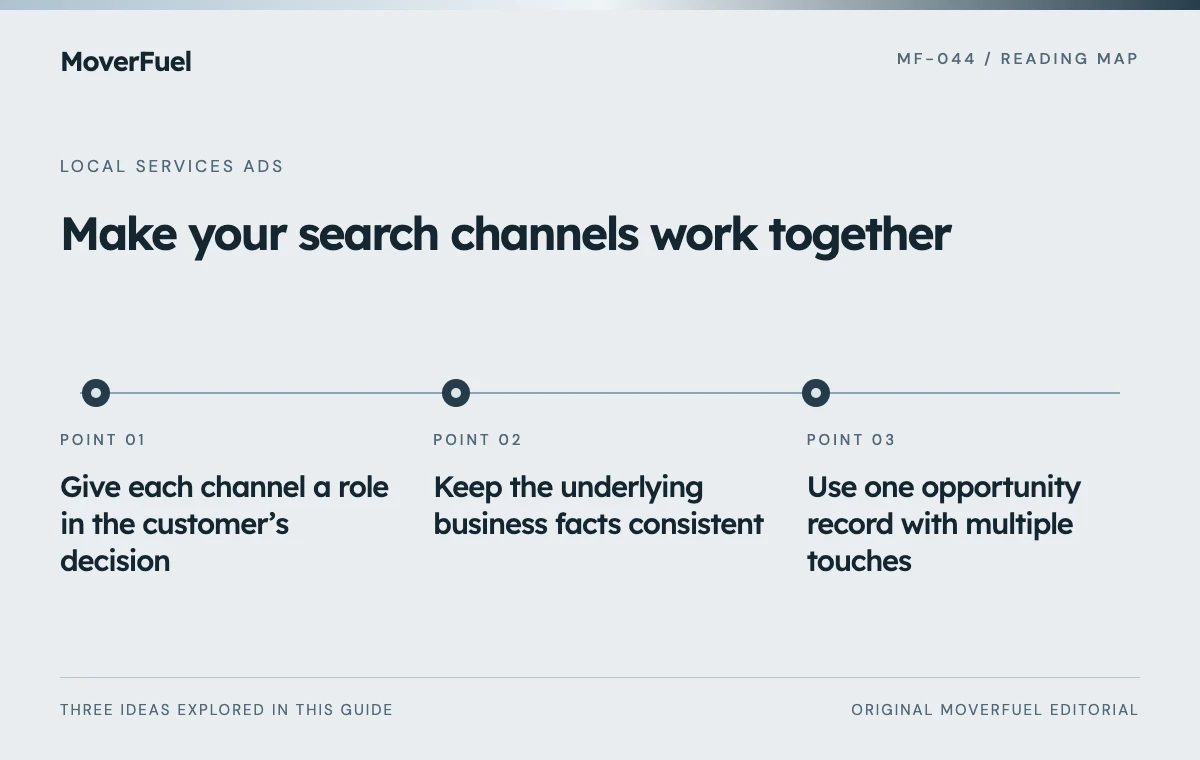
Give each channel a role in the customer’s decision
Scroll the table horizontally to compare all columns.
| Channel or asset | Useful role | What it still needs |
|---|---|---|
| Local Services Ads | Create direct conversations about eligible local services | Accurate scope, response coverage and job matching |
| Organic service pages | Explain capabilities and answer relevant buying questions | Crawlable, useful content and a working conversion path |
| Business Profile | Present consistent local business information and evidence | Accurate ownership, services and ongoing maintenance |
| Search campaigns | Reach selected query themes with a specific message | Relevant destinations, budget control and outcome data |
These roles can overlap. The purpose of the map is to identify what each component contributes and where a customer might need more information. Do not force every channel to carry an identical message if the customer is at a different point in the decision.
Google’s Search Essentials guidance emphasizes useful content and technical access for search systems. A service page should therefore explain the actual work and help a visitor act, rather than exist only as a keyword target. [1]
Keep the underlying business facts consistent
Create an approved service fact sheet covering the business identity, offered work, pickup coverage, relevant route limitations, contact paths and estimate process. Use it to review the website, profile and advertisements. A customer should not hear three incompatible versions of what the mover does.
If storage is available only through one branch, make that distinction clear. If the advertised offer requires a survey, the destination should not promise an instant final price. Consistency here is practical customer service, not merely a branding exercise.
Assign an owner when operations changes
When capacity, coverage or services change, one person should coordinate the updates across surfaces and confirm completion. Do not assume a profile edit automatically updates campaign settings or website copy. Keep a short change log with the affected channels.
Keep attribution separate from proof of incremental demand
Attribution assigns credit under a chosen method. It does not, by itself, reveal what would have happened without a channel. Last-touch reporting can favor the final contact path; first-touch reporting can overlook useful later interactions. Show the rule and retain the underlying journey when available.
Review branded and non-branded demand where the available reports permit it. If a campaign captures customers who already know the company, that can still have value, but the interpretation differs from acquiring new demand. Avoid calling every attributed booking a newly created customer opportunity.
For stronger causal evidence, consider a carefully designed holdout or allocation experiment when volume and business conditions make it feasible. Document seasonality, capacity and service-mix changes that could otherwise explain the result.
Run one review with separate diagnostic views
Scroll the table horizontally to compare all columns.
| View | Decision |
|---|---|
| Total spend and mature retained jobs | Is the combined acquisition system sustainable? |
| Channel inquiries and fit reasons | Where does unsuitable demand enter? |
| Response and estimate progression | Is the receiving team losing useful contacts? |
| Website questions and conversion friction | What information or interaction needs improvement? |
| Market capacity and marginal results | Where should the next budget increment go? |
Keep SEO work accountable through useful leading indicators and later qualified demand without pretending every content update produces immediate bookings. Likewise, keep paid campaigns accountable for the quality of the jobs they acquire rather than only the speed of traffic delivery.
Use the LSA versus Search comparison for equivalent cost definitions, and the moving-company SEO guide for the organic service architecture.
Finish the meeting with coordinated actions. If the dominant issue is an unclear service offer, fix the profile, ad and page together. If the issue is a lost estimator handoff, do not ask every channel manager to generate more leads before repairing it.
Common questions
Should each channel report its own bookings?
It can report attributed bookings, but the business needs a deduplicated total and a clear attribution rule. Separate channel claims should not be added together as though every booking were unique.
Does adding paid advertising replace SEO work?
No. Advertising and organic content have different operating roles. Decide their scope from customer needs, channel evidence and resources rather than assuming one automatically substitutes for the other.
Your next step
Coordinate the offer, retain the customer journey and reconcile to unique jobs. Then use channel-specific evidence to improve the combined acquisition system.
Sources & editorial notes
Platform claims cite the documents below. Operating frameworks and labeled examples are MoverFuel editorial analysis, not client results or industry benchmarks.
- Google: Search EssentialsAccessible, helpful service content as an organic-search foundation. Reviewed .
- Supermove: Marketing Milestones SummaryProject-level marketing fields and multiple milestone rows; no claim of a configured MoverFuel integration. Reviewed .