
The LSA inbox can tell you about lead activity, but a useful cost-per-booked-move calculation also needs the job system. Match the advertising ledger to unique opportunities, wait for the sales cycle to mature and keep cancellations visible. Otherwise, a precise-looking acquisition number can describe the wrong set of customers.
 View full-size graphic ↗
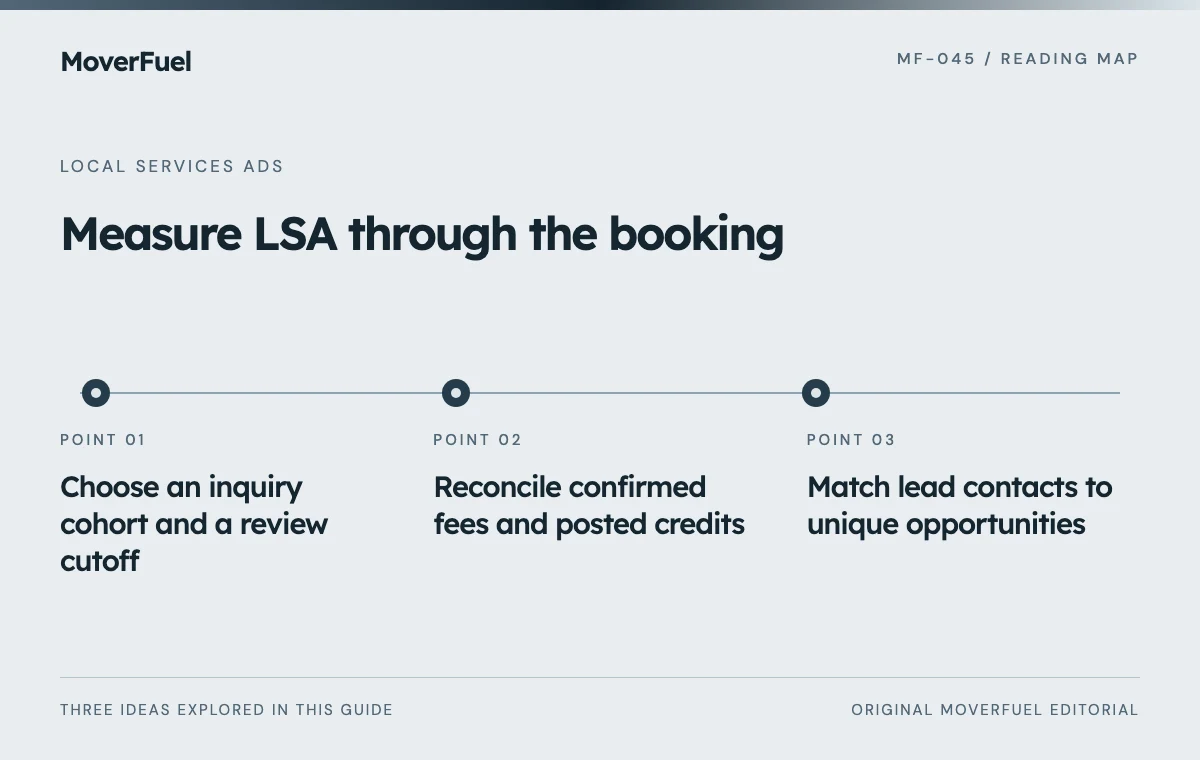
Choose an inquiry cohort and a review cutoff
Select leads received during a defined period, then follow those opportunities through estimates and bookings. Record the date on which outcomes were reviewed. This gives the numerator and denominator a common acquisition history even when a job books later.
Keep a separate calendar view when operations needs to know which jobs booked or moved this month. Do not divide this month’s advertising bill by every booking this month if many of those bookings originated in earlier periods or other channels.
Supermove’s marketing report documentation offers different date filters, including created and booked dates, along with project status and cancellation visibility. That illustrates why the selected filter matters; confirm the meaning of fields in whichever operating system you actually use. [1]
Reconcile confirmed fees and posted credits
Export or record the original charges and actual posted adjustments for the cohort. Preserve the source lead identifier and adjustment date. Pending reviews belong in a separate column so they do not reduce confirmed cost before the outcome is known.
Use the lead-credit reconciliation guide for the distinction between the original invoice and later adjustments.
Scroll the table horizontally to compare all columns.
| Item | Amount | Treatment |
|---|---|---|
| Original lead charges | $4,000 | Included in cohort acquisition cost |
| Posted credits associated with those leads | $400 | Deducted once |
| Potential credits still unresolved | $150 | Disclosed, not deducted |
| Confirmed net advertising fees | $3,600 | $4,000 minus $400 |
If an adjustment posts after the reporting cutoff, either update the cohort report with a new review date or show it in the next reconciliation. Do not silently change a historical result without retaining the reason. Keep the invoice-period and cohort views reconcilable.
Match lead contacts to unique opportunities
A customer may call twice, send a message and submit a website form about the same proposed move. Match these contacts to the opportunity using the company’s documented rule. Retain the individual contact records for service and attribution review, but do not let them multiply the job count.
Review uncertain matches instead of guessing
The same contact can also arrange two separate moves. Preserve a distinct opportunity when the service, dates or scope establish separate work. Flag ambiguous cases for review, particularly when multiple branches or family members are involved.
For multi-touch opportunities, apply the same attribution policy used elsewhere in the business. An LSA-assisted job may be shown in an assisted view without being counted as a second unique acquisition in the company total. Label the view so the reader knows what the denominator represents.
Calculate each funnel cost from its own denominator
Scroll the table horizontally to compare all columns.
| Cohort outcome | Count | Cost calculation |
|---|---|---|
| Unique inquiries | 60 | $3,600 / 60 = $60 |
| Qualified opportunities | 40 | $3,600 / 40 = $90 |
| Estimates completed | 30 | $3,600 / 30 = $120 |
| Booked moves | 18 | $3,600 / 18 = $200 |
| Retained bookings after 3 cancellations | 15 | $3,600 / 15 = $240 |
| Completed moves by the review cutoff | 12 | $3,600 / 12 = $300 so far |
Every figure is hypothetical and uses one acquisition cohort. The $200 booked-move cost and $240 retained-booking cost are both correct under their definitions. The $300 completed-job cost is provisional if three retained bookings have not yet reached their move dates.
Do not interpret future scheduled work as a delivery failure. Show scheduled, completed and cancelled counts separately. If the final three jobs complete without further cost adjustments, this cohort’s completed-job acquisition cost would become $240.
When no bookings exist, the cost per booking is undefined. Display the spend and zero outcome count with an explanation. Reporting a zero-dollar acquisition cost would reverse the meaning of the result.
Use the calculation to choose a specific improvement
Read the stages together. A large loss between inquiries and qualification suggests a different investigation from a large loss between estimates and bookings. Cancellations can erase a promising initial booking rate. Use reasons from the operating record to decide which explanation is credible.
Compare service mix and contribution before reallocating budget. A low acquisition cost for jobs that consume excessive travel or specialist resources may be less useful than a higher cost for work that fits the operation. Keep advertising cost distinct from delivery economics, then evaluate them together.
To set an allowable lead cost, multiply the acceptable acquisition cost per retained booking by the observed retained-booking rate per unique inquiry. In the example, 15 / 60 = 25%. An illustrative $240 retained-booking allowance would imply a $60 lead allowance. This is a planning relationship, not a guaranteed market price.
The market budget guide shows how to use that relationship alongside branch capacity and uncertainty.
Make reconciliation part of the reporting close
Assign an owner to check unmatched leads, unresolved credits, duplicate opportunities and later cancellations. Save the report cutoff and the source exports or approved references. A repeatable close process makes changes in acquisition cost explainable.
Report the limits of the data alongside the number. If a group contains unclassified contacts or unmatched bookings, quantify them and mark the result provisional. Repairing that gap is more useful than comparing unreliable figures to a supposed industry average.
Common questions
Should I use booked moves or completed moves?
Both answer useful questions. Bookings describe sales conversion; retained and completed jobs expose cancellations and delivery maturity. Label each measure and avoid treating future scheduled jobs as failed outcomes.
Can I include management fees in the calculation?
Yes, if you define and allocate them consistently. Show advertising-only cost separately when comparing platform efficiency, and state which additional costs appear in a fully allocated view.
Your next step
Match confirmed acquisition costs to unique jobs from the same inquiry cohort. Keep retained and completed outcomes visible, and preserve the reporting cutoff so the number remains interpretable.
Sources & editorial notes
Platform claims cite the documents below. Operating frameworks and labeled examples are MoverFuel editorial analysis, not client results or industry benchmarks.
- Supermove: Marketing Milestones SummaryDate-filter and project-status distinctions in moving-company reporting. All calculations and sample values are original hypothetical examples. Reviewed .