
Older advice to dispute every unwanted Local Services lead can create a misleading forecast of refunds. Start with the current account status and Google’s current rules, then reconcile actual adjustments. A declined moving job, an unsuccessful sales conversation and an incorrect charge are not interchangeable categories.
 View full-size graphic ↗
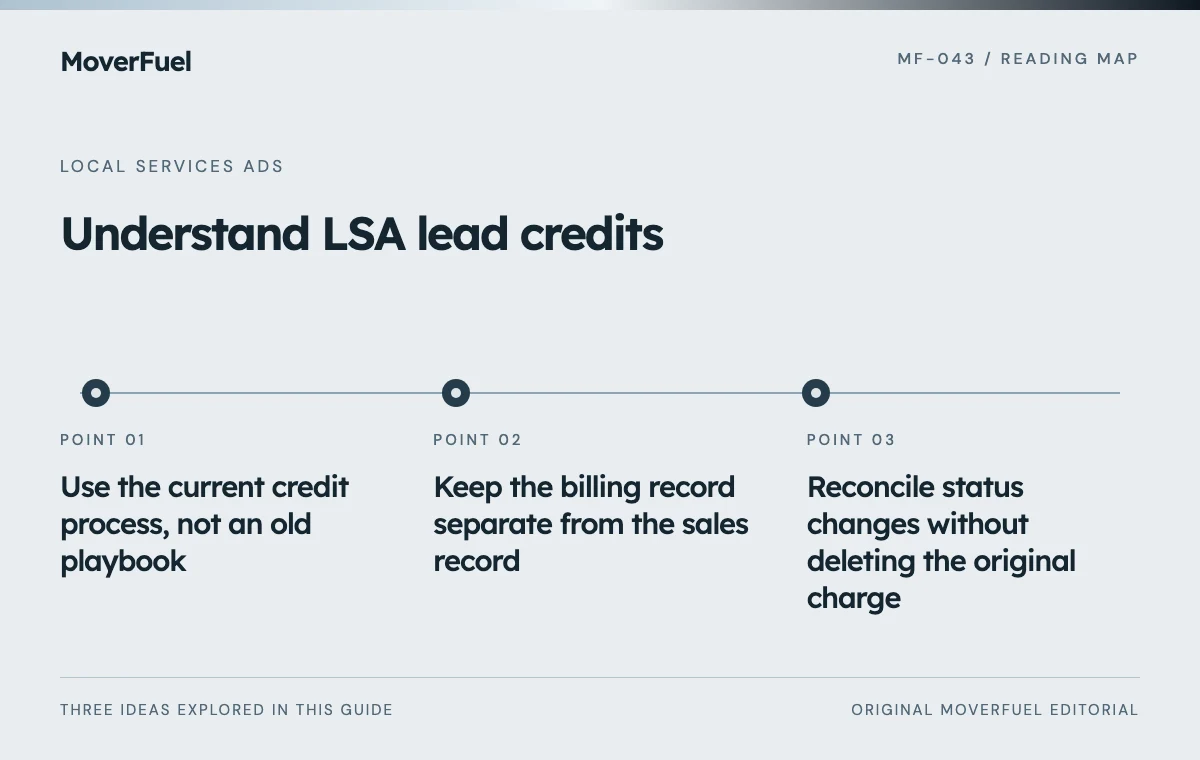
Use the current credit process, not an old playbook
Policy check: October 27, 2026. Google describes initial lead assessment and later automated reassessment of charged leads. Some contacts are not charged initially; others may receive credits later. Feedback is available, but it is not a promise of reimbursement. [1]
The current guidance excludes credits for unsupported job types and geography. It also excludes EMEA advertisers and specified verticals, including health care and tax specialists. Verify the current official page and the account’s applicable process before relying on a credit expectation. [1]
If an agency proposes a refund-recovery service, ask what current process it uses and which outcomes it can actually verify. Do not count projected recoveries as savings merely because someone has labeled a set of leads undesirable.
Keep the billing record separate from the sales record
Scroll the table horizontally to compare all columns.
| Billing question | Sales question |
|---|---|
| Was a fee charged? | Was the requested move suitable? |
| Is an adjustment pending or posted? | Did the team reach the customer? |
| Which invoice or balance contains the change? | Was an estimate completed? |
| What is the confirmed net cost? | Was the job booked, lost or cancelled? |
A real customer can decline an estimate without making the lead invalid. A company can be fully booked for the requested date without that capacity issue establishing a charge error. Record the business reason honestly and handle any billing question through the applicable process.
This separation also protects the analysis. If every lost estimate is marked “refund expected,” the channel appears cheaper before any money is returned and the sales team’s actual losses disappear from view.
Reconcile status changes without deleting the original charge
Google says credits usually reach the account balance within 30 days and that the original charge remains on the invoice. The guidance distinguishes not-charged, charged, in-review and credited leads. A pending review is not a posted credit. [1]
Scroll the table horizontally to compare all columns.
| Lead | Original fee | Posted credit | Pending item | Confirmed net fee |
|---|---|---|---|---|
| A | $60 | $0 | None | $60 |
| B | $50 | $50 | None | $0 |
| C | $70 | $0 | Review unresolved | $70 |
| D | $0 | $0 | None | $0 |
| Total | $180 | $50 | Unresolved review shown separately | $130 |
These figures are fictional arithmetic, not Google prices or a promised credit rate. Retain the original charge, the adjustment date and the source record for each posted credit. That preserves an audit trail when the charge and credit fall in different billing periods.
Explain the difference between financial and acquisition views
A cash or invoice-period report shows when a charge or adjustment was posted. An inquiry-cohort report can attach the adjustment to the original acquisition group. Both can be useful, but label them clearly and reconcile the difference rather than forcing them to match by deleting records.
Submit accurate feedback and preserve unresolved questions
Use the current feedback interface with factual descriptions. Record what the customer requested and what the company learned. Avoid exaggerating a service mismatch into fraud or inventing a reason that appears more likely to produce a credit.
For an unexplained billing discrepancy, collect the relevant account and lead identifiers, dates and charge information through approved internal access. Use official support where needed. Keep sensitive customer material within the authorized process rather than placing it in a public support post.
Assign a person to review outstanding items and close them only when the actual status is known. If the result is no credit, preserve that outcome and update the forecast. An unresolved list should not quietly become assumed savings at month-end.
Use the review to prevent repeat operating waste
Even a confirmed credit does not return the staff time spent handling an unsuitable inquiry. Look for repeated scope confusion, coverage problems or slow follow-up that can be repaired before more contacts arrive. Keep credit recovery and acquisition improvement as separate workstreams.
The service-area guide addresses geographic fit; the lead-quality worksheet helps distinguish fit from response and sales outcomes.
Evaluate the channel using confirmed net fees and retained jobs. If the economics work only under an optimistic assumption about future adjustments, reduce the uncertainty before increasing spend. Financial discipline is more useful than a large count of submitted complaints.
Common questions
Does every lead I decline qualify for a credit?
No. Business fit and platform charging rules are separate. Check the applicable current policy and actual account decision rather than assuming an unwanted inquiry is refundable.
Should pending credits reduce reported acquisition cost?
Show them separately as unresolved. Use posted adjustments for a confirmed net-cost calculation, and explain any difference between invoice-period and inquiry-cohort reporting.
Your next step
Use current policy, preserve the original ledger and recognize only confirmed adjustments. Improve the causes of unsuitable demand even when a billing review is underway.
Sources & editorial notes
Platform claims cite the documents below. Operating frameworks and labeled examples are MoverFuel editorial analysis, not client results or industry benchmarks.
- Google: automated lead creditsCurrent automated assessment, exclusions, status definitions and credit posting guidance, checked October 27, 2026. Worked ledger is hypothetical. Reviewed .