
There is no single marketing budget that fits every moving company. A useful budget starts with what a completed job contributes, how many inquiries become completed work and how much additional demand the operation can fulfill. Separate the spending categories, model several outcomes and choose a test limit the business can support. A percentage of revenue can be a planning reference, but it does not answer those operating questions.
 View full-size graphic ↗
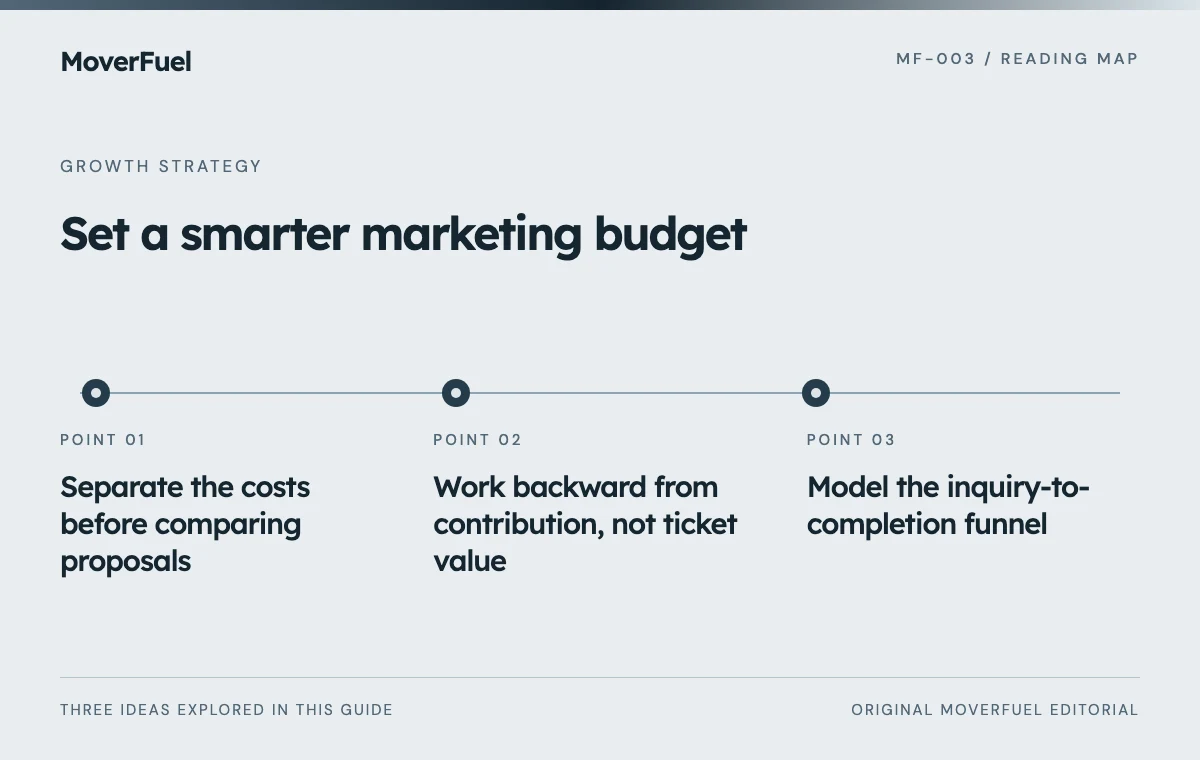
Separate the costs before comparing proposals
Compare the full investment before choosing a plan. The marketing cost FAQ separates agency fees, media and implementation.
A quoted monthly agency fee and a total marketing budget are different numbers. Ask what the scope includes, what is paid directly to platforms and which implementation tasks are separate. A low management fee can still require substantial website, tracking or creative work before the campaign is ready.
Scroll the table horizontally to compare all columns.
| Category | Examples | How to plan it |
|---|---|---|
| Media | Search, social or eligible local-service advertising | A recurring limit with review and pacing rules |
| Management | Strategy, campaign work and reporting | A clear recurring scope and owner |
| Implementation | Landing pages, tracking setup and creative production | One-time or project costs with dependencies |
| Tools | Call tracking, analytics support and integrations | Actual subscriptions and usage charges |
| Sales effort | Intake, estimates and follow-up | Internal time or provider costs attributable to the process |
The SBA recommends a complete breakdown of marketing-plan costs and continuing measurement. For a mover, include the work needed after the inquiry as well as the cost of generating it. Otherwise, the budget may appear affordable only because someone else's time has been treated as free. [1]
Work backward from contribution, not ticket value
Revenue is the amount sold. Contribution is what remains after the variable costs included in your defined model. It still has to help cover fixed overhead and profit requirements. OpenStax's managerial-accounting framework distinguishes contribution from the final operating result. Apply a consistent cost definition before using it for acquisition decisions. [2]
Agree which costs belong in the model
A moving job can involve crew labor, fuel, packing materials, subcontracted work and other costs whose behavior differs by operation and time horizon. Some expenses rise with each job; others change when another crew or vehicle is added. Review the classification with the person responsible for the company's financial records. Avoid subtracting the same cost twice.
If the business spends the entire $700 acquiring that job, nothing from that model remains for the costs and return excluded from the calculation. Set an acquisition allowance that reflects the full business requirement, then test whether the channel can deliver appropriate work within it.
Model the inquiry-to-completion funnel
Use unique inquiries as the starting unit. Multiply by the qualification rate, the booking rate among qualified opportunities and the completion rate among bookings. Keep the denominators explicit. A 30% booking rate means little unless you know whether it refers to every inquiry, qualified leads or completed estimates.
Scroll the table horizontally to compare all columns.
| Input or outcome | Conservative case | Stronger case |
|---|---|---|
| Cost per unique inquiry | $100 | $80 |
| Unique inquiries | 40 | 50 |
| Qualification rate | 50% | 60% |
| Qualified inquiries | 20 | 30 |
| Booking rate among qualified inquiries | 30% | 40% |
| Booked moves | 6 | 12 |
| Completion rate | 90% | 90% |
| Expected completed moves | 5.4 | 10.8 |
| Media cost per expected completion | About $741 | About $370 |
Fractional completions are expected values in a planning model, not literal jobs on a calendar. With the hypothetical $700 contribution before acquisition, the conservative case produces $3,780 before media and other excluded costs. Subtracting $4,000 of media leaves negative $220 before management, tools, overhead and profit. The stronger case produces $7,560 before media, leaving $3,560 before those other costs.
The lesson is the sensitivity to several stages, not that either case predicts your market. Use your own mature records where available and label uncertain inputs. A cheap inquiry can become an expensive completed job when qualification, booking or completion weakens.
Use the marketing ROI calculator for an additional scenario, checking which costs its inputs include. A calculator's result is only as useful as those definitions.
Check cash timing and saleable capacity
A campaign may incur costs before the customer books, pays the balance or completes the move. Map that timing rather than treating projected revenue as immediately available cash. A deposit also carries the obligation to deliver the service and may be affected by the company's cancellation and refund terms.
Then compare the scenario with actual capacity. Ten additional completed jobs may fit one calendar and exceed another, depending on move size, dates, routes and staffing. If growth requires another crew or truck, include the added cost and ramp-up constraint in the expansion decision rather than extrapolating from existing capacity.
- Separate booked date, service date and cash collection date.
- Confirm which dates and service types can absorb additional work.
- Include the cost of intake and estimating during the test.
- Set a cash limit and a review date before launching.
- Keep a reserve appropriate to the company's actual operating obligations.
Choose a bounded test instead of a promised lead count
When the data is weak, choose a test that answers a specific question. For example: can an existing local service page and intake team turn demand from a defined market into qualified estimates? State what is in scope, which costs are included and what evidence would make the test interpretable.
Do not assume a fixed spend produces a fixed number of leads. Auctions, market demand, customer response and operational changes introduce uncertainty. A useful proposal should explain how the team will inspect the campaign, diagnose mismatches and report what is not yet known.
If conversion tracking is broken or calls do not reach the estimator, repair those dependencies first. Spending through a known measurement failure does not create a more informative test. Likewise, changing several services, prices and landing pages at once can make the resulting numbers hard to interpret.
The 90-day planning framework turns the budget into named work, dependencies and decision dates.
Write increase, hold and stop conditions
A budget needs a decision rule, not just a monthly number. Increase cautiously when mature cohorts show suitable work, the economics meet the company's requirements and capacity remains. Hold when the test is still maturing or the evidence is incomplete. Reduce or stop a particular activity when a verified problem makes continued spending unproductive.
Scroll the table horizontally to compare all columns.
| Decision | Evidence to examine |
|---|---|
| Increase | Additional demand remains serviceable; marginal outcomes and contribution justify a larger test |
| Hold | The sales cycle has not matured, or a known data issue prevents a fair conclusion |
| Repair | Suitable demand is lost through routing, response or estimate friction |
| Reduce or stop | Persistent mismatch or economics remain unacceptable after a documented review |
Review service types separately when their economics differ. A blended total can conceal an expensive route or make a valuable commercial pipeline look weak before it matures. Record changes in pricing, staffing and fulfillment costs so the next budget discussion uses the same definitions as the last one.
Common questions
Should moving companies spend a fixed percentage of revenue on marketing?
A percentage can organize a preliminary plan, but it should not replace job economics, cash timing and capacity analysis. Two companies with the same revenue can have very different acquisition needs and cost structures.
Is return on ad spend the same as marketing profit?
No. Revenue divided by advertising spend does not deduct fulfillment costs, management fees, tools or overhead. Use clearly defined contribution and profit calculations alongside revenue measures.
How should we budget when we have little reliable lead data?
Begin with explicit scenarios and a bounded measurement phase. Define the funnel, repair inquiry handling and track mature outcomes. Do not present assumed conversion rates as observed results.
Your next step
Separate the cost categories, agree on contribution definitions and test the funnel under several assumptions. Choose an amount the business can sustain, with clear review conditions. The right budget is one you can explain through operating evidence rather than a universal percentage.
Sources & editorial notes
Platform claims cite the documents below. Operating frameworks and labeled examples are MoverFuel editorial analysis, not client results or industry benchmarks.
- SBA: marketing and salesComplete marketing cost breakdown and continuing measurement. Reviewed .
- OpenStax: contribution margin and cost behaviorContribution margin distinguishes revenue less variable costs from the amount remaining after fixed costs. All moving-company scenarios are original hypothetical arithmetic. Reviewed .