
A moving company's marketing stack should make important work easier to perform and verify. It does not need a separate subscription for every feature advertised by a vendor. Start by assigning a system of record to each business function, then identify the connections and responsibilities needed to make the whole arrangement useful.
 View full-size graphic ↗
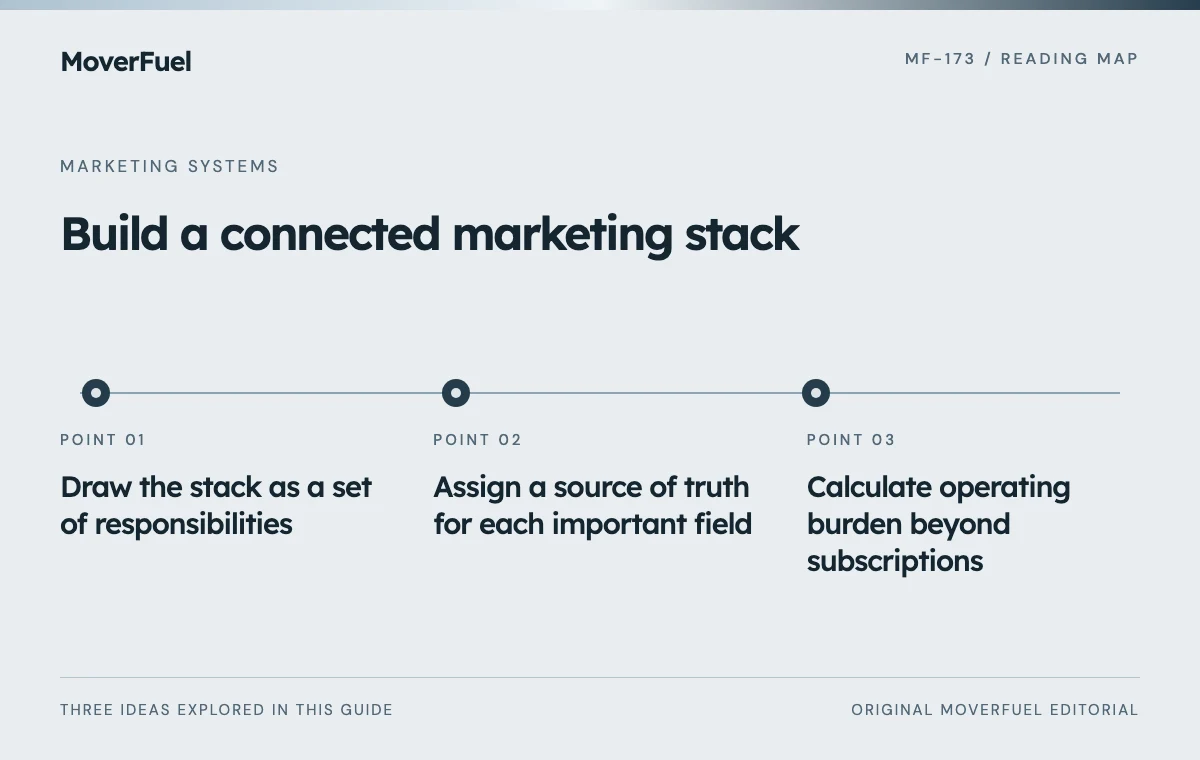
Draw the stack as a set of responsibilities
Scroll the table horizontally to compare all columns.
| Function | What it owns | What it should connect to |
|---|---|---|
| Website and forms | Public service information and valid requests | Customer record and measurement |
| Advertising platforms | Campaign delivery and platform outcomes | Landing experience and eligible conversion data |
| Call measurement | Supported phone interaction evidence | Opportunity and job records |
| CRM or moving system | Customer opportunity and operating outcomes | Reporting and appropriate follow-up |
| Reporting layer | Defined views of trusted records | Decision-makers and source systems |
The same product may cover several functions. That can simplify work when the definitions and exports are adequate. It can also hide limitations if the company assumes an all-in-one label means every required workflow is supported.
Mark the gaps before evaluating new products. A missing owner, inconsistent stage definition or unreliable form delivery may need a process repair rather than another software purchase.
Assign a source of truth for each important field
Decide which system owns the inquiry identity, acquisition source, booked status, job date and final value. Other systems may display or supplement those fields, but the team needs a rule for resolving disagreement.
Check meanings before joining reports
Supermove milestone documentation distinguishes creation, booking and job timing. HubSpot distinguishes lifecycle and lead-status concepts. These examples show why similarly named fields across products cannot be assumed to describe the same event. [1] [2]
Maintain a small data dictionary with field meaning, owner and update rule. It is especially useful when a staff member or agency changes. The business should not depend on one person's memory to explain how its performance numbers are assembled.
The lead-source field guide provides a practical example of this ownership discipline.
Calculate operating burden beyond subscriptions
Scroll the table horizontally to compare all columns.
| Cost or effort | Question to ask | Evidence |
|---|---|---|
| Subscription and usage | Which features and limits affect the actual workload? | Current plan and contract |
| Setup and integration | Who implements and maintains the connections? | Scope and owner |
| Training and administration | Can the team use it consistently? | Workflow trial |
| Data cleanup | What must be corrected before migration? | Sample audit |
| Exit and continuity | Can records and critical assets leave safely? | Export and transition test |
Use current vendor terms for the actual plan under consideration. A generic price from a comparison article may exclude required permissions, usage or integration features. Avoid comparing products as though all subscriptions deliver the same operating result.
Include the cost of duplicate work. If staff must copy every inquiry between systems, the stack may create errors and delays that do not appear on the software invoice.
Require a task-based trial
Choose representative tasks: receive a valid request, associate a call, update an estimate outcome, export a report and correct a record. Ask the team to complete them in the proposed system and record what requires manual intervention.
Test exceptions such as duplicate delivery, a changed move date or an unavailable owner. A product demonstration usually follows a clean path; the company needs to know what happens when real work departs from it.
Use the CRM integration acceptance guide to verify the actual data journey.
Keep business control and data access explicit
Document account ownership, administrators, billing responsibility and agency permissions. The company should understand how access changes when a relationship ends. Avoid shared credentials where role-based access is available, and keep secrets out of ordinary planning documents.
FTC guidance recommends minimizing retained information and controlling access. Apply that to exports, recordings, customer records and third-party tools. A useful stack does not need to replicate all personal information into every connected system. [3]
Review vendor retention, security and deletion arrangements against the actual use case. Product popularity is not a substitute for understanding how the company's data will be handled.
Review the stack when the workflow changes
Keep an inventory with product, purpose, owner, key connections, renewal date and exit process. Revisit it after a new branch, service, CRM migration or agency transition. Retire unused tools deliberately after preserving required records and continuity.
Measure whether the stack improves reliable inquiry handling and decision-making. A dashboard with more charts is not necessarily better if the team cannot reconcile its numbers or act on them.
MoverFuel is a marketing agency, not a proprietary moving CRM or dispatch platform. Platform examples here describe evaluation requirements, not a claim that every tool is connected to MoverFuel's example dashboard.
A tracking and automation assessment can identify the smallest practical set of improvements before the company commits to more software.
Common questions
Does a moving company need an all-in-one marketing platform?
Not necessarily. Evaluate whether one product or a small connected set can perform the required tasks reliably, with clear ownership and usable exports.
What is the first step before replacing a CRM?
Define the problems, field ownership and workflows the replacement must improve. Test representative tasks and data migration before assuming a new product will fix process issues.
Your next step
Build the stack around responsibilities and reliable data. Clear ownership, tested connections and manageable operating effort matter more than a long software list.
Sources & editorial notes
Platform claims cite the documents below. Operating frameworks and labeled examples are MoverFuel editorial analysis, not client results or industry benchmarks.
- Supermove: Marketing Milestones SummarySupermove milestone definitions distinguish event and date bases. Reviewed .
- HubSpot: contact and company lifecycle stagesHubSpot distinguishes lifecycle stages and Lead Status, illustrating semantic differences between fields. Reviewed .
- FTC: protecting personal informationFTC guidance supports minimizing retained information and limiting access to business data. Reviewed .