A useful moving photography library answers customer questions: who will arrive, how the team prepares and what services the business actually performs. Start with those proof needs before scheduling a shoot. A collection of truck photos may establish visual consistency while leaving the most important service questions unanswered.
 View full-size graphic ↗
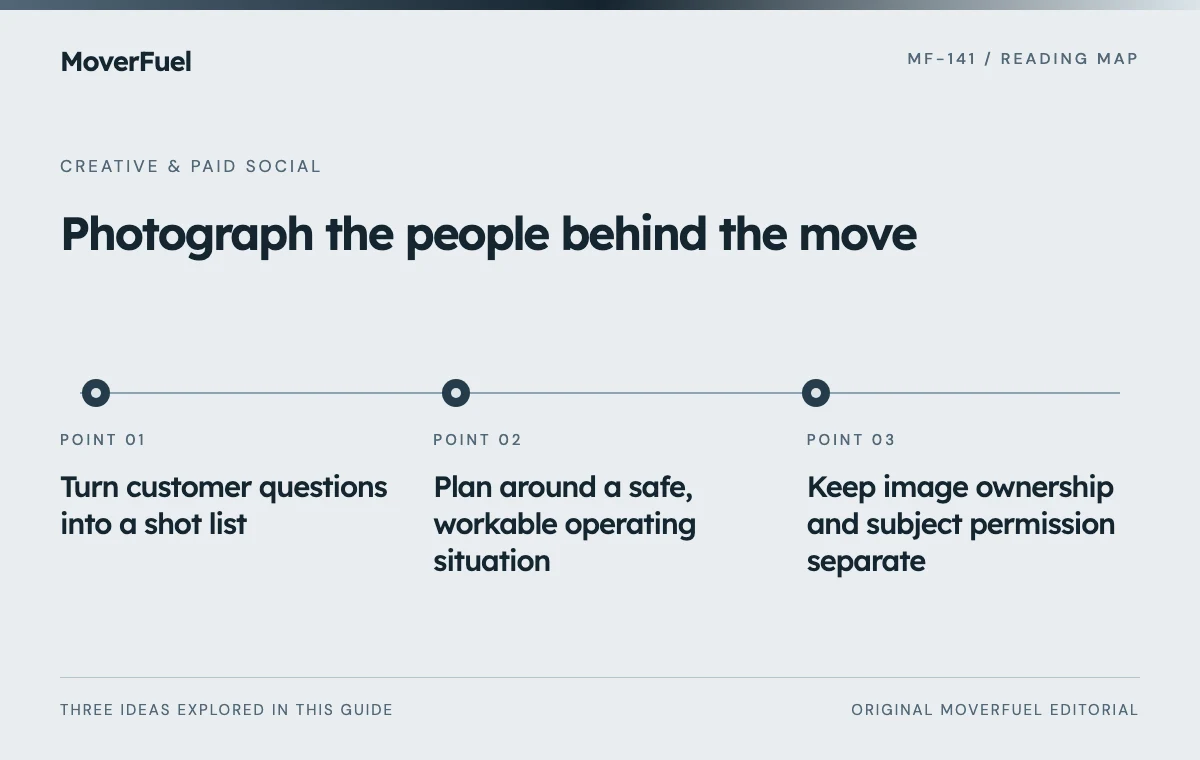
Turn customer questions into a shot list
Scroll the table horizontally to compare all columns.
| Proof need | Possible image | Review before use |
|---|---|---|
| Recognizable team | Approved crew portrait in a suitable setting | People's permission and current affiliation |
| Prepared equipment | Actual organized equipment and materials | Accurate condition and safe presentation |
| Careful process | Authorized wrapping or preparation demonstration | No unsafe staging or exaggerated claim |
| Service capability | Real approved packing, storage or office work | Permission and truthful scope |
| Brand recognition | Clean truck composition with current branding | No implication of fleet size beyond reality |
| Customer next step | Estimator reviewing a non-sensitive sample scope | No visible private records |
Ask intake staff which questions customers repeatedly raise. If people do not understand packing options, plan images that explain those options. If they want to know who will arrive, a credible team image may be more useful than another distant vehicle shot.
Do not treat a photo as proof of a certification, review rating or performance statistic. The image can demonstrate a visible process, but any accompanying claim still needs its own support.
Plan around a safe, workable operating situation
Choose a location and time that will not disrupt a customer's move or put crew members under competing instructions. A controlled demonstration may be easier to manage than photographing a live job. Label it appropriately if the context could otherwise imply a real customer project.
Assign one person to coordinate the shoot
The coordinator should confirm the approved shot list, permissions, operating restrictions and who can stop the shoot. The photographer should not direct workers into unfamiliar or unsafe handling simply to obtain a better angle. Follow the company's established procedures and site requirements.
Prepare the environment: current uniforms and branding, clean equipment, uncluttered backgrounds and no private documents. Check reflective surfaces and screens that might reveal customer details. A few minutes of preparation can prevent an otherwise useful image from becoming unusable.
Keep image ownership and subject permission separate
The U.S. Copyright Office explains that original photographs can be protected when created and that ownership can depend on employment, contracts or transfers. Receiving the image file or paying for a shoot does not by itself explain every usage right. [1]
Scroll the table horizontally to compare all columns.
| Record | What to establish |
|---|---|
| Photographer agreement | Who owns or licenses the image and for which uses |
| People shown | Appropriate consent for intended commercial use |
| Customer or property context | Permission and privacy review |
| Third-party branding or artwork | Whether inclusion and use are permitted |
| Paid advertising | Whether the rights cover the planned campaign use |
| Duration and restrictions | Any expiry, territory or channel limits |
Have the actual agreements and jurisdiction-specific release questions reviewed appropriately. A photographer's license, a person's permission and a property's privacy concerns are different issues. Keep their records linked to the asset rather than relying on an informal memory that someone said yes.
Capture enough flexibility for real placements
Plan wide, medium and detail compositions where useful. Leave space around key subjects so the image can be cropped for the intended website and ad placements without cutting off faces, hands or essential equipment. Verify current placement specifications before export.
Capture some frames with natural space for text and others that stand alone. Do not put essential proof at an edge likely to disappear in a mobile crop. Review a small phone-sized preview during selection rather than assuming a sharp full-resolution image will communicate at every size.
Keep colors and editing faithful to the scene. Improve exposure and clarity without changing what the image claims to show. Removing a private detail may be appropriate; adding equipment or expanding the apparent fleet can misrepresent the business.
Organize assets by evidence and allowed use
Scroll the table horizontally to compare all columns.
| Field | Purpose |
|---|---|
| Asset ID and capture date | Locate the original and know its age |
| Service and subject | Find images for a specific customer question |
| Caption and context | Prevent misleading reuse |
| Rights reference | Confirm permitted uses before publishing |
| Approved crops | Speed up placement preparation |
| Review or expiry date | Remove outdated or restricted assets |
Keep original files separate from edited exports. Use descriptive names and a shared index that staff can understand. Include alt-text guidance for website use based on the image's purpose in the page, not a list of keywords.
Review the library when branding, staff, equipment or services change. Retire images that no longer accurately represent the business. Refresh intentionally around missing proof, not an unsupported belief that a fixed posting frequency guarantees rankings.
Use the library in creative and video production and moving-company website design so both channels explain the same real service.
Common questions
Can a mover use photos taken on a customer's property?
Only after resolving the relevant permissions, privacy concerns and image rights for the intended use. Review visible personal details and keep the approval record with the asset.
How many truck photos does a moving company need?
There is no universal count. Build a balanced library that answers customer questions about people, preparation and services, with enough approved variations for the placements you actually use.
Your next step
Plan photography as a reusable evidence library. Safe capture, clear permissions and honest context make the images more valuable than a large folder of attractive but unexplained shots.
Sources & editorial notes
Platform claims cite the documents below. Operating frameworks and labeled examples are MoverFuel editorial analysis, not client results or industry benchmarks.
- US Copyright Office: What is Copyright?US Copyright Office guidance explains protection of original fixed photographs and ownership through creation, employment or transfers; possession alone does not define all rights. Reviewed .