
A useful moving video ad shows the viewer why the service matters before asking for a quote. The opening identifies a recognizable concern, the middle provides credible evidence and the close explains the next step. Plan those three jobs before choosing music, transitions or a dramatic truck shot.
 View full-size graphic ↗
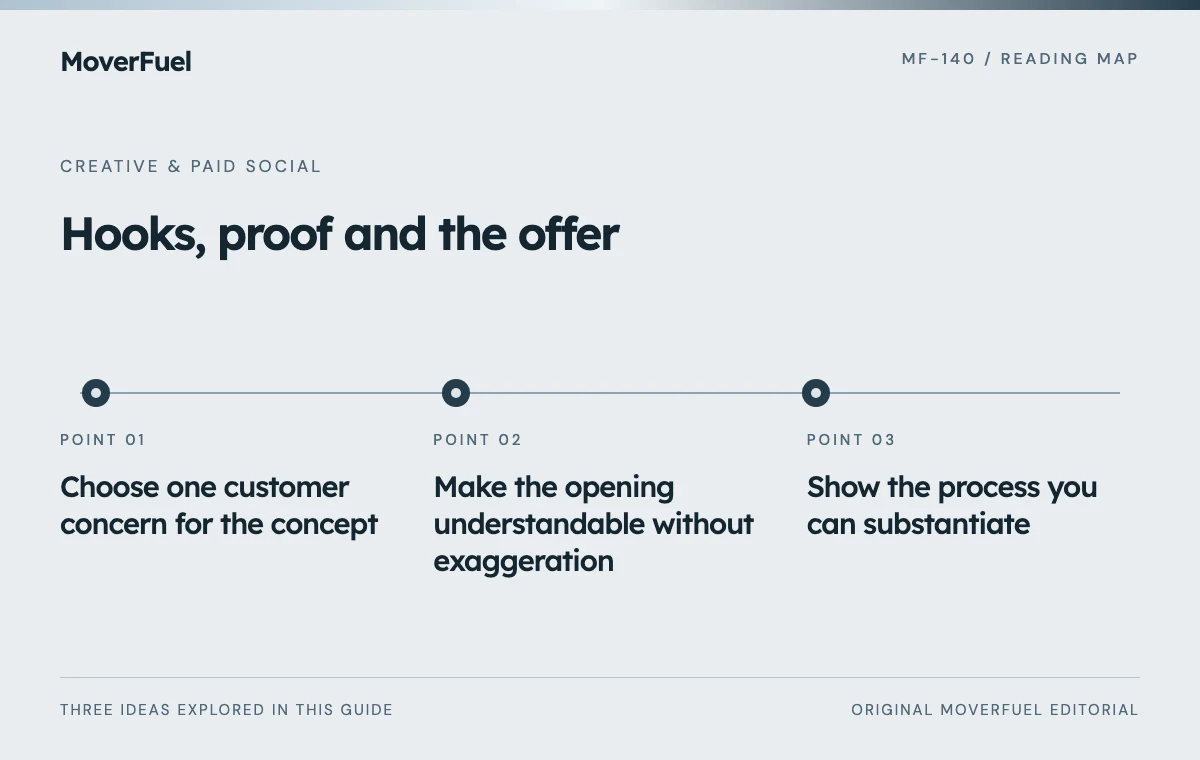
Choose one customer concern for the concept
A local home customer may want to understand access planning and handling. An office coordinator may worry about sequencing and business disruption. Trying to address every moving service in one short ad can make the message difficult to recognize.
Scroll the table horizontally to compare all columns.
| Concern | Opening visual beat | Useful proof | Accurate next step |
|---|---|---|---|
| Apartment access | Show the building access plan being reviewed | Actual preparation and equipment process | Request a scope discussion |
| Fragile-item handling | Show an authorized demonstration of preparation | Real materials and trained handling steps | Discuss the items needing assessment |
| Office coordination | Show a labeled project sequence | Approved planning and handoff process | Arrange a commercial survey conversation |
These are creative concepts, not claims about existing MoverFuel client footage. Use real approved assets or clearly identified demonstrations. Never stage unsafe handling to make the opening more dramatic.
Make the opening understandable without exaggeration
The hook should help the right viewer recognize the situation. An original line such as ‘Moving out of an apartment with a tight elevator window?’ introduces a concrete planning problem. It does not require an invented failure story or an unsupported claim that other movers will mishandle the job.
Let the image and words explain the same thing
If the opening discusses access, show relevant access planning rather than unrelated highway footage. Keep on-screen text readable and brief enough to understand in the actual placement. Check the crop on a phone, not only on a large editing monitor.
Do not prescribe a universal number of seconds as a guarantee of attention or conversion. The opening needs to communicate promptly, but its effectiveness should be tested with the intended audience and offer. A startling image that attracts the wrong viewers can increase engagement without improving lead quality.
Show the process you can substantiate
Use an approved shot of staff preparing equipment, reviewing scope or protecting an item. Explain what is happening in plain language. A viewer should learn something about the service, not merely see a montage of uniforms and trucks.
Advertising claims must be truthful and supported under FTC guidance. Avoid absolute promises such as no damage, guaranteed savings or zero disruption unless the claim is appropriately substantiated and accurately qualified. A testimonial cannot supply evidence the advertiser does not otherwise have. [1]
Verify rights for footage, music, logos and people shown. Obtain appropriate permission for customer property and projects, and remove private documents or identifying details from the frame. A customer's willingness to speak on camera does not automatically settle every asset-rights question.
Close with an offer the intake team recognizes
Name the service and next action: request an estimate review, discuss packing needs or arrange a commercial site assessment. State enough context for the customer to understand what submitting information means. Do not imply that clicking an ad reserves a moving crew.
Scroll the table horizontally to compare all columns.
| Element | Question before release |
|---|---|
| Video promise | Can operations deliver what is described? |
| Landing destination | Does it explain the same service and next step? |
| Form | Does it collect appropriate initial qualification? |
| Intake script | Will staff recognize the advertised offer? |
| Availability or promotion | Is the claim current and authorized? |
Keep the close visible and understandable without crowding the frame. Test the actual platform preview because overlays and interface elements can obscure text. Verify current placement requirements rather than relying on an old template.
Plan accessible versions while writing the script
W3C recommends planning media accessibility from the beginning. Captions should communicate speech and relevant non-speech audio; important visual information may require description, and a useful transcript can support the website version. [2]
Review automatic captions for names, place names and meaning. Ensure text has readable contrast and enough display time. Do not assume a silent viewer can understand a message that exists only in narration, or that a blind viewer can understand an essential visual claim that is never described.
Retain a clean source edit and organized versions for the placements actually used. This makes corrections to an offer or caption practical without rebuilding the whole asset library.
Evaluate the message, not only the view count
Name the hypothesis for each concept and connect it to a business question. Track attention and clicks as diagnostics, then examine qualified inquiries and mature estimates or bookings. A video with fewer views may attract more suitable work than a broadly entertaining clip.
Review customer questions from intake. If viewers repeatedly misunderstand the included services, revise the offer explanation. If the proof is credible but the next action is unclear, test the close. Keep the learning specific enough to guide the next storyboard.
Connect creative and video production with Facebook Ads testing so creative decisions use the quality of the resulting moving inquiries.
Common questions
Do moving video ads need expensive production?
They need a clear concept, usable audio and visuals, accurate proof and appropriate permissions. Production scale should fit the message and test; expensive footage does not establish a stronger offer.
What should a video ad's hook do?
Help the intended customer recognize a relevant moving concern quickly. It should lead naturally into credible evidence and the next step, rather than attract attention unrelated to the service.
Your next step
Build the ad around one concern, evidence the company can stand behind and a clear next step. Accessible delivery and outcome-based testing make the creative useful beyond its view count.
Sources & editorial notes
Platform claims cite the documents below. Operating frameworks and labeled examples are MoverFuel editorial analysis, not client results or industry benchmarks.
- FTC: advertising and marketingFTC guidance requires truthful and substantiated advertising claims. Reviewed .
- W3C WAI: Making Audio and Video Media AccessibleW3C media accessibility guidance covers early planning, captions, visual description and transcripts appropriate to the content. Reviewed .