Customer-created photos, clips and stories can help explain a moving experience, but a public post is not an unrestricted asset library. A useful UGC program makes participation voluntary, confirms rights and context, and records exactly where an approved contribution may be used. Start with that workflow before asking for more content.
 View full-size graphic ↗
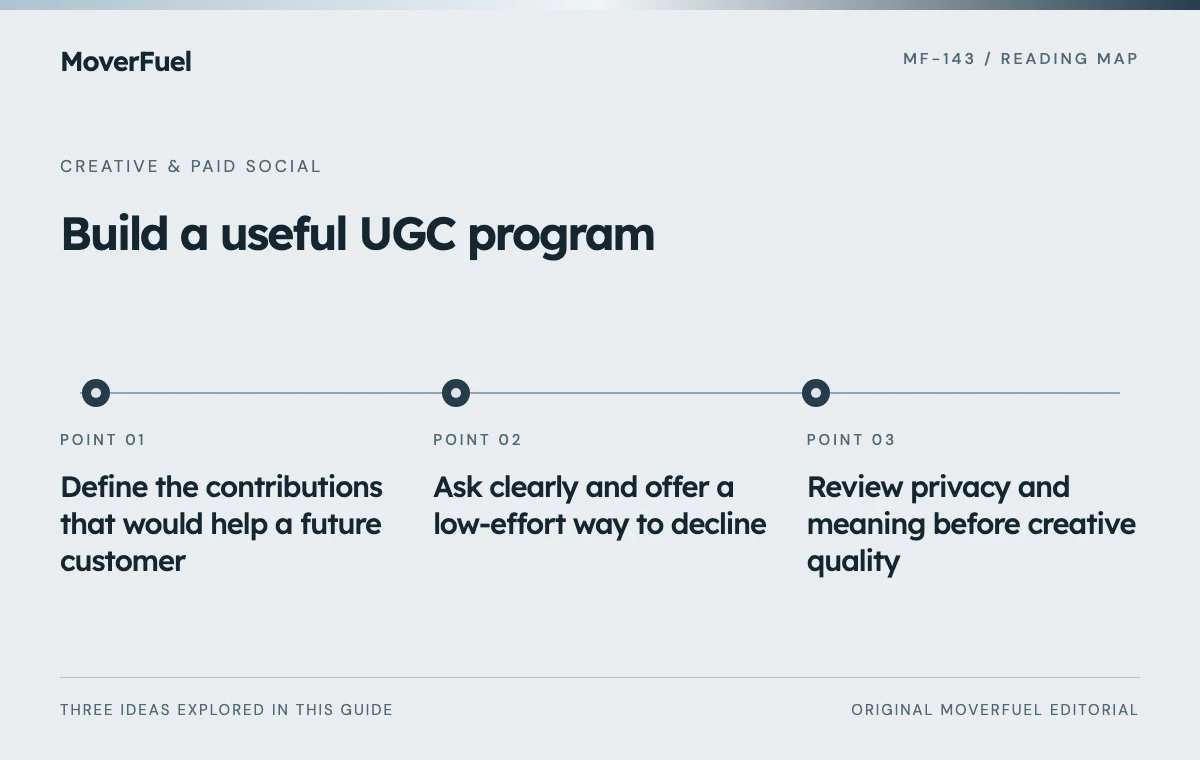
Define the contributions that would help a future customer
Useful contributions might show preparation before a move, an organized packing approach or a customer's explanation of the estimate process. Choose a clear purpose and avoid asking customers to produce a polished advertisement while managing their relocation.
Scroll the table horizontally to compare all columns.
| Content type | Potential value | Review concern |
|---|---|---|
| Preparation photo | Shows a practical planning step | Private documents, addresses or people visible |
| Short experience clip | Explains a customer's own observation | Accuracy, consent and material relationships |
| Written planning tip | Helps another customer prepare | Context and permission to attribute |
| Approved project image | Illustrates a specific service | Ownership and customer/property permission |
Do not make participation a condition of good service, a refund or resolving a complaint. Keep the request separate from public review solicitation. The program should not ask only for praise or imply that customers must describe a positive experience.
Ask clearly and offer a low-effort way to decline
An original request: ‘If you would like to share a photo or short tip from your moving preparation, we can explain how it might be used in our customer resources. Please avoid private documents or other people's information. Sharing is optional; we will confirm permission before publishing.’ Adapt the request to the actual intended channels.
Explain whether the business seeks website use, organic social posting, paid advertising or another use. Do not collect broad rights language merely because it is convenient. Use an appropriate agreement that matches the real program and obtain qualified review where needed.
Confirm who can authorize the contribution
Copyright can protect original photos and video, and ownership or licensing may differ from who appears in the image. The Copyright Office's guidance makes clear that rights can belong to creators or be transferred under applicable arrangements. Ask about the creator and permissions rather than assuming the uploader owns everything. [1]
Review privacy and meaning before creative quality
Inspect visible addresses, labels, screens, access codes, documents and people who have not agreed to appear. Confirm whether the content reveals a customer's schedule or other private context. Reject or appropriately edit material that cannot be used responsibly under the permissions obtained.
Read or watch the full contribution before selecting a short excerpt. Preserve the meaning and the service context. A customer showing their own packing should not become an ad implying the company provided that packing service.
Scroll the table horizontally to compare all columns.
| Check | Release condition |
|---|---|
| Creator rights | Documented permission or applicable license |
| People and property | Relevant approvals and privacy review |
| Factual context | Accurate description of the experience |
| Edit integrity | Meaning remains intact |
| Relationship disclosure | Required connection is clearly disclosed |
| Usage scope | Placement falls within the recorded permission |
FTC endorsement guidance applies when customer content becomes an advertising endorsement. Honest experience and disclosure of unexpected material connections matter; do not treat a gift or payment as irrelevant because the asset looks informal. [2]
Maintain a rights-aware asset register
Assign an asset ID and link the original file, creator, permission record, approved channels, restrictions, edit history and review date. Keep sensitive permission information access-controlled while giving the creative team a clear approved-use status.
Create a process for questions, withdrawal requests and expired permissions. The response depends on the actual agreement and applicable requirements, but the team should at least be able to locate every placement and the responsible owner. An asset that cannot be traced is difficult to manage responsibly.
Keep unapproved submissions out of the shared publishing folder. A filename such as ‘great customer clip’ is not a review status. Use an explicit state that distinguishes received, under review, approved, restricted and retired.
Publish for a defined communication purpose
Use the contribution where it answers a relevant question: a planning guide, service explanation or truthful campaign concept. Add accurate context and attribution according to the permission. Do not imply a broad performance result from one customer's experience.
Evaluate whether the content improves understanding, useful engagement or qualified conversations. Track the effort required to request, review and manage contributions as well as the number received. A smaller set of well-documented assets can be more useful than a large unreviewed collection.
Review the program periodically for privacy problems, pressure in requests and misleading edits. Train staff to explain the purpose consistently. If incentives are considered, have the arrangement and disclosures reviewed, and keep it separate from platform rules that may prohibit incentivized reviews.
Pair this workflow with testimonial video planning and creative production so customer contributions remain accurately represented.
Common questions
Can I repost a customer's public moving photo as an ad?
Do not assume a public post grants advertising rights. Confirm creator rights, relevant permissions, privacy and the intended usage scope before republishing it.
Is a UGC program the same as a review campaign?
No. Customer-content permissions and public-review policies involve different workflows. Keep them separate, especially when considering incentives or editing material for advertising.
Your next step
Build UGC around voluntary contribution and traceable permission. Review context and privacy before design quality, then use approved assets for a specific customer question.
Sources & editorial notes
Platform claims cite the documents below. Operating frameworks and labeled examples are MoverFuel editorial analysis, not client results or industry benchmarks.
- US Copyright Office: What is Copyright?US Copyright Office guidance explains original photo/video protection and ownership or licensing; public availability does not itself define reuse rights. Reviewed .
- FTC: Endorsement Guides questions and answersFTC endorsement guidance addresses honest experience and unexpected material connections in advertising. Reviewed .