
A customer discovers your moving company through a guide, returns through a search advertisement and calls after a recommendation from a friend. Which source gets credit? First-touch and last-touch rules answer that question differently because they describe different parts of the journey. Neither rule can recover interactions that were never observed or prove what caused the decision.
 View full-size graphic ↗
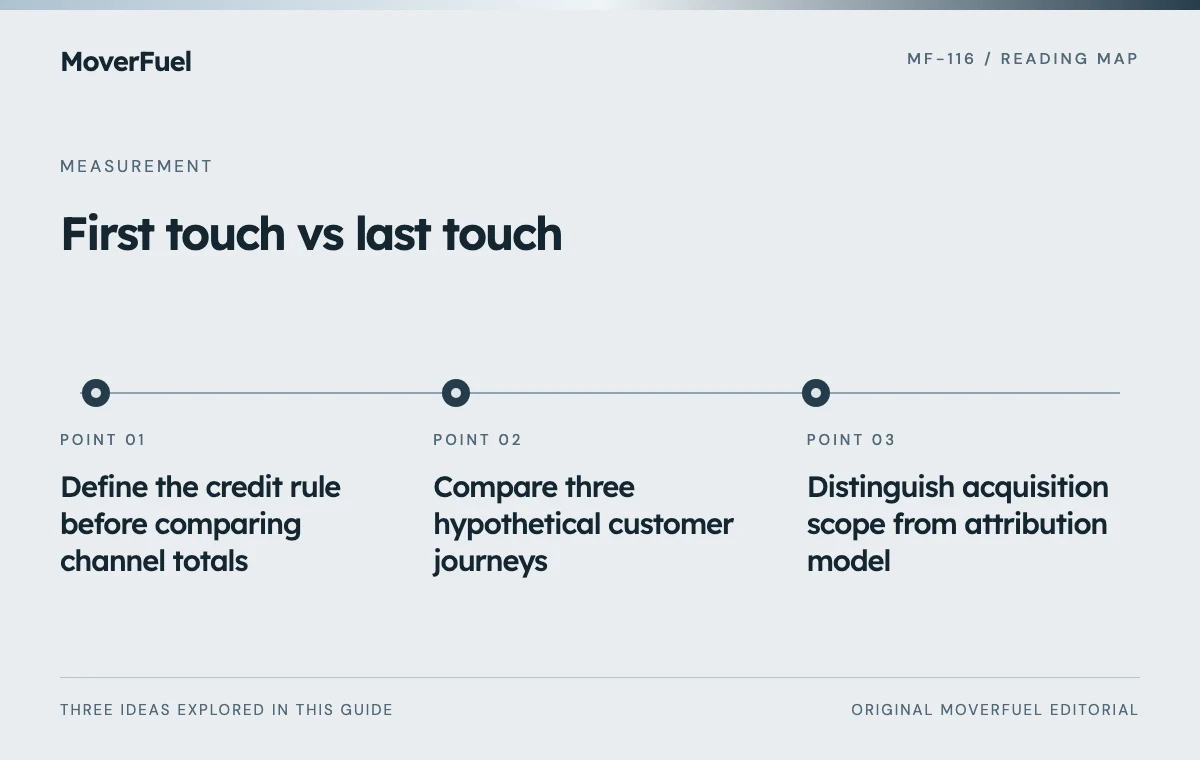
Define the credit rule before comparing channel totals
In a simple first-observed-touch rule, credit goes to the earliest recorded interaction in the defined journey. In a simple last-observed-touch rule, credit goes to the final recorded interaction before the chosen outcome. Specify the outcome, observation window and treatment of direct visits; otherwise the labels are ambiguous.
Google Analytics currently offers specific attribution models rather than a generic menu of every historical model. Its documentation says the first-click model was removed in 2023, and changing the reporting model affects event-scoped dimensions without changing user- or session-scoped dimensions. [1]
Choose one unique moving opportunity as the unit for the examples. If a customer submits a form and later calls about the same move, those contacts belong to one journey rather than two newly acquired jobs.
Compare three hypothetical customer journeys
Scroll the table horizontally to compare all columns.
| Observed journey before inquiry | First-observed credit | Last-observed credit | What remains uncertain |
|---|---|---|---|
| Organic guide → paid search → quote form | Organic search | Paid search | Whether the ad added demand or captured a return visit |
| Partner referral link → direct visit → phone call | Partner | Direct under this simple rule | Whether the referral remained decisive |
| Paid social → organic service page → estimate request | Paid social | Organic search | Unobserved conversations or prior brand awareness |
If each journey produces one booking, first-touch reporting assigns one booking to organic, one to the partner and one to paid social. The simple last-touch rule assigns one to paid search, one to direct and one to organic. The business still has three bookings, not six.
The table intentionally gives direct visits credit under its stated rule. Platform models can treat direct traffic differently, so do not expect these examples to reproduce a particular analytics report. The purpose is to make the rule's effect visible.
Keep the underlying outcomes fixed
When comparing models, use the same opportunities and outcome dates. If one view includes canceled jobs or a different date range, the discrepancy is not solely an attribution difference. Reconcile the population before debating which rule is more useful.
Distinguish acquisition scope from attribution model
GA4 organizes traffic-source information at user, session and event scopes. First-user information describes acquisition of the user; session information describes a session; event-scoped credit answers a different question. A first-user source total should not be treated as a renamed last-click report. [2]
Scroll the table horizontally to compare all columns.
| Question | Useful perspective |
|---|---|
| How did the observed user first arrive? | User acquisition scope |
| What brought this visit? | Session acquisition scope |
| How is this key event credited? | Event attribution settings and model |
| How did this moving opportunity progress? | Reconciled CRM journey |
| What would happen without the marketing? | A suitable causal evaluation |
Record the report name, dimension scope, model, lookback settings and time basis when sharing numbers. Two correct reports can disagree because they answer different questions. Clear labels often resolve an argument that otherwise looks like broken tracking.
Preserve uncertainty in the observed journey
A customer may change devices, decline tracking, call from a saved number or hear about the company offline. The first recorded interaction may not be the actual first encounter. The last recorded interaction may not be the final influence before booking.
Keep customer-reported discovery as a separate field rather than overwriting captured source data. ‘A friend recommended you’ can add useful context even when the measured visit came from search. Neither field should automatically erase the other.
Do not force unknown traffic into a preferred channel. Document identity and matching limits, especially when joining calls and forms. A smaller set of confidently reconciled journeys can be more useful than a complete-looking table built on speculative matches.
Use different views to ask better allocation questions
First-touch views can help reveal discovery paths; last-touch views can show where customers return to act. Use both as diagnostic perspectives, then inspect qualified outcomes and economics. Do not fund or cut a channel solely because one credit rule favors it.
Use the report reconciliation workbook to separate attribution differences from duplicates, missing records and date mismatches.
When a budget decision requires knowing incremental impact, plan an appropriate experiment or other defensible causal analysis. Attribution remains a model of credit over observed data. Its value comes from transparent assumptions and useful questions, not from pretending it is a complete history of persuasion.
Common questions
Which model is always correct for movers?
No single credit rule answers every question. Use a clearly defined model for the decision, reconcile the same outcome population and acknowledge missing interactions.
Is GA4 First user source a first-click attribution setting?
No. It is a user-scoped acquisition dimension. Google's current reporting attribution settings are a separate concept.
Your next step
Attribution changes who receives credit, not how many real jobs occurred. Compare models on the same reconciled opportunities and keep scope, direct-traffic treatment and uncertainty explicit.
Sources & editorial notes
Platform claims cite the documents below. Operating frameworks and labeled examples are MoverFuel editorial analysis, not client results or industry benchmarks.
- Google Analytics: attribution settingsCurrent event-scoped attribution settings, unaffected user/session scopes and removal of the first-click model. Reviewed .
- Google Analytics: scopes of traffic-source dimensionsUser, session and event traffic-source scopes. Three customer journeys are original hypothetical examples. Reviewed .