
A real estate professional who recommends a mover is putting a client relationship at stake. A useful partnership therefore begins with service fit and a dependable handoff, not a promise to exchange as many leads as possible. Make it easy for the customer to choose freely and for both businesses to understand what happens next.
 View full-size graphic ↗
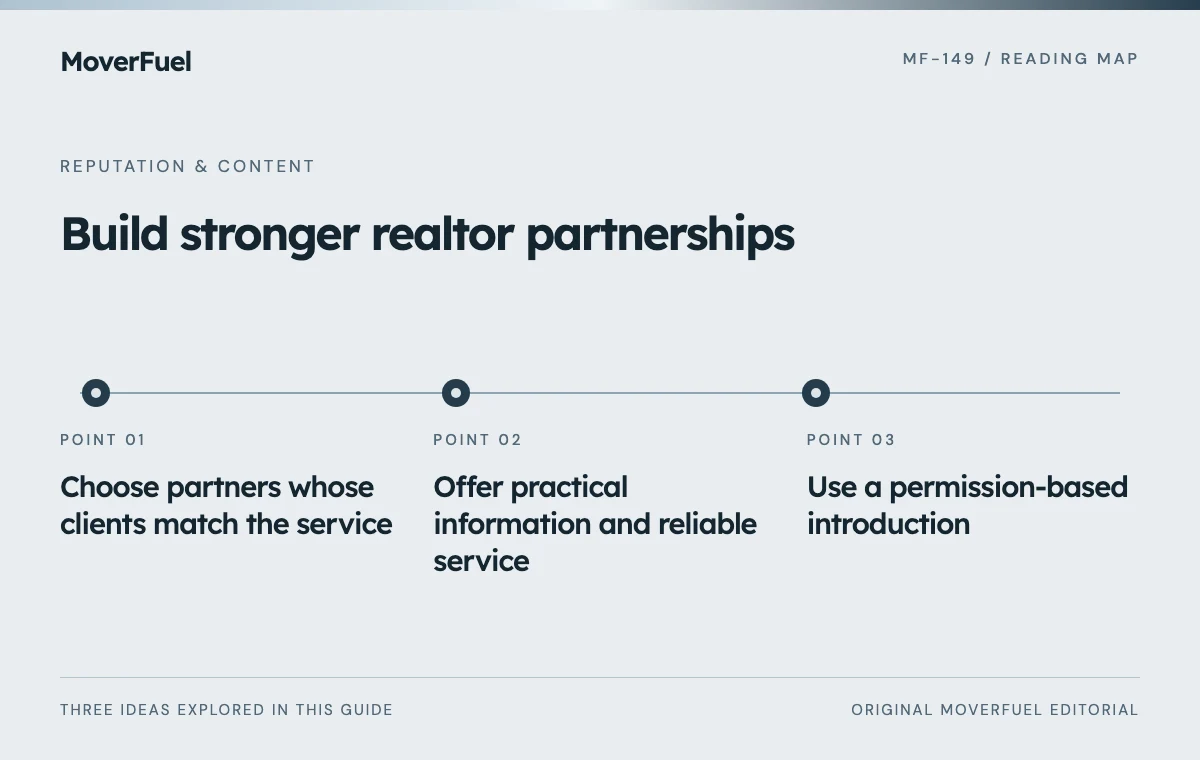
Choose partners whose clients match the service
Scroll the table horizontally to compare all columns.
| Question | What to establish |
|---|---|
| Where do clients move? | Origin and destination fit with actual service areas |
| What work do they need? | Local, long-distance, packing or storage relevance |
| What constraints recur? | Closing uncertainty, access or scheduling needs |
| How are vendors recommended? | Brokerage policy and customer choice |
| Who handles introductions? | Named contact and permitted information flow |
| What could harm the relationship? | Unreliable response, overpromising or privacy failures |
A high-volume agent is not automatically a suitable partner if the client's moves do not fit the company's coverage or capacity. Discuss the actual work and be clear about exclusions. Declining a poor-fit introduction promptly can protect the relationship better than accepting a job the team cannot serve well.
Start with a small number of relationships that can be maintained. A shared operating standard is more useful than a large contact list with no agreed handoff.
Offer practical information and reliable service
Provide an accurate service overview, estimate process and customer preparation checklist. Explain how the business handles uncertain dates and scope changes without making commitments outside its authority. The partner should know whom to contact for a question or service issue.
Write a short operating agreement
Define the introduction method, response expectation, service boundaries and escalation contact. Keep the customer free to select another provider. Do not ask a partner to present the mover as independently vetted beyond what they have actually checked.
Use only approved, truthful evidence about the business. Avoid claiming exclusive status, official affiliation or guaranteed availability unless those statements are real and accurately explained. A relationship should not depend on the partner repeating unsupported marketing claims.
Use a permission-based introduction
Scroll the table horizontally to compare all columns.
| Step | Action |
|---|---|
| Customer expresses a need | Partner explains that a mover can be introduced |
| Customer chooses to proceed | Confirm the preferred introduction method |
| Minimal information shared | Provide only the details needed for initial contact |
| Mover acknowledges ownership | Assign a representative and next step |
| Outcome recorded | Track fit and progress without oversharing private details |
| Service concern arises | Use the agreed escalation contact |
An original introduction pattern is: ‘With your permission, I can connect you with a moving company that serves this area so you can discuss your options. You are free to use any provider.’ The mover then confirms the customer's request rather than treating the referral as a completed booking.
Do not circulate a client's contact details among multiple businesses without an appropriate basis and permission process. Keep any status updates to the partner within what the customer has agreed can be shared. A referral source does not need unrestricted access to the customer's quote or private move details.
Review compensation and disclosure before offering incentives
The CFPB's RESPA guidance describes restrictions on certain referral payments involving covered settlement-service circumstances. Whether a particular arrangement falls within those rules is fact-specific. This does not establish that every moving referral is either covered or exempt. [1]
Before offering fees, gifts, discounts tied to referrals or promotional exchanges, obtain appropriate review of the actual arrangement, applicable state requirements and brokerage policies. Do not assume that calling a payment ‘marketing’ or a ‘thank-you’ determines its legal treatment.
FTC endorsement guidance also addresses unexpected material connections that may affect how a recommendation is evaluated. Any required disclosure should be clear in the actual recommendation context; a hidden partnership page may not resolve the issue. [2]
Track the relationship without inflating referral value
Use a referral-source field and a stable inquiry record. Distinguish a new introduction from a customer already in the pipeline. If several people recommended the mover, record the evidence without turning one job into multiple acquired customers.
Review service fit, response reliability, completed estimates, mature bookings, contribution and complaints. Keep any program costs in the defined acquisition scope. A relationship that sends many unsuitable inquiries may require a clearer service overview rather than more frequent outreach.
Hold a periodic operating review with the partner using appropriately limited information. Discuss recurring handoff issues and how to improve the customer's experience. Do not promise a fixed number of reciprocal recommendations or organize undisclosed praise to create artificial consensus.
Connect the handoff to lead tracking and the local moving solution so the partnership reflects real service coverage and measurable outcomes.
Common questions
Can a mover pay real estate agents for referrals?
Do not assume a universal answer. Review the specific arrangement, applicable laws, brokerage rules and disclosure requirements before offering compensation or other benefits.
What should a partner receive after an introduction?
Only the status information appropriate under the customer's permissions and the agreed process. The partner does not automatically need private estimate, payment or move details.
Your next step
Build referral relationships around fit, customer choice and reliable execution. Clear handoffs and reviewed terms protect the relationship better than informal promises of rewards or guaranteed business.
Sources & editorial notes
Platform claims cite the documents below. Operating frameworks and labeled examples are MoverFuel editorial analysis, not client results or industry benchmarks.
- CFPB: RESPA Section 8 FAQsCFPB Section 8 FAQ describes fact-specific covered settlement-service referral restrictions; it does not resolve every moving referral arrangement. Reviewed .
- FTC: Endorsement Guides questions and answersFTC guidance addresses disclosure of unexpected material connections in recommendations. Reviewed .