
A good moving intake script helps a caller explain the job and helps the team decide what should happen next. It should sound like a conversation, not a questionnaire read at speed. Start with the route and timing, branch into the relevant service questions, then summarize what has actually been agreed.
 View full-size graphic ↗
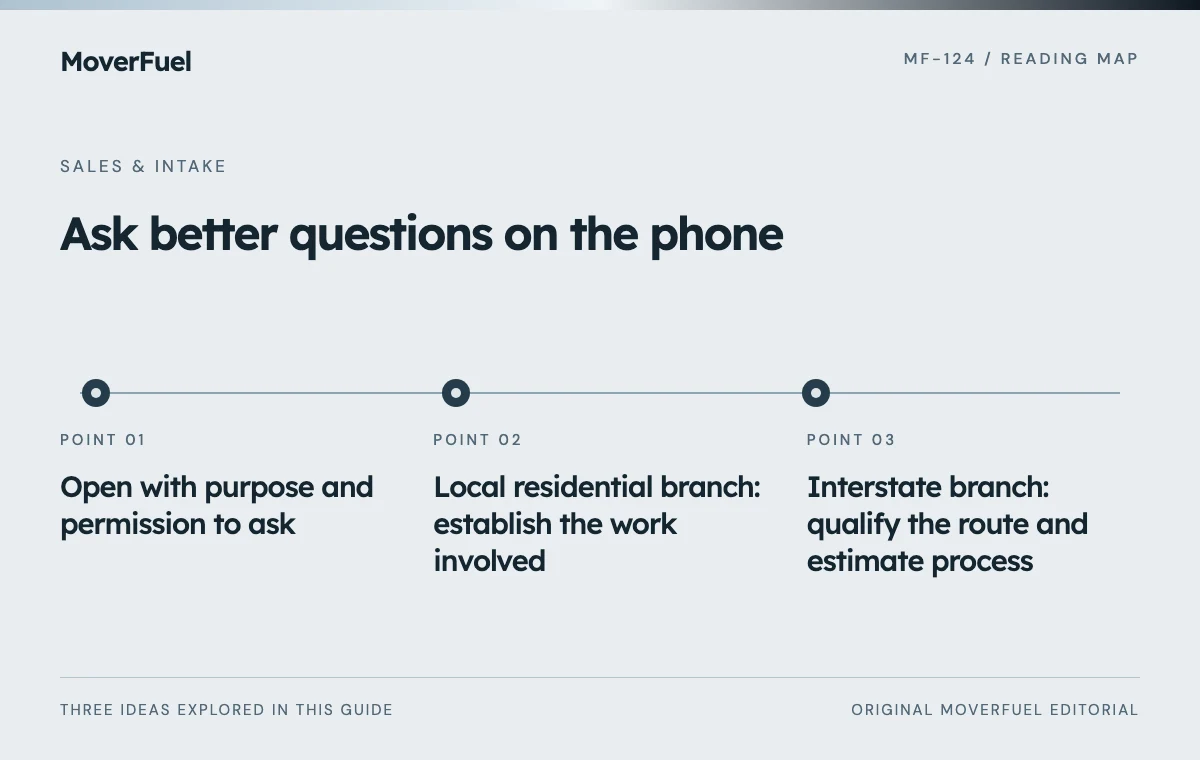
Open with purpose and permission to ask
An original opening to adapt: ‘Thanks for calling. I can help work out the right next step for your move. Where are you moving from and to, and do you have a date in mind?’ Let the caller finish before asking for more detail. A customer calling about an existing job needs a service handoff, not a fresh sales script.
Confirm whether the caller wants a new estimate, a change to an existing quote or help with a booked move. Search for an existing inquiry before creating another record. Explain why you need additional details rather than asking for information that has already been supplied.
Scroll the table horizontally to compare all columns.
| Caller situation | Helpful response |
|---|---|
| New local move | Confirm route and date before inventory |
| Existing quote | Find the quote and ask what changed |
| Booked-job issue | Route to the responsible operating team |
| Outside service area | Explain the verified limitation promptly |
| Unsure of date | Record the window and flexibility |
Collect only information needed for the task and restrict access to customer records. FTC business guidance recommends understanding the data held, keeping only what is needed and protecting it. Do not put sensitive access instructions in an unrestricted marketing note. [1]
Local residential branch: establish the work involved
Try: ‘What size home are you moving from, and are there any stairs, elevator bookings or parking restrictions at either address?’ Follow with: ‘Will you need packing, storage or help with any items that require special handling?’ These questions identify operational requirements rather than attempting to price the whole job from bedroom count alone.
Reflect the scope back before discussing the next step
Example: ‘I have a two-bedroom apartment, an elevator reservation at pickup and a destination with one flight of stairs. You would like packing included. Have I missed anything that could affect access or the inventory?’ Record uncertainties explicitly when the customer cannot answer.
If your company uses an inventory review or survey before quoting, explain that process and offer the actual available options. Never describe a rough conversation as a confirmed estimate if the business has not completed its required assessment. Do not promise availability before checking the authorized schedule.
Interstate branch: qualify the route and estimate process
For a move crossing state lines, ask: ‘Which origin and destination cities are involved, and how flexible are the pickup and delivery requirements?’ Then establish inventory, access, storage needs and any dates that are constraints rather than preferences.
FMCSA's interstate household-goods consumer guidance distinguishes a written estimate from a rate quote and describes inspection-based estimation. Use the company's applicable estimate process; a phone intake script does not replace it. Intrastate requirements need separate verification. [2]
A useful transition is: ‘These details help us confirm whether the route fits our service. The next step is the appropriate inventory review and written estimate. I will explain what information is still needed and who will follow up.’ This avoids turning preliminary qualification into a price or delivery commitment.
Commercial branch: find the decision and site requirements
Scroll the table horizontally to compare all columns.
| Need to establish | Natural question |
|---|---|
| Project contact | Who is coordinating the move and approving the plan? |
| Scope | Which teams, furniture or equipment are relocating? |
| Operating constraints | Are there hours when the building or business cannot be disrupted? |
| Site access | Who can confirm loading access and building requirements? |
| Decision process | Is there a survey, proposal deadline or procurement process we should plan around? |
Do not force a commercial relocation into a residential room-count script. A site walkthrough, staged work or coordination with another contractor may be necessary. Record the next responsible contact and the information the estimator needs before the survey.
Ask only relevant procurement questions. A small office move may have one decision-maker, while a larger project may involve facilities and finance. The purpose is to arrange the right conversation, not make every inquiry complete an enterprise qualification form.
Close with a specific handoff and a record
Finish by summarizing route, date window, service scope, unresolved details and the next action. An example: ‘Our estimator will review the inventory with you tomorrow in the agreed window. That review will cover packing and access. The move is not reserved yet; we will explain the booking requirements with the estimate.’ Use only a window the team can honor.
The intake record should show the customer's preferred contact method, the owner, the promised next step and any material uncertainty. Review a consent-appropriate sample of conversations for missing scope or inaccurate promises. Coach the behavior, rather than rewarding calls that end quickly with incomplete information.
Use the same criteria across qualified moving lead assessment and your lead tracking workflow so marketing and intake describe the same opportunity.
Common questions
Should every caller answer every question?
No. Use a short common opening, then ask only the questions relevant to the service and next step. Existing customers and booked-job issues need a different route from new sales inquiries.
Can intake staff give a price immediately?
Only within the company's verified authority and applicable estimate process. Explain preliminary information honestly, gather missing scope and escalate when a written estimate or survey is required.
Your next step
The script succeeds when the customer understands the next step and the estimator receives an accurate, usable scope. Keep local, interstate and commercial branches distinct while maintaining one clear handoff standard.
Sources & editorial notes
Platform claims cite the documents below. Operating frameworks and labeled examples are MoverFuel editorial analysis, not client results or industry benchmarks.
- FTC: protecting personal informationFTC guidance supports data minimization, inventory and protection of retained customer information. Reviewed .
- FMCSA: avoiding unexpected moving costsFMCSA interstate household-goods guidance distinguishes written estimates and rate quotes and explains inspection-based estimation. Reviewed .