
A customer referral program should make a genuine recommendation easy to pass along without turning a friend's contact details into an unsolicited sales list. Define who can participate, what counts as a referral and how any reward is earned. Then build a tracking process that respects customer choice and prevents duplicate credit.
 View full-size graphic ↗
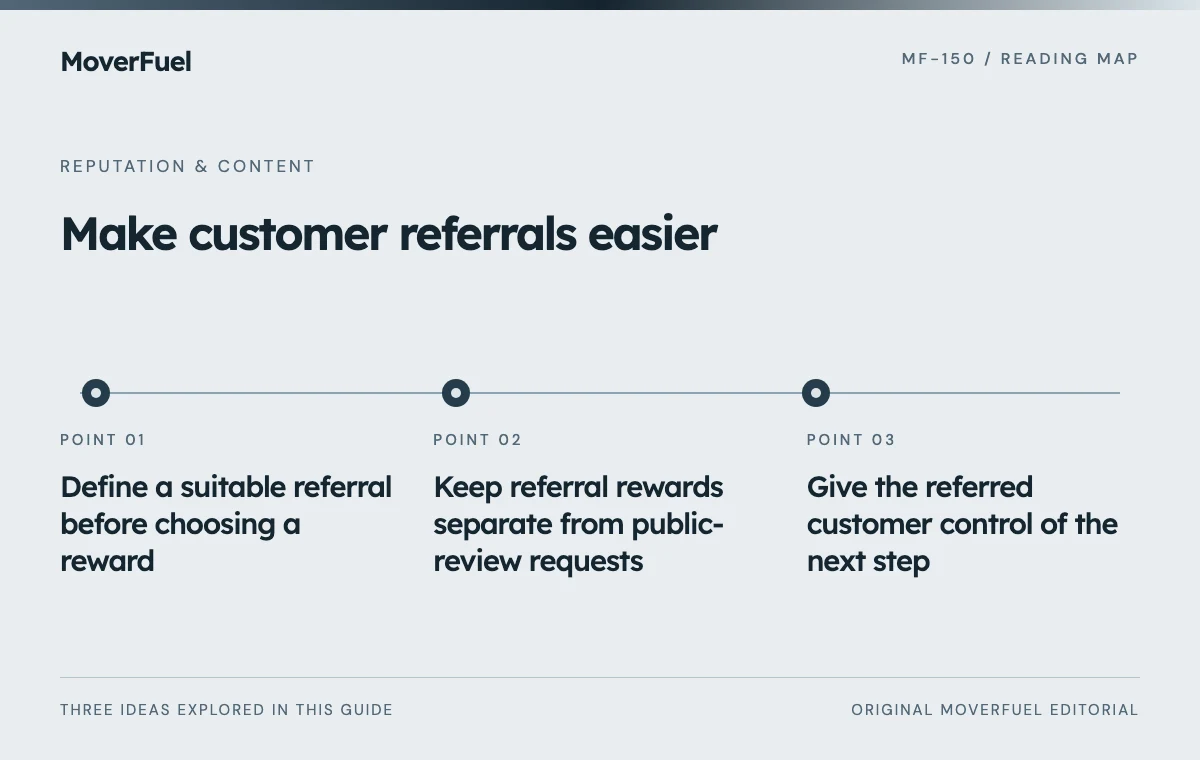
Define a suitable referral before choosing a reward
A referral can begin when someone chooses to contact the moving company after a recommendation. It should not require a past customer to upload an entire address book or submit another person's private details without an appropriate basis. A shareable service page or clear introduction process may be sufficient.
Scroll the table horizontally to compare all columns.
| Decision | What the terms should explain |
|---|---|
| Eligible participant | Who may refer and any exclusions |
| Suitable inquiry | Service-area and service-fit requirements |
| New versus existing | How existing opportunities and repeat records are handled |
| Qualifying event | Inquiry, booking or completion under the chosen terms |
| Reward, if any | Amount or benefit, conditions and timing |
| Cancellation or correction | What happens if the qualifying event changes |
| Questions and disputes | Named support path and review process |
Keep the program understandable before adding tiers or elaborate incentives. A complicated rule may create more administrative work than acquisition value, especially when several people recommend the same mover to one household.
Keep referral rewards separate from public-review requests
Google Maps policy prohibits review incentives. Do not make a referral benefit conditional on a public review, a positive rating or prescribed praise. A customer-referral program and a public-review workflow need separate rules and messages. [1]
If a recommendation carries an unexpected material benefit, FTC endorsement guidance may require clear disclosure of the connection. Review how the actual program is presented rather than assuming a reward is irrelevant because it is small or provided after the referral. [2]
Have the proposed benefit reviewed before launch
Confirm applicable legal, tax, consumer-promotion and platform requirements for the actual arrangement. Do not publish a universal reward recommendation or copy a competitor's incentive terms. The appropriate program depends on the business, participants and jurisdictions involved.
Give the referred customer control of the next step
An original sharing message might say: ‘If someone you know is planning a move in our service area, you can share this page so they can decide whether to request an estimate.’ If a reward exists, include the appropriate clear explanation and disclosure rather than hiding it in unrelated terms.
When an introduction is requested, confirm how the new customer wants to be contacted and collect only the details needed for the initial discussion. Do not pressure the referrer to disclose a friend's schedule, address or financial circumstances.
Scroll the table horizontally to compare all columns.
| Stage | Customer-centered action |
|---|---|
| Recommendation shared | Recipient can choose whether to engage |
| Inquiry received | Explain the service and estimate next step |
| Source recorded | Ask neutrally about the recommendation |
| Fit confirmed | Use the normal qualification process |
| Qualifying event verified | Apply the published program terms |
| Reward or update issued | Provide accurate status with appropriate privacy |
Keep the referrer informed only to the extent permitted and needed. They do not automatically need to know the quote value, move details or reason the customer did not book.
Resolve duplicates and ambiguous credit consistently
Use a referral identifier or source field connected to the inquiry and job. Record when the referral was received and whether the customer was already active. If multiple people claim credit, apply the published rule rather than making a different decision each time.
Test a repeat submission, a cancelled job, a changed move date and a referral that does not fit the service area. Keep a review queue for ambiguous cases. Do not issue rewards from an unverified form submission simply because the automation can do so.
Retain a record of the qualifying event and any reward status with appropriate access controls. Define who can approve exceptions and how a customer can ask for a correction. Clear records help prevent disputes without turning the program into an invasive monitoring system.
Use lead tracking and automation to connect the event and outcome while preserving the business's actual rules.
Evaluate completed work and the customer experience
Report unique eligible referrals, qualified inquiries, estimates, bookings and completed jobs. Include rewards and administration in the defined program cost. Compare contribution after those costs, not only the gross value of referred work.
A fictional example: a program costs $600 in verified rewards and $200 in administration and produces four completed referred jobs. Its defined program cost is $200 per completed job. That figure does not include every business cost or prove all four jobs were incremental; it describes the stated scope.
Review whether participants understand the terms and whether the process creates unwanted contact or disputes. Simplify confusing rules and correct misleading messages. A sustainable program supports genuine recommendations and a useful customer journey rather than maximizing reward claims.
For business-to-business relationships, use the separate realtor referral partnership guide. Keep those arrangements distinct from consumer referral terms.
Common questions
Should a moving referral reward depend on a positive review?
No. Keep referral qualification separate from public reviews. Google prohibits review incentives, and recommendations with material benefits may require appropriate disclosure.
How should an existing lead referred by a customer be handled?
Apply a clear published rule for existing opportunities and record the evidence. Do not count one inquiry twice or improvise reward eligibility differently for each participant.
Your next step
A good referral program has simple terms, voluntary introductions and verifiable outcomes. Keep rewards separate from reviews and measure the program's actual costs and completed work.
Sources & editorial notes
Platform claims cite the documents below. Operating frameworks and labeled examples are MoverFuel editorial analysis, not client results or industry benchmarks.
- Google Maps: prohibited and restricted contentGoogle Maps policy prohibits incentivized reviews; referral rewards must not be conditioned on public reviews. Reviewed .
- FTC: Endorsement Guides questions and answersFTC guidance addresses unexpected material connections in endorsements; the specific arrangement determines disclosure requirements. Reviewed .