
Structured data should make a page’s facts explicit. It should not create a second, more impressive business story hidden in code. For a moving company, the useful starting point is a small set of accurate entities and page types maintained alongside the visible website.
 View full-size graphic ↗
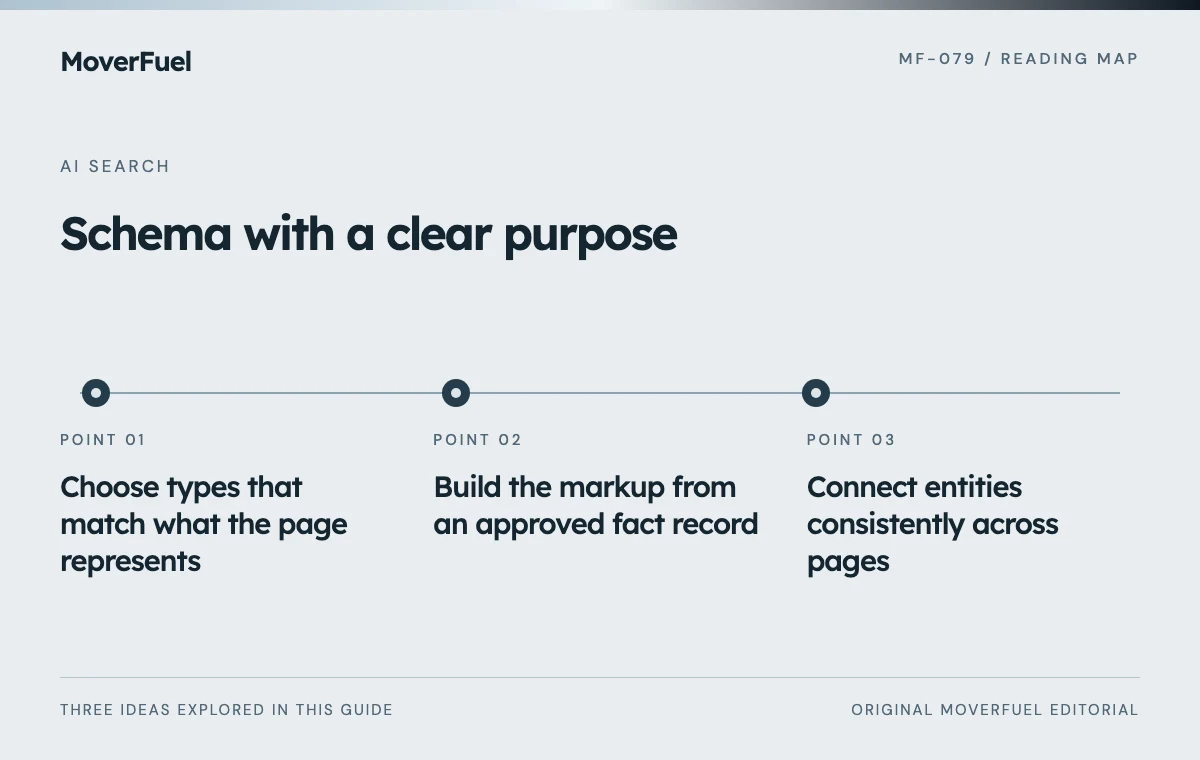
Choose types that match what the page represents
Separate the company, the service being described and the editorial article explaining a topic. They are related, but they are not interchangeable. A service page can refer to its provider without pretending to be a customer review or a news story.
Scroll the table horizontally to compare all columns.
| Page or entity | Type to evaluate | Facts to verify |
|---|---|---|
| Actual moving business | MovingCompany or an appropriate business type | Name, public identity and real operating details |
| Organization identity | Organization | Official URL, logo and relevant identity properties |
| Defined moving service | Service | Provider, scope and truthful service area |
| Editorial resource | Article | Headline, author attribution and genuine dates |
| Page hierarchy | BreadcrumbList | Actual navigable page relationships |
Schema.org defines MovingCompany as a LocalBusiness subtype for a moving company. That does not make it appropriate for an agency merely because the agency serves movers. Select the entity the page actually describes. [1]
A valid Schema.org type is not automatically a Google rich-result feature. Check the current feature documentation for any search appearance you intend to pursue, rather than assuming every property produces a visible enhancement.
Build the markup from an approved fact record
Use verified names, URLs and business relationships. Leave unsupported optional properties out. Do not invent opening hours, addresses, review totals, prices or author biographies because a template contains those fields.
Google’s structured-data policies require relevant, truthful information that corresponds to visible page content. They also make clear that correct markup does not guarantee a rich result. [2]
Treat ratings and claims as evidence-dependent
A review displayed on a page needs a real source and appropriate permission or rights. A star value inserted only into markup is not evidence. Before using review-related properties, check the applicable feature policies and whether the entity and page qualify; syntax alone cannot establish that.
Create the underlying business identity record before wiring its fields into a schema generator.
Connect entities consistently across pages
Choose stable identifiers for the organization and genuine branches so different pages can refer to the same entity. Keep those identifiers aligned with the intended canonical domain. A staging hostname should not become a permanent identity reference by accident.
A branch page should describe the branch it represents, while a general service page may refer to the wider organization. Document the relationship instead of copying the headquarters address onto every city page. Public coverage and physical locations remain different facts.
Scroll the table horizontally to compare all columns.
| Check | Failure it catches |
|---|---|
| Provider identity | Service points to an unrelated or obsolete business node |
| Author and publisher | Article credits an invented person or wrong organization |
| Canonical destination | Markup uses a preview or retired domain |
| Branch association | Every location silently inherits headquarters facts |
| Breadcrumb URLs | Structured hierarchy links to pages that do not exist |
Validate syntax, meaning and rendered output
First confirm that the JSON parses. Then check types and properties using an appropriate schema validator. For supported Google features, use the relevant rich-result testing tools. Finally, compare the rendered page with the markup and inspect the actual URLs and facts.
Test several page templates, including pages without optional images or reviews. Check draft and unpublished content separately so it does not accidentally appear in public schema or sitemaps. A reusable component should handle missing optional evidence cleanly.
Update schema when the underlying content changes
Assign the same fact owner to visible content and structured data. When a branch moves, an article is substantively revised or a service changes, update both representations. Avoid independent plugins generating conflicting versions of the same organization.
Add deployment checks for canonical domains, required fields and duplicate identifiers. Keep a record of which generator owns each schema type so future developers can change it without leaving a second stale copy behind.
Measure the implementation as an accuracy and eligibility improvement. Search appearance, traffic and qualified inquiries can be observed separately, but a markup installation should not be sold as guaranteed rankings or assistant recommendations.
Common questions
Does adding Service schema create a special Google result?
Not automatically. Schema vocabulary and supported search features are different things. Check the current Google feature guidance for the appearance you are targeting.
Should missing optional fields be filled with example data?
No. Omit unsupported optional values and document what evidence is needed. Example addresses, ratings and authors must not reach production markup.
Your next step
Use a small, accurate schema model connected to real pages and verified facts. Validate meaning as carefully as syntax, and maintain markup whenever the business or content changes.
Sources & editorial notes
Platform claims cite the documents below. Operating frameworks and labeled examples are MoverFuel editorial analysis, not client results or industry benchmarks.
- Schema.org: MovingCompanyMovingCompany type hierarchy and meaning. Reviewed .
- Google: general structured data guidelinesTruthful visible content, feature-specific requirements and no guaranteed rich results. Planning and validation workflow are original recommendations. Reviewed .