
A website may use one trading name, an industry listing another and a location page a third. Sometimes those differences are legitimate; sometimes they make it unclear which company a customer is hiring. Entity clarity means explaining the relationships and facts well enough that readers and systems can distinguish the business from similarly named organizations.
 View full-size graphic ↗
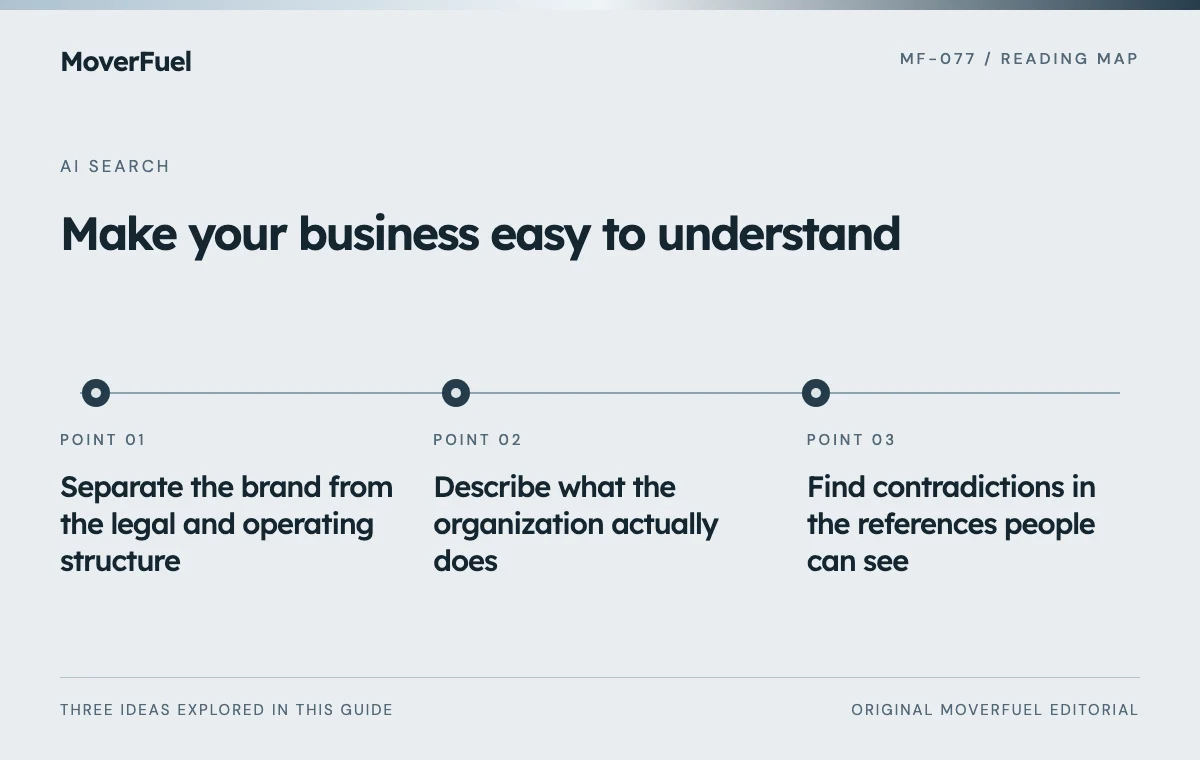
Separate the brand from the legal and operating structure
Create an internal identity record before editing public pages. Include the customer-facing brand, relevant legal entity, real operating units, owned domains and authorized profiles. Record how each relationship is supported and which details should be public.
Scroll the table horizontally to compare all columns.
| Element | Question to resolve | Evidence owner |
|---|---|---|
| Trading brand | What name do customers encounter? | Business owner or brand lead |
| Legal entity | Who contracts for the service? | Responsible business adviser |
| Operating branch | Where and how is the service delivered? | Operations manager |
| Website and profiles | Which destinations represent the business? | Account administrator |
| Affiliations and credentials | What is current and verifiable? | Authorized record owner |
Do not publish private registration details merely to fill a content field. Decide which facts help a customer identify the company and which belong in the appropriate contractual or regulatory context. Accuracy includes explaining legitimate differences, not forcing every record into one label.
Describe what the organization actually does
A moving carrier, a broker, a storage operator and an agency serving movers have different roles. State the company’s role clearly in its primary description and service pages. MoverFuel, for example, is a marketing agency for moving companies; it should not describe itself as the provider performing household moves.
Explain relationships instead of implying ownership
If storage or specialist work is provided through another business, explain the arrangement accurately. Do not imply that partner equipment, facilities or credentials belong to your company. Similarly, an acquired brand may need a clear relationship statement rather than an abrupt name replacement that confuses returning customers.
Use concrete language about services and coverage. ‘Serving customers in a city’ is different from ‘our office in that city.’ Readers should be able to understand the operating relationship without interpreting vague claims about a nationwide presence.
Find contradictions in the references people can see
Review the homepage, About page, contact details, branch pages and important third-party listings. Search former names and domains to identify obsolete references. Classify each mismatch as an error, a legitimate variation or an unresolved relationship.
Scroll the table horizontally to compare all columns.
| Observation | Investigation | Possible correction |
|---|---|---|
| Old brand on a directory | Was it a rebrand or a separate business? | Update the record with the real relationship |
| Two websites claim the same branch | Who currently operates it? | Clarify ownership and contact destination |
| Credential belongs to another entity | Is the affiliation accurately described? | Correct attribution or remove the claim |
| Photo implies a facility at every branch | Where was it taken? | Add accurate context and branch-specific evidence |
For phone and address repairs, use the more focused citation and NAP maintenance process. Entity review additionally examines what the business is and how its parts relate.
Use structured data to describe verified facts
Google says Organization structured data can help it understand administrative details and distinguish organizations in search. Include properties that apply to the real business; structured data is an explanation of facts, not a place to invent missing credentials or locations. [1]
Maintain stable identifiers for the organization and its real branches. Connect pages to the appropriate entity, and use official profile links only when they identify that same business. A similarly named company or an industry article about the category is not an equivalent identity reference.
Give business changes an update owner
Rebrands, acquisitions, relocations and branch closures need a coordinated information plan. Identify the records affected, the people who control them and the sequence of updates. Preserve a history so future teams can understand why an old name still appears in a legitimate source.
Measure progress through resolved contradictions and tested customer paths. Do not claim that a completed identity spreadsheet guarantees a knowledge panel or an AI recommendation. It improves the reliability of the information available to those systems and to customers.
Review new claims before publication. An award, partnership, review or project image should have an evidence owner and permission where required. This prevents a content team from gradually turning a clear company identity into an unsupported collection of trust badges.
Common questions
Is entity clarity the same as identical business listings?
No. Listing consistency is one part. Entity clarity also explains legal and trading relationships, services, branch ownership and attribution of evidence.
Does Organization schema guarantee an AI mention?
No. It can describe the business in a structured format, but it does not require a search system or assistant to display or recommend it.
Your next step
Maintain an evidence-backed identity record and use it across public copy, profiles and markup. Explain legitimate relationships instead of hiding differences or inventing uniformity.
Sources & editorial notes
Platform claims cite the documents below. Operating frameworks and labeled examples are MoverFuel editorial analysis, not client results or industry benchmarks.
- Google: Organization structured dataOrganization structured data can help business disambiguation; use relevant properties. Identity record and governance process are original guidance. Reviewed .