
‘Can you move us?’ often hides several questions: Is the pickup area covered? Can the crew handle the building access? Is packing included? Can the timing work? A useful moving-company page resolves those uncertainties in the order a customer needs them, with enough detail to support an informed estimate request.
 View full-size graphic ↗
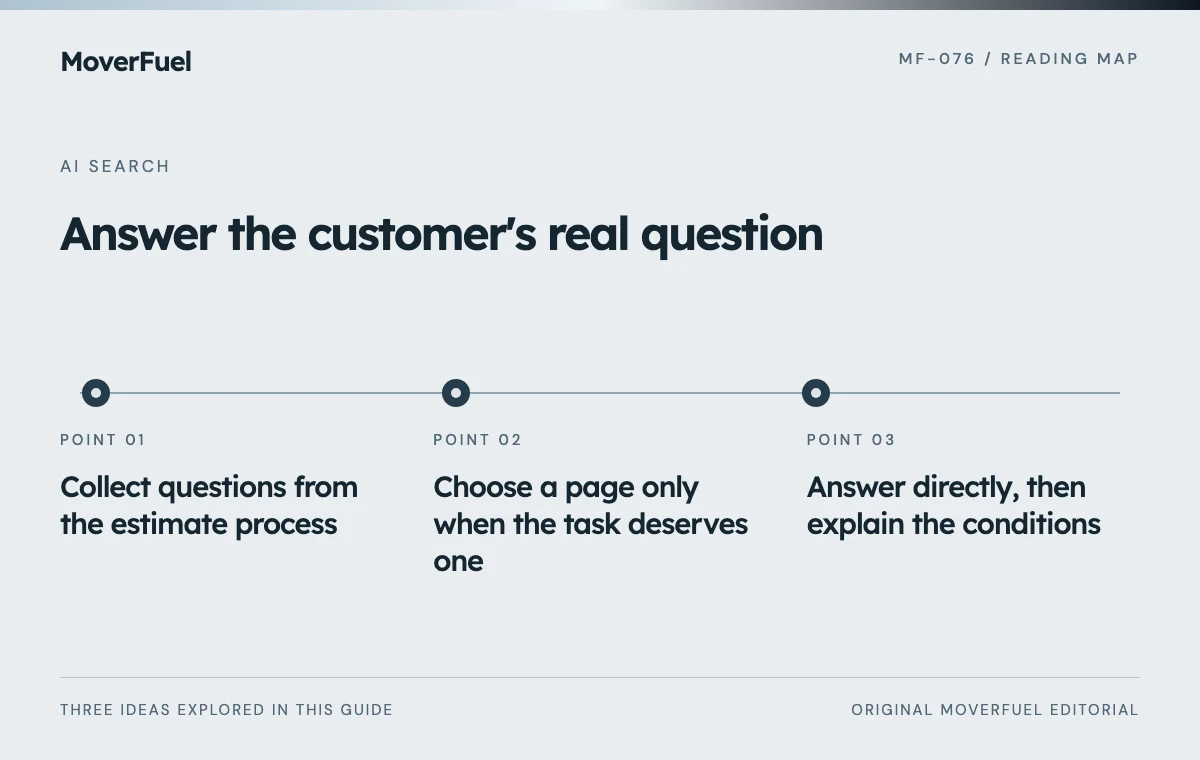
Collect questions from the estimate process
Ask estimators and customer-care staff to record recurring questions without retaining unnecessary personal details. Review permitted, appropriately handled inquiry records and quote emails. Separate questions people ask before choosing a mover from questions asked after booking; they belong at different points in the journey.
Scroll the table horizontally to compare all columns.
| Question | Underlying decision | Best subject-matter reviewer |
|---|---|---|
| Do you serve my building? | Geographic and access fit | Local operations |
| Will you pack the kitchen? | Scope and optional work | Estimating team |
| Is the price final? | Estimate conditions and uncertainty | Authorized pricing reviewer |
| What happens if my closing changes? | Scheduling flexibility | Booking coordinator |
| How do I prepare before arrival? | Post-booking readiness | Crew or customer-care lead |
Look beyond frequency. A question asked infrequently may still be decisive for a valuable service such as office relocation. Record why the answer matters and what goes wrong when the customer misunderstands it.
Choose a page only when the task deserves one
Group questions by the decision they support. Packing inclusions may belong on a packing service page; a detailed preparation checklist may justify its own resource. Several wording variations of ‘do you move apartments?’ usually need one clear answer, not separate URLs.
Google’s helpful-content guidance emphasizes original, useful coverage for an intended audience rather than pages made primarily to attract search traffic. Use that principle to judge whether a proposed page adds a complete new task or merely repeats an existing answer. [1]
Give each answer a primary home
Maintain a question-to-page map with an owner and supporting links. A short answer can appear on a relevant service page while linking to a deeper guide. Keep the key facts consistent; do not let two pages publish different scheduling or pricing conditions because different writers handled them.
Answer directly, then explain the conditions
Start with the practical answer the company can support. Follow with the conditions that change it, the information needed and the next step. Avoid opening every answer with a promotional paragraph about the importance of choosing a reliable mover.
A good answer identifies who must confirm the decision. If a move depends on access restrictions or specialist handling, explain what the customer should provide and who reviews it. Do not convert a conditional capability into an unconditional promise for the sake of a shorter answer.
Scroll the table horizontally to compare all columns.
| Part | Question for the editor |
|---|---|
| Direct response | Can the reader find the answer without scrolling through promotion? |
| Conditions | What changes the answer for this move? |
| Evidence | Who confirmed the policy or factual claim? |
| Action | What information or step helps the customer proceed? |
Use examples that clarify rather than decorate
Compare two situations when the distinction matters. An apartment with an elevator reservation differs from one with unrestricted access; a customer packing their own belongings differs from one buying packing service. Explain what information the estimator needs, without inventing a universal surcharge or timing rule.
Use tables for options and lists for preparation steps. Keep critical qualifications in visible text rather than only inside an image. Link to the relevant service or estimate path where it helps the reader act; avoid a collection of unrelated links at the end of every answer.
The moving website conversion guide explains how these answers connect to the wider inquiry journey.
Assign an owner and a reason to review
Record the policy owner, evidence source and last substantive review. Trigger updates when the company changes services, scheduling rules, coverage or estimate procedures. A date badge is not a substitute for checking the answer.
Ask sales staff whether new inquiries arrive better informed. Track repeated misunderstandings and revise the relevant section. If a page attracts the wrong request, inspect its wording and scope before adding more text.
Retire or consolidate answers that no longer serve a distinct purpose, preserving useful links and existing URLs where possible. The goal is a dependable library that makes the company easier to understand, not a growing count of questions with nearly identical answers.
Common questions
Should every customer question become a blog post?
No. Put the answer where it supports the relevant decision. Create a separate article when the topic needs substantial explanation or serves a distinct task.
Can we write a short answer for AI search and a different answer for people?
Use one accurate explanation that serves the reader. A concise opening can lead into useful detail without creating conflicting versions of the company’s policy.
Your next step
Research real questions, assign each a useful home and write an answer with clear conditions. Keep an operating owner responsible for the facts after publication.
Sources & editorial notes
Platform claims cite the documents below. Operating frameworks and labeled examples are MoverFuel editorial analysis, not client results or industry benchmarks.
- Google: helpful people-first contentPeople-first, original and useful content principles. Question mapping and moving examples are original editorial recommendations. Reviewed .