AI search optimization is useful when it makes a moving business easier to understand and evaluate. It becomes misleading when a technical checklist is sold as proof that an assistant will recommend the company. Separate the work you control—accurate information, accessible pages and credible explanations—from the visibility you can actually observe. Neither a schema test nor a single answer screenshot establishes a reliable ranking.
 View full-size graphic ↗
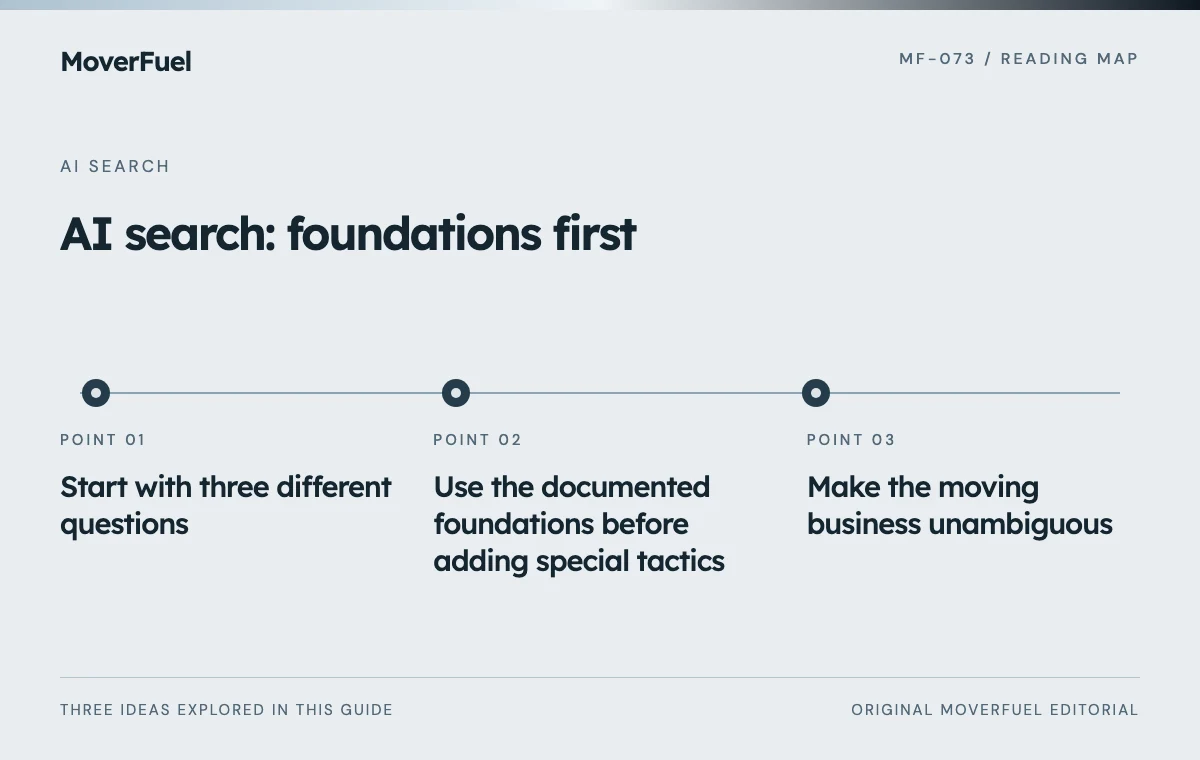
Start with three different questions
For a concise distinction between readiness and recommendations, read what AEO and GEO mean in the moving marketing FAQ.
Scroll the table horizontally to compare all columns.
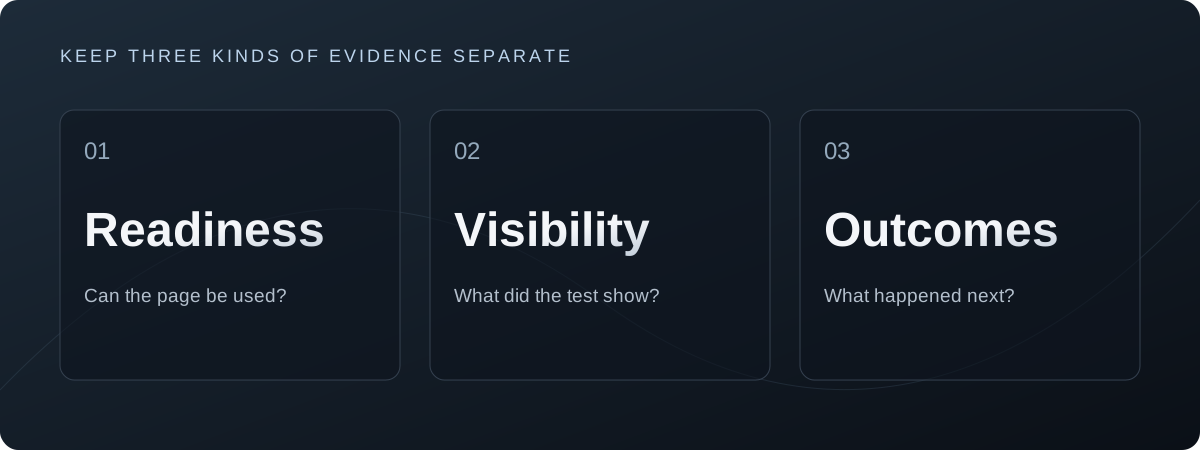
| Question | Evidence you can collect | Limit |
|---|---|---|
| Can the page be accessed and understood? | Rendered content, indexing checks and accurate business details | Access does not guarantee selection |
| Did a system show or cite the business? | A dated prompt, response, citations and test context | One observation is not stable market-wide visibility |
| Did the exposure contribute to suitable work? | Referrals, inquiry records and eventual booking outcomes | Some exposure and influence cannot be attributed |
Keep these questions separate in the scope of an audit and in the monthly report. A readiness review can identify a blocked page or unclear service description. An observation study can record what happened in a defined test. Attribution can connect some visits with inquiries. None of those measurements should be renamed to imply that it answers all three.
AEO and GEO are common labels for work intended to improve answer-oriented and generative-search discovery. They do not create a separate permission to make unsupported claims about a business. For a mover, the useful task remains concrete: explain who provides the service, where it is available and what a customer should do next.
Use the documented foundations before adding special tactics
Google's guidance says that established SEO practices remain relevant to its AI search features. Supporting links must meet the applicable Search eligibility requirements; satisfying them does not guarantee inclusion. Google also says that special AI files or special schema are not required for these features. [1]
That is a Google-specific statement, not a universal description of ChatGPT, Claude, Gemini or every retrieval system. Check each provider's current documentation before changing crawler rules or asserting how its products select sources. Search access, user-initiated retrieval and model training can involve different controls.
- Make important service information available as readable page text.
- Use crawlable internal links so the relevant pages can be discovered.
- Check unintended access blocks, indexing directives and canonical inconsistencies.
- Keep visible information and structured data aligned.
- Test the real rendered page rather than assuming a successful build proves accessibility.
Spend implementation time on a documented problem. If the service page is inaccessible or contradicts the business profile, those are understandable defects to fix. A package of vaguely described ‘AI signals’ needs a clearer explanation of its purpose and evidence. [2]
Make the moving business unambiguous
Review the company name, real operating locations, services, coverage and contact details across the website and maintained profiles. Explain meaningful relationships such as branches or service divisions. Do not describe a service area as a physical office or imply that a marketing agency is the moving operator.
Connect each claim with evidence the customer can inspect
If the company offers office relocation, explain the project process and show approved relevant work. If it offers storage, describe what the customer needs to confirm. If it serves interstate moves, use accurate operator identity and approved service information. Avoid unsupported superlatives, fabricated ratings and vague nationwide claims.
The purpose is not to repeat the company name in every paragraph. It is to remove ambiguity from the customer's decision. A concise service explanation with an honest limitation is more useful than a long page that claims to handle every possible move without explaining how.
These foundations also support local profile accuracy and moving-company SEO. Treat them as connected publishing work rather than three contradictory sets of business facts.
Answer the questions that change a moving decision
Use real questions from estimate conversations to choose content. A local customer may need to understand elevator coordination or packing options. A long-distance customer may ask how inventory affects the estimate process. A facilities manager may need to know how a relocation is phased. Those questions deserve different answers because the tasks differ.
Scroll the table horizontally to compare all columns.
| Broad topic | Specific customer task | Useful content asset |
|---|---|---|
| Local moving | Prepare for a building with access restrictions | A planning checklist explaining what to confirm |
| Packing | Choose which packing work to request | A service comparison with clear exclusions |
| Office relocation | Coordinate a survey and project stakeholders | A process outline and information checklist |
Answer the main question early, then supply the conditions, examples and next step. Use headings and tables when they make the explanation easier to use. Do not manufacture hundreds of near-identical question pages or force every answer into a fixed word count. Google warns against scaled content produced to manipulate visibility rather than help users. [3]
Original value can come from an operator-approved process, an annotated example, a useful comparison or a clear explanation of what changes the recommendation. It does not require invented case studies or unsupported claims that your team has tested every assistant.
Record visibility observations without overstating them
If you test an assistant, save the exact question, date, product, available mode, stated location, account context and response. Distinguish a brand mention from a cited link, and distinguish both from an explicit recommendation. Record whether the answer describes the business accurately. A citation to the wrong service or an invented location is not a success to celebrate.
Use a small, repeatable set of questions tied to real customer needs and actual service areas. Repeat observations when useful, while acknowledging that responses may vary. A report can say that the company appeared in a specific observed test set. It cannot honestly convert that set into the percentage of all potential customers who will see the business.
Do not use hidden instructions, fabricated third-party praise or content designed to manipulate an assistant into repeating a recommendation. Such material fails the customer-usefulness test and can conflict with search spam policies. Build a source that is worth consulting instead.
Connect observable referrals to the inquiry process
When analytics identifies a referral, inspect the landing page and whether the visit produced a useful inquiry. Continue through qualification and booking when the data permits. Keep the source record and explain missing attribution. A copied URL, an untagged visit or exposure without a click may not appear as an identifiable AI referral.
Reporting products and documentation change. Confirm the reports actually available in the relevant account and their current definitions before publishing a dashboard claim. Do not assume that every AI interaction can be separated from ordinary search or assigned to a specific answer.
Prioritize changes that help both the customer and the business: clearer coverage, accurate service explanations, accessible pages and a working estimate path. Review whether the improved pages attract suitable inquiries. Keep technical readiness, observed inclusion and booked outcomes as separate lines of evidence.
Use the AI search readiness checklist to organize controllable improvements. It is a self-assessment, not a scan or a guarantee of recommendations.
If you want help with the controllable improvements, see AI search optimization for movers.
Common questions
Does schema guarantee that an AI assistant will recommend a mover?
No. Structured data can describe supported facts, but it is not proof of selection or endorsement. Keep it consistent with visible content and use appropriate types without inventing reviews or business details.
Can we report an AI ranking from one prompt?
You can report the specific observation with its context. One response does not establish a stable ranking, audience reach or market share. Repeated tests still need their scope and limitations stated.
Should existing service pages be rewritten entirely for AI?
Start with actual deficiencies. Improve unclear answers, missing evidence or technical access problems. Preserve useful content and established URLs. A new label does not justify replacing information that already helps customers.
Your next step
Make the company easy to identify, the services easy to understand and the next step easy to complete. Verify provider-specific requirements, document any visibility observations honestly and judge referrals through the same qualified-inquiry process as other channels.
Sources & editorial notes
Platform claims cite the documents below. Operating frameworks and labeled examples are MoverFuel editorial analysis, not client results or industry benchmarks.
- Google: AI features and your websiteGoogle AI-search eligibility, conventional SEO foundations and lack of special technical requirements. Reviewed .
- Google: generative AI optimization guideGoogle-specific guidance on llms.txt and unsupported optimization shortcuts. Reporting availability is not assumed. Reviewed .
- Google: spam policiesScaled-content and manipulative-search practices. The measurement method is original editorial analysis. Reviewed .