
Moving-company SEO should help a customer find a provider that can serve the actual move. That requires more than repeating city names: the website must be accessible to search engines, explain real services and locations, answer useful questions and make the estimate path work. A practical roadmap connects those foundations to qualified organic inquiries, then reviews whether the work becomes suitable bookings.
 View full-size graphic ↗
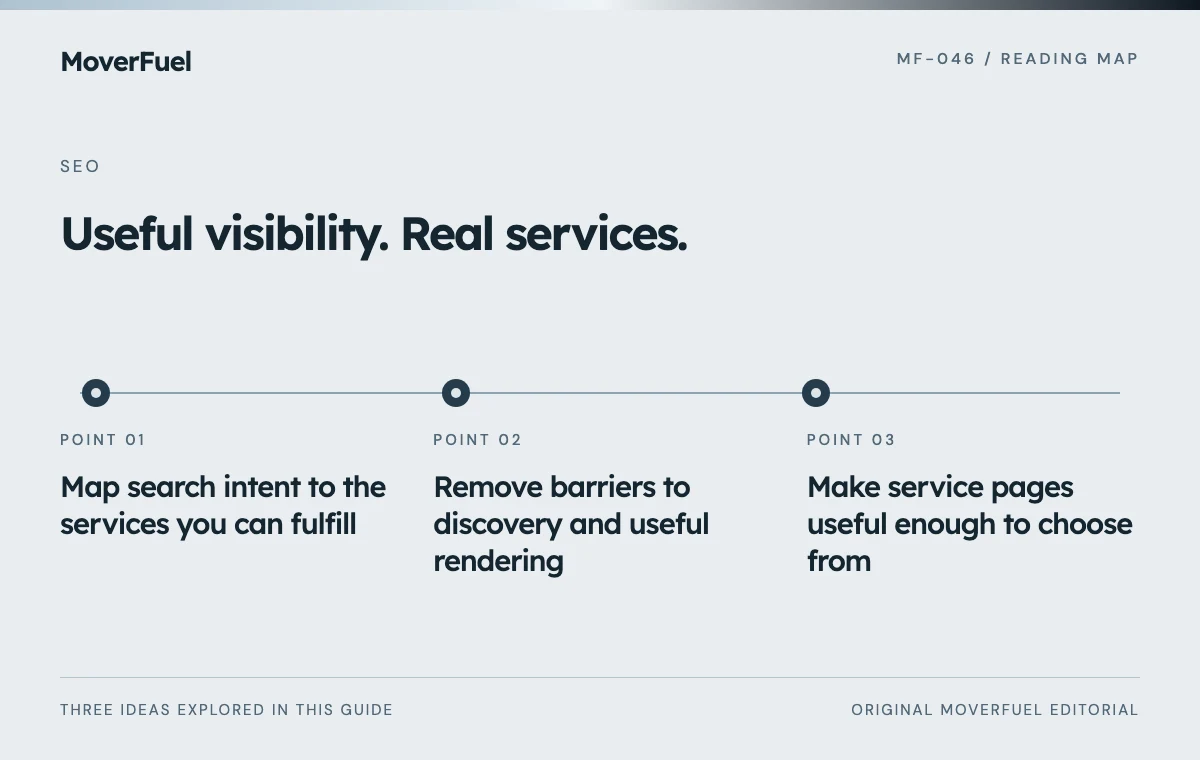
Map search intent to the services you can fulfill
Begin with the operating offer. List local, interstate, residential, commercial, packing and storage services only where the business actually provides them. Record coverage and meaningful restrictions. SEO research should discover how customers describe those services, not pressure the company into claiming work it cannot deliver.
Scroll the table horizontally to compare all columns.
| Customer task | Page purpose | Information needed |
|---|---|---|
| Hire a local household mover | Local moving service page | Coverage, scope and estimate process |
| Arrange an interstate move | Long-distance service page | Origin/destination fit and scheduling questions |
| Plan an office relocation | Commercial service page | Project discovery, access and responsibilities |
| Understand moving estimates | Educational guide | Inputs, process and questions to ask |
| Find a branch | Real location page | Verified branch details and services |
Assign one primary purpose to each page. A service page should explain the offer and the next step. A guide should answer a research question in enough depth to be useful. They can support each other without both attempting to become the same all-purpose “moving company” page.
Resolve overlapping pages before adding more
Review existing URLs, search queries and internal links. If two pages answer the same question for the same audience, decide whether to improve one or give each a genuinely different purpose. Preserve useful public URLs where possible. A new slug is not inherently an SEO improvement.
Remove barriers to discovery and useful rendering
Google’s Search Essentials combines technical eligibility, spam policies and helpful-content practices. Meeting those conditions does not guarantee crawling, indexing or visibility. Treat technical work as making the site accessible and understandable, not as purchasing a ranking entitlement. [1]
Inspect important pages as a search engine and a customer would encounter them. Confirm that intended public URLs respond successfully, contain the main content and are not accidentally marked for exclusion. Check canonical choices and sitemap entries against the pages the business actually wants discovered.
Use crawlable internal links. Google recommends anchor elements with usable href destinations and descriptive link text. A button that changes content through a script without a normal destination may not provide the same discovery path as a real article or service link. [2]
Scroll the table horizontally to compare all columns.
| Check | Why it matters to the project |
|---|---|
| Important route returns the right status | Prevents broken destinations and false-success pages |
| Main copy is available in the rendered page | Lets users and crawlers access the explanation |
| Canonical and indexability agree | Reduces conflicting instructions |
| Sitemap lists intended public pages | Provides an accurate discovery inventory |
| Mobile estimate journey works | Preserves the commercial value of visibility |
Make service pages useful enough to choose from
Explain who the service is for, what the company handles, what the customer must provide and how the estimate proceeds. For local household moves, that may include origin, destination, access and date questions. For commercial work, it may include a survey and project stakeholders. The differences should affect the content, not just the heading.
Use actual customer questions to improve the page. If estimators repeatedly explain whether packing is included, address the distinction clearly. If customers misunderstand coverage, clarify it before the form. Helpful detail can reduce unsuitable inquiries while making the service easier to evaluate.
Publish approved evidence where available: real work descriptions, permissioned photographs, authentic reviews or documented credentials. If evidence has not been supplied, do not invent it. A precise explanation of the process is more credible than an unsupported claim of being the highest-rated mover in every city.
Describe real coverage without manufacturing locations
Separate a physical branch from an area the company serves. A location page should not imply that a staffed office exists where there is only a service-area interest. Google Business Profile guidance requires accurate business representation and has eligibility conditions for locations and service-area businesses. [3]
A useful geographic page can explain real service differences, travel considerations or branch responsibilities. A collection of pages with only the city name changed adds little decision value. Google’s spam policies address doorway abuse and scaled content created primarily to manipulate search visibility. [4]
Use the Google Business Profile guide alongside website work. First verify that the profile and website describe the same real business, then improve the information relevant to customers.
Build guides around distinct customer decisions
Educational content should help the reader do something: prepare for an estimate, compare service options or understand a process. Choose topics from recurring customer questions and the gaps in existing pages. Give each guide a specific purpose before adding it to a publishing calendar.
Link a guide to the service that naturally follows its answer. An office relocation planning article can lead to the commercial discovery process. A packing explanation can lead to the relevant service scope. Use a small number of contextual links that help the reader, not a block of every keyword variation.
Original value can come from a clear checklist, a carefully explained comparison or verified operational expertise. It does not require an invented survey or proprietary statistic. Label hypothetical examples and distinguish company-specific practices from general information.
Measure visibility, qualified inquiries and bookings separately
Use search reporting to understand discovery: which pages and themes receive impressions and clicks. Use website and lead systems to understand what happens afterward. These tools answer related questions, but their counts and attribution definitions do not always match one for one.
Track organic inquiries by relevant service and market where the data supports it. Record contactability, fit, estimate progression and bookings. A rise in visits to an informational page is useful only in the context of its purpose; it should not be reported as an equivalent rise in customers.
Apply the definitions in the qualified moving leads guide so organic and paid reporting use compatible business stages. Keep uncertain attribution labeled rather than assigning every unknown inquiry to SEO.
Review mature cohorts and the effect of seasonality, capacity or sales changes. Organic improvements do not occur on a universal timetable. Report completed work, observed search changes and commercial outcomes separately so the owner can see what is known and what still needs time.
Prioritize a roadmap the business can maintain
Scroll the table horizontally to compare all columns.
| Stage | Work product | Acceptance question |
|---|---|---|
| Access and preservation | Route, indexability and existing-content inventory | Can important pages be reached without losing useful URLs? |
| Service relevance | Improved core service and coverage pages | Can a customer determine fit and request an estimate? |
| Local consistency | Accurate business details and profile alignment | Do the website and real operation agree? |
| Content support | Distinct guides and contextual links | Does each guide answer a different useful question? |
| Measurement and iteration | Lead-quality review with a change record | Can the team connect changes to evidence? |
Assign an owner and review date to each priority. Avoid a plan consisting entirely of article counts or backlink counts. The useful deliverable is a better service explanation, a resolved technical problem or a more reliable path from discovery to a qualified estimate.
Revisit the roadmap when the company adds services or enters a market. New pages need real operating information, and old pages need maintenance when the offer changes. Sustainable SEO is a publishing and measurement discipline attached to the business, not an isolated monthly checklist.
The same acceptance questions work for judging outside help, including ours: see how we run SEO for moving companies.
Common questions
Does every service area need a separate page?
No. Create a distinct page when it provides useful, accurate information for that area or branch. Avoid near-identical pages that only swap city names or imply locations that do not exist.
How long does moving-company SEO take?
There is no universal timeline. Technical condition, competition, existing visibility, content quality and business changes affect the work. Report milestones and observed outcomes rather than promising a fixed ranking date.
Can SEO guarantee more booked moves?
No. Visibility can support acquisition, but service fit, website usability, response quality, pricing and capacity also affect bookings. Measure the complete journey.
Your next step
Build SEO around real services, useful answers and a working estimate journey. Preserve existing value, fix the highest-impact gaps and judge progress through both search evidence and qualified business outcomes.
Sources & editorial notes
Platform claims cite the documents below. Operating frameworks and labeled examples are MoverFuel editorial analysis, not client results or industry benchmarks.
- Google: Search EssentialsSearch eligibility and no indexing or ranking guarantee. Reviewed .
- Google: crawlable linksCrawlable anchors and descriptive link text. Reviewed .
- Google: representing your businessAccurate business representation and location eligibility. Reviewed .
- Google: spam policiesDoorway and scaled-content-abuse policies. Reviewed .