
An AI voice agent may be useful for a narrow intake task, such as collecting a callback request when staff cannot answer. That possibility does not establish that it can accurately quote a move, resolve a complaint or reserve a crew. Evaluate the proposed task and failure consequences before evaluating how natural the voice sounds.
 View full-size graphic ↗
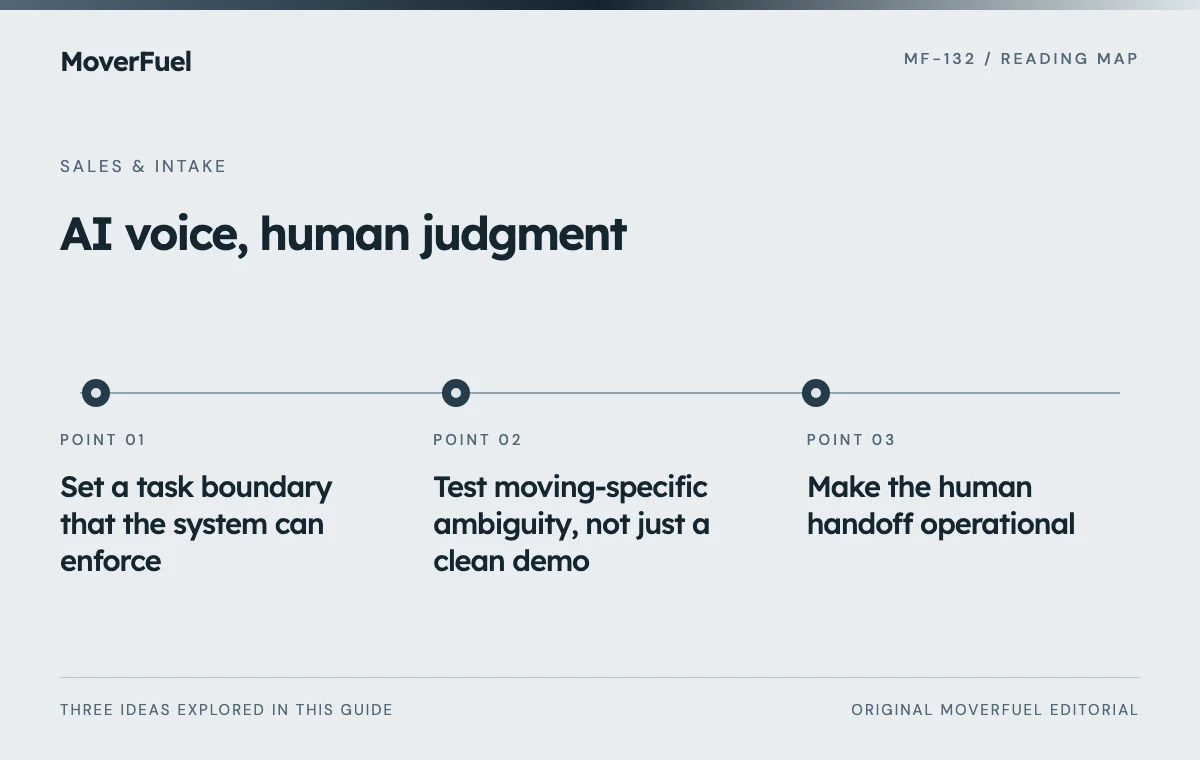
Set a task boundary that the system can enforce
Scroll the table horizontally to compare all columns.
| Task | Trial treatment |
|---|---|
| Capture callback details | Allow with confirmation and minimal data |
| Ask route and date window | Allow; preserve uncertainty |
| Explain verified office hours | Use maintained business information |
| Quote a binding price | Exclude unless a separately verified process authorizes it |
| Promise crew availability | Escalate to the authorized scheduling process |
| Handle a complaint or claim | Transfer to an appropriate person |
| Take sensitive payment information | Keep outside a general intake trial |
NIST's AI Risk Management Framework is voluntary guidance for addressing trustworthiness across AI design, use and evaluation. It provides a risk-management basis, not a certification that a particular voice vendor is safe or suitable for moving sales. [1]
Write the permitted responses and the conditions that require escalation. The system should be able to say that it cannot confirm an answer. A fluent response outside its authority can be more damaging than an obvious failure because the customer may rely on it.
Test moving-specific ambiguity, not just a clean demo
Prepare original test scenarios using synthetic customer details. Include similar city names, an uncertain move date, a changed destination, stairs at only one address and a customer correcting the inventory. Test interruptions, background noise and a caller who asks to speak to a person immediately.
Scroll the table horizontally to compare all columns.
| Scenario | Expected response |
|---|---|
| Caller gives two possible dates | Retain the date window; do not choose one silently |
| Commercial project with special access | Capture essentials and route to the qualified team |
| Customer asks whether the price is guaranteed | Avoid unsupported terms; escalate |
| Caller corrects an address | Confirm the corrected value before saving |
| Caller expresses frustration | Offer a human handoff without an argument |
| System cannot reach the CRM | Report the limitation and follow the approved fallback |
Score factual capture, unsupported claims, escalation success and customer effort. A transcript that looks plausible may still store the wrong date or fail to create a callback task. Check the downstream record and whether the responsible person actually receives it.
Make the human handoff operational
Transfer context, not just the call
The receiving person needs a concise summary of the request, confirmed details, unresolved points and the reason for escalation. Distinguish the customer's statements from the system's interpretation. Do not force the caller to repeat everything because the handoff carries only a phone number.
Define what happens when nobody answers the transfer. The caller should receive an accurate expectation and a recorded callback task with an owner. Test this failure path during the same hours in which the agent will operate.
Review disclosure, contact rules and vendor data practices
Inbound intake and outbound calling are different deployments. The FCC's 2024 declaratory ruling classified AI-generated human voices within the TCPA's artificial or prerecorded voice provisions. That historical classification is not a complete current compliance determination for a proposed campaign; have the actual use, jurisdictions and contact permissions reviewed. [2]
Tell customers accurately what system they are interacting with, and have recording and privacy practices reviewed before launch. Do not use an artificial voice to impersonate a real employee or imply a human has reviewed information when nobody has.
Ask the vendor where audio and transcripts go, who can access them, how long they remain, whether they are used for training and how they can be exported or deleted. FTC guidance supports examining service-provider security and setting expectations in writing. [3]
Also verify outage behavior, configuration ownership, update notices and rollback. A model or prompt change can alter behavior without a visible website release. Keep a test set that can be rerun after material vendor changes.
Start with a bounded trial and explicit stop criteria
Choose a low-authority task, limited hours and a defined volume. Compare it with the existing handling process using similar inquiry types. Record coverage, successful callbacks, qualification accuracy, estimate progression and complaints; do not judge only by calls answered or labor minutes saved.
Stop or narrow the trial after material false promises, failed urgent transfers, inappropriate data handling or repeated inaccurate records. Investigate the cause before restarting. Include the staff time needed to review and repair outputs in the economic comparison.
Compare the role with human call-center and in-house options and connect accepted records through lead tracking. No live MoverFuel voice-agent product or integration is implied by this evaluation guide.
Common questions
Can an AI voice agent replace a moving estimator?
A limited intake trial does not establish that capability. Estimation, pricing authority, operational constraints and applicable requirements need their own verified process and qualified oversight.
What is the most important trial metric?
Use a balanced set: accurate records, appropriate promises, successful human handoffs, customer experience and downstream outcomes. A high answer rate alone can conceal serious failures.
Your next step
Treat a voice agent as a bounded operational system with failure modes. Start with limited authority, test realistic ambiguity and retain an effective human fallback before considering expansion.
Sources & editorial notes
Platform claims cite the documents below. Operating frameworks and labeled examples are MoverFuel editorial analysis, not client results or industry benchmarks.
- NIST AI Risk Management FrameworkNIST AI RMF is voluntary risk-management guidance, not a vendor certification. Reviewed .
- FCC: February 2024 AI-generated voice ruling announcement (GPO archive)The FCC's February 8, 2024 announcement, reviewed in full through the GPO archive, confirms the historical AI-generated voice classification. This is not the full order or a current campaign-compliance determination. Reviewed .
- FTC: protecting personal informationFTC guidance supports service-provider security review and written expectations. Reviewed .