An AI tool should be evaluated against the work the moving company needs done, including the mistakes it must avoid. A fluent demonstration does not prove accurate service information, reliable lead classification or safe customer communication. Define the task, test difficult cases and keep a person accountable for consequential outputs.
 View full-size graphic ↗
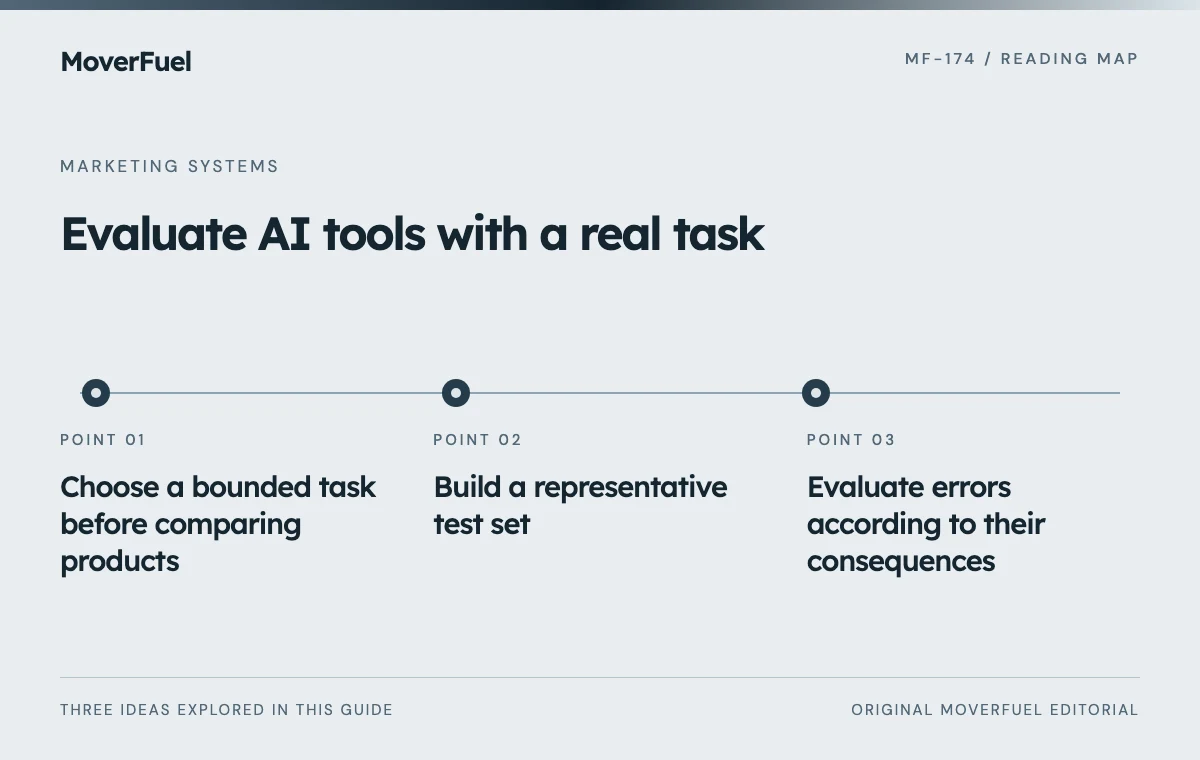
Choose a bounded task before comparing products
Examples include drafting a first version of a service FAQ, summarizing an approved call for staff review or suggesting groups for a keyword analysis. Each task needs a different definition of success. Do not judge them all by how polished the output sounds.
Scroll the table horizontally to compare all columns.
| Field | Example question | Why it matters |
|---|---|---|
| Purpose | What decision or work will this assist? | Avoids novelty-driven purchases |
| Inputs | Which approved information may it use? | Controls accuracy and data exposure |
| Output | What should it produce? | Makes evaluation concrete |
| Unacceptable errors | Which mistakes could mislead or harm? | Sets boundaries |
| Human owner | Who verifies and approves the result? | Preserves accountability |
Start with work whose output can be checked. A claim that a tool will autonomously grow the business is too broad to evaluate without a defined mechanism and evidence.
Build a representative test set
Use ordinary cases, ambiguous cases and deliberate edge cases. For a service-content task, include unsupported locations, unavailable services and incomplete facts. For a lead-summary task, include uncertainty, changed dates and a customer who has declined further contact.
Prepare an expected answer or review rubric
The evaluator needs to know which facts must be preserved, which uncertainties should remain visible and which claims must not appear. A tool should not receive credit for confidently filling gaps with invented details.
Scroll the table horizontally to compare all columns.
| Criterion | What to inspect | Evidence to record |
|---|---|---|
| Factual accuracy | Matches approved source information | Specific errors and corrections |
| Task usefulness | Helps the intended workflow | Reviewer time and required edits |
| Uncertainty handling | Flags missing or conflicting facts | Ambiguous-case outputs |
| Policy and privacy fit | Uses permitted data appropriately | Configuration and contractual review |
| Consistency | Performs acceptably across cases | Repeated representative tests |
This is an original practical rubric, not a certified score. Weight the criteria according to the consequences of error rather than creating a universal AI quality percentage.
Evaluate errors according to their consequences
NIST's AI Risk Management Framework is voluntary guidance for incorporating trustworthiness into AI design, use and evaluation. It is not a certification that makes a vendor or output safe for every task. [1]
A rough draft with an awkward sentence is different from a customer-facing promise about availability, pricing or operating authority. Keep higher-consequence outputs behind appropriate review and restrict the tool's ability to take actions beyond its approved role.
Record failures individually. A high average score can hide the one error type the business cannot tolerate. Define stop conditions before the trial, including when the tool must be limited or rejected.
Review the data arrangement before using real records
Ask what information the vendor receives, retains and uses, who can access it, how deletion works and what contractual controls apply. Test with synthetic or appropriately de-identified material until the actual arrangement has been reviewed.
FTC data-security guidance recommends minimizing collected and retained information and controlling access. A feature that can ingest a full CRM export does not establish that the export is necessary or appropriate. [2]
Check whether outputs or logs expose personal details to broader teams. Restrict permissions according to the task and avoid placing credentials or sensitive customer records in prompts merely for convenience.
Revisit the review when vendor terms, model behavior or connected tools change. Approval of one configuration should not automatically authorize a materially different workflow.
Apply extra checks to published marketing content
Google's guidance on generative AI content emphasizes usefulness and warns that scaled content without added value can violate spam policies. AI assistance is not a substitute for original purpose, accurate information and editorial review. [3]
Check sources directly, remove unsupported claims and make the article useful to a real reader. A list of citations produced by a model is not evidence that those pages exist or support the text. Keep approved brand and service facts available to the reviewer.
The helpful moving-advice guide offers a content-quality checklist. AI search optimization concerns discoverability, not permission to publish unchecked output.
Compare the real workflow cost with the benefit
Measure setup, review, correction and maintenance effort alongside any time saved. A fast first draft may create more work if staff must repeatedly repair factual mistakes. Compare against the current process using the same task and quality requirements.
Choose adopt, restrict, retest or reject, and record the reason. A tool may be useful for internal brainstorming but unsuitable for autonomous customer replies. Preserve that narrower conclusion rather than treating adoption as an all-or-nothing endorsement.
Connect approved tools to a defined marketing workflow with an owner, test cases and a way to pause incorrect behavior.
Common questions
Does an AI tool's confident answer mean it is accurate?
No. Verify important facts against approved evidence and test how the tool handles missing or conflicting information. Fluency is not proof.
Can an AI evaluation score guarantee safe performance?
No. A score summarizes selected tests under a particular configuration. Preserve error details, human accountability and ongoing monitoring, especially for consequential tasks.
Your next step
Evaluate a defined task with representative cases and explicit failure limits. Keep useful assistance, restrict unsupported actions and make human review part of the operating cost.
Sources & editorial notes
Platform claims cite the documents below. Operating frameworks and labeled examples are MoverFuel editorial analysis, not client results or industry benchmarks.
- NIST AI Risk Management FrameworkNIST AI RMF is voluntary trustworthiness and risk-management guidance, not vendor certification. Reviewed .
- FTC: protecting personal informationFTC guidance supports minimizing information and controlling access. Reviewed .
- Google: generative AI content guidanceGoogle permits useful AI assistance while warning against scaled content without added value. Reviewed .