
The choice between a call center and an in-house moving sales team depends on the work you need handled. Overflow reception, local estimate qualification and complex commercial sales require different authority and knowledge. Define the task first, then compare providers and staff against the same customer outcome.
 View full-size graphic ↗
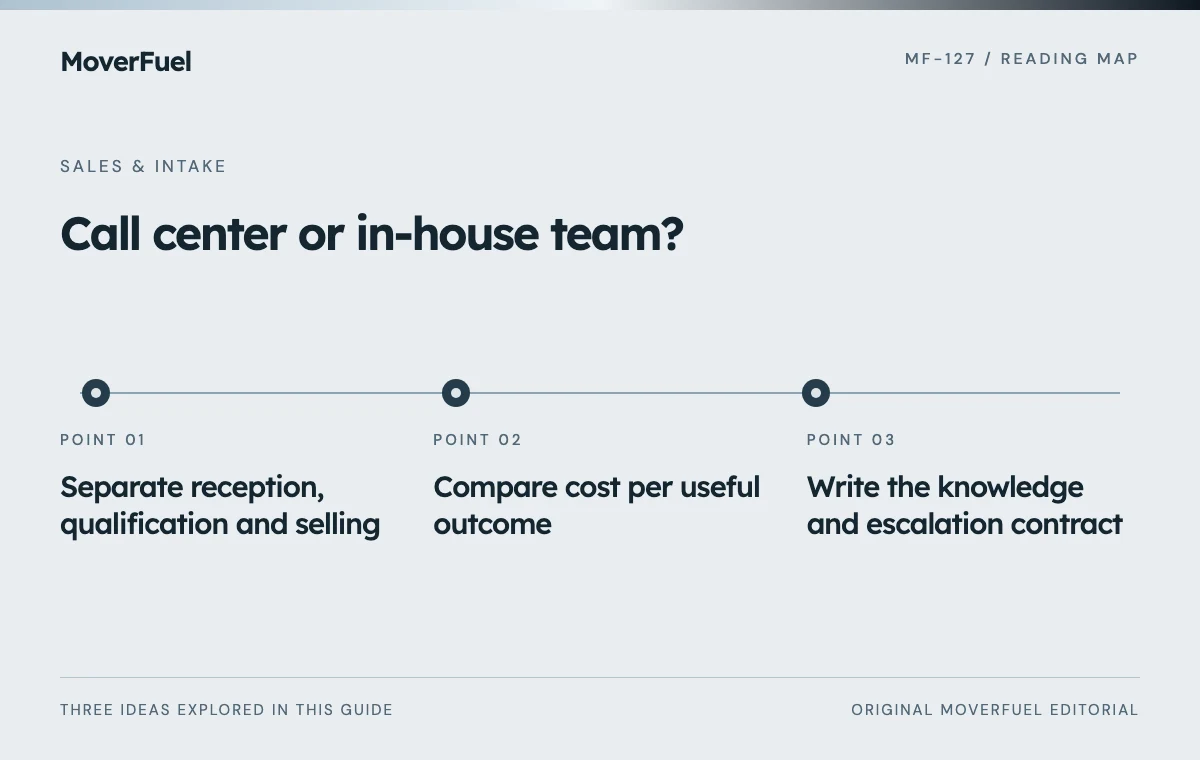
Separate reception, qualification and selling
Reception establishes who called and routes the request. Qualification confirms whether the route, date and service fit the business. Selling may involve scope explanation, estimate coordination and a booking decision. A provider that reliably answers calls may not be equipped or authorized to perform all three.
Scroll the table horizontally to compare all columns.
| Dimension | In-house team | External team | Hybrid approach |
|---|---|---|---|
| Local operating context | Direct access, subject to training | Needs maintained reference material | External triage, internal exceptions |
| Coverage | Limited by staffing plan | Depends on contracted hours and capacity | Overflow outside normal coverage |
| Estimate authority | Can be defined by role | Must be explicitly restricted | Complex estimates stay internal |
| Coaching | Direct management responsibility | Requires evidence and vendor cooperation | Shared scorecard and escalation |
| Data ownership | Internal controls still required | Contract, access and exports matter | Minimize transferred fields |
Neither column guarantees quality. A distracted internal employee can miss important information, while a well-trained external team may handle a narrow task consistently. Assess the actual process rather than treating the staffing label as proof.
Compare cost per useful outcome
Include wages or vendor fees, management time, training, software, coverage gaps and rework. A low per-call fee can become expensive if staff must repeatedly repair incomplete records. An internal salary should not be compared with a vendor invoice without accounting for the work and hours each covers.
Use a common denominator
In an illustrative trial, option A costs $2,400 and produces 40 usable estimate handoffs; option B costs $3,000 and produces 60. Their costs per usable handoff are $60 and $50. Those fictional numbers do not settle the choice: booking quality, completion, complaints and capacity still matter.
Define a usable handoff in advance: required route and scope information, correct contact details, documented next step and an accepted owner. Do not let a vendor count every answered call as a qualified estimate opportunity. Track mature booked and completed outcomes when enough time has passed.
Connect this comparison to cost per booked move without assigning the whole company's bookings to one intake model.
Review customer data and accountability before a trial
FTC business guidance specifically recommends examining a service provider's security practices and putting relevant expectations in writing. This is pertinent when an outside call center handles customer information; a vendor's general assurance is not a substitute for due diligence. [1]
Identify the fields the provider needs, who can access them, retention and deletion arrangements, export rights, incident reporting and subcontractor involvement. Have applicable recording, privacy and contact requirements reviewed for the actual jurisdictions and workflow. Do not assume that outsourcing transfers away every responsibility.
Run a limited comparison with shared quality criteria
Start with a bounded task, such as overflow qualification during defined hours, while retaining internal control of complex estimates. Train both teams on the same qualification criteria. Record inquiry mix and coverage conditions so differences in outcomes can be interpreted.
Review a permitted sample for accuracy, promises, tone, missing fields and handoff completion. Also measure contact delay, repeated customer effort, estimate attendance and eventual outcomes. Include cases the team escalated correctly; refusing to improvise an answer can be a sign of good handling.
Set stop conditions for material misinformation, unsafe data handling or failed urgent transfers. At the end, decide whether to expand, narrow or end the arrangement based on observed results. A hybrid model may fit better than moving every call to one side.
Use lead tracking and automation to make ownership and outcomes visible across both teams.
Common questions
Is an outsourced call center cheaper for movers?
It depends on the task, coverage and quality. Compare total cost per usable handoff and mature business outcome, including training, supervision and rework, rather than only hourly or per-call prices.
Should a call center quote moving prices?
Only within verified authority and the applicable estimate process. Complex scope, unavailable pricing information and operational exceptions should go to the authorized internal team.
Your next step
Choose the staffing model that reliably handles a defined task. A controlled trial with common quality criteria, clear authority and retained data ownership is more useful than a blanket preference for outsourcing or hiring.
Sources & editorial notes
Platform claims cite the documents below. Operating frameworks and labeled examples are MoverFuel editorial analysis, not client results or industry benchmarks.
- FTC: protecting personal informationFTC guidance recommends service-provider security diligence, contractual expectations and verification for outsourced handling of customer data. Reviewed .