
A Spanish-language service page creates an expectation that the customer can understand the next conversation too. Before translating a large website, confirm who can answer the inquiry, explain the estimate and support the move. A smaller complete language journey is more useful than many translated pages leading to an unsupported handoff.
 View full-size graphic ↗
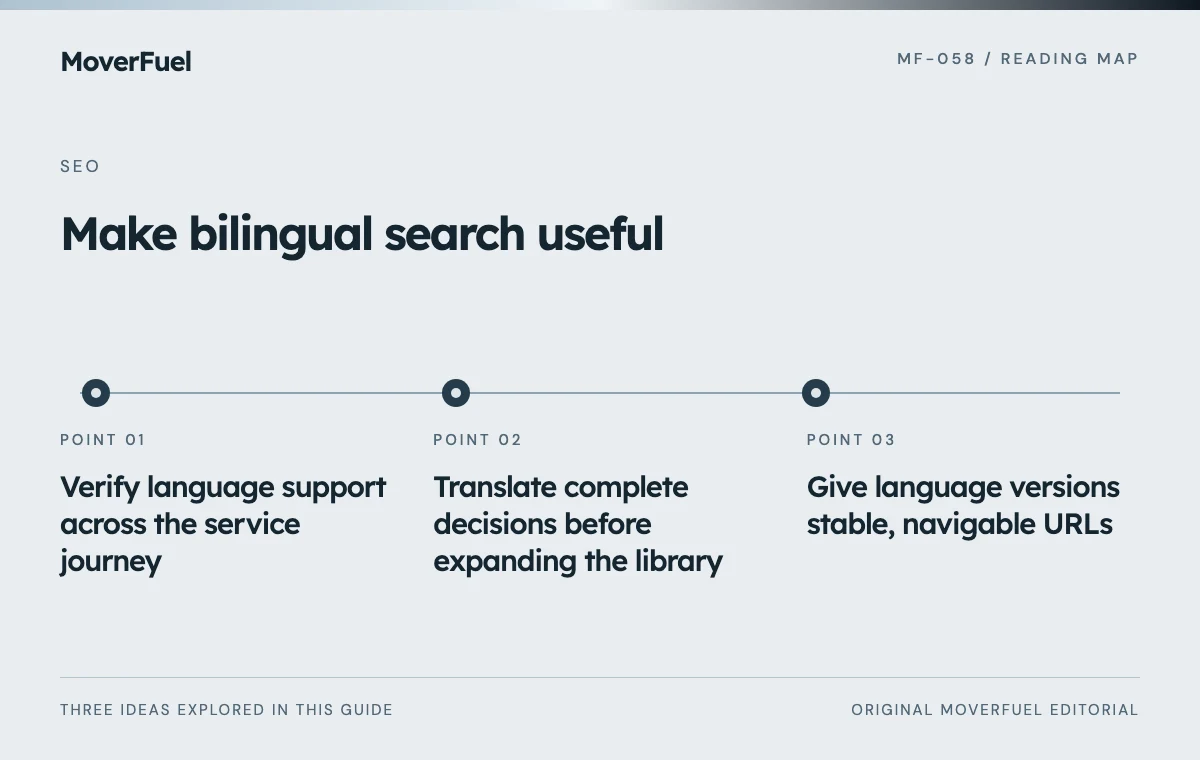
Verify language support across the service journey
Scroll the table horizontally to compare all columns.
| Stage | What to confirm | Owner |
|---|---|---|
| Initial inquiry | Who can respond in the advertised language? | Sales lead |
| Estimate explanation | Can scope, questions and next steps be understood? | Estimator |
| Written communications | Are necessary messages and documents appropriately reviewed? | Operations |
| Moving-day coordination | How are customer questions routed? | Dispatch |
| Follow-up | Can service issues and feedback be handled? | Customer support |
Record the actual availability of bilingual staff rather than implying every employee speaks the language. If support is available during specific hours or through a designated person, explain that accurately. Do not use translation as a cosmetic way to claim a capability the operation lacks.
Validate demand using real customer questions, service-market knowledge and available search evidence. Avoid assuming a language preference from a person’s name or neighborhood. Let customers choose how they want to communicate.
Translate complete decisions before expanding the library
Begin with the most important supported service journey: service explanation, genuine coverage, estimate request and confirmation. Add related preparation content when it answers a demonstrated need. An isolated article that leads into an incomprehensible form is an incomplete experience.
Keep service facts equivalent across languages while allowing natural wording. If the English page says a survey is required, the Spanish version should not accidentally imply an instant final quote. Record material scope changes so both versions are updated together.
Use a qualified language reviewer
Machine-assisted drafting can help prepare a version, but a competent reviewer should check moving terminology, regional usage, tone and practical meaning. Review legal or contractual material through the appropriate responsible process rather than treating a general marketing translation as sufficient.
Ask the reviewer to follow the journey as a customer. The most important defect may be an untranslated error message or a confusing estimate instruction, not a grammatical issue in the opening paragraph.
Give language versions stable, navigable URLs
Use a clear URL structure for each published language version and provide visible language navigation. Keep the reader on the equivalent service or article when switching where that equivalent exists. Do not send every language switch to a generic homepage without explanation.
Google documents hreflang annotations for localized equivalents. Each version should reference itself and the other versions with fully qualified URLs, and reciprocal references are required for the relationship to be recognized. Google determines language from content rather than relying on hreflang or the HTML lang attribute to detect it. [2]
The HTML language attribute still matters for accessibility and user-agent behavior. Hreflang describes a relationship between localized pages; it is not a replacement for readable translated content or correct page-language markup. [1]
Have the developer review canonical choices and language annotations together. A translated page should not accidentally declare an unrelated page as its preferred version. Test actual published URLs rather than copying annotations from a different site.
Test the form, phone path and follow-up in each language
Scroll the table horizontally to compare all columns.
| Area | Practical test |
|---|---|
| Navigation | Switch between equivalent pages without losing context |
| Service facts | Compare coverage, inclusions and estimate promises |
| Forms | Read labels, help text, errors and success feedback |
| Routing | Confirm the selected language reaches the responsible team |
| Calls | Verify the actual greeting and transfer process |
| Follow-up | Review the messages the customer really receives |
Use permitted local or controlled test records so QA does not trigger unwanted live customer workflows. Confirm that special characters and names are preserved correctly. Check mobile layout because translated text length can change button wrapping and field instructions.
Keep privacy and communication notices understandable in the relevant journey, with appropriate review. Do not assume translating a checkbox automatically resolves every consent requirement or operational policy.
Measure the supported journey without stereotyping the audience
Review the selected page language, inquiry language preference, service fit and booking progression when those fields are appropriately collected. Avoid treating language as a substitute for geography, income or job value. The purpose is to assess whether the customer can complete the journey.
If one language path has many inquiries but few completed conversations, inspect staffing and routing before concluding that the audience is lower quality. A translation expansion can expose an operating gap rather than a marketing failure.
Use the organic traffic-quality framework to compare outcomes with consistent definitions and explicit attribution limits.
Assign ongoing ownership for both versions. A bilingual site becomes unreliable when one language receives current service updates and the other remains frozen at launch. Expand only at a pace the business can maintain accurately.
Common questions
Is translating the homepage enough?
Usually not for a complete service journey. Prioritize the relevant service explanation, request process, messages and real language support so customers can continue after the first page.
Does hreflang translate or guarantee rankings for a page?
No. It describes localized relationships to Google. The content, technical implementation and customer experience still need to be accurate and useful.
Your next step
Build a complete supported language journey, review it with competent people and keep the equivalent pages and operating handoffs current.
Sources & editorial notes
Platform claims cite the documents below. Operating frameworks and labeled examples are MoverFuel editorial analysis, not client results or industry benchmarks.
- W3C: Understanding language of pageAccessible page-language identification for assistive technology and other user agents. Reviewed .
- Google: localized page versionsLocalized-page annotation requirements and language-detection distinction. Operational translation QA is original editorial guidance. Reviewed .