
A service page should help someone decide whether your company can handle their move and what to do next. Search phrases help reveal that decision, but they cannot replace an accurate explanation of the work. Build the page around the questions an estimator would want a suitable customer to understand.
 View full-size graphic ↗
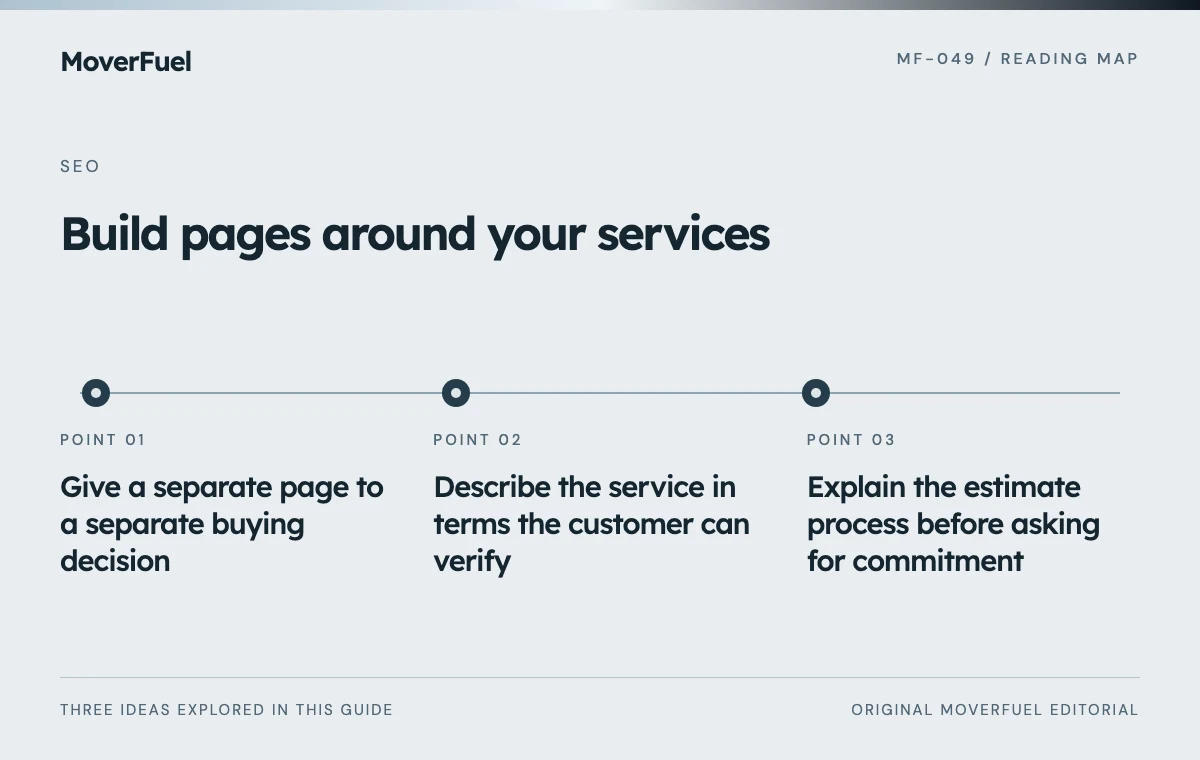
Give a separate page to a separate buying decision
Residential moving, office relocation and packing support can justify different pages when their scope, planning and estimate requirements differ. Minor wording variations for the same service usually belong on one coherent page. Start with the customer task rather than a target URL count.
Scroll the table horizontally to compare all columns.
| Service | Decision the page helps make | Distinct information |
|---|---|---|
| Residential moving | Can this team handle my household relocation? | Inventory, access, date planning and optional support |
| Office relocation | Can this provider coordinate our business move? | Decision roles, survey process and operational constraints |
| Packing services | Which preparation tasks can I delegate? | Included work, materials, exclusions and scheduling |
| Moving and storage | Can the company bridge my collection and delivery dates? | Storage arrangements, handling stages and access expectations |
If the business cannot explain how two proposed pages differ, pause the second page. A stronger existing page may serve the reader better than a thin variation that adds navigation and maintenance work.
Describe the service in terms the customer can verify
Explain what is included, what may be optional and what requires a separate assessment. Avoid implying that every job receives every add-on. The page should reduce misunderstandings before the estimate, not leave sales to correct an overly broad promise.
Use the language customers use while preserving accuracy. Explain unfamiliar terms such as a survey or access assessment in context. A first-time customer may not know why the estimator asks about stairs, elevators or packing requirements.
Make important limitations easy to find
Include relevant boundaries without turning the page into a defensive list. A specialist item may need advance review; a route may require confirmation; storage access may follow a defined process. State what the customer should provide so the company can give an informed answer.
Have operations approve the scope before publication. Content that describes a service the crews cannot deliver creates a customer problem even if it attracts relevant searches.
Explain the estimate process before asking for commitment
Tell the reader what information starts the process and what happens after submission. If a survey is needed, explain its purpose. If the form requests only an initial conversation, do not label it as an immediate binding price.
Scroll the table horizontally to compare all columns.
| Customer question | Useful answer on the page |
|---|---|
| What should I prepare? | Locations, preferred date and initial scope |
| Why do you need more details? | Explain how inventory and access affect planning |
| Who responds? | Describe the actual receiving team or role |
| What happens next? | State the genuine review or appointment step |
| Can I use my phone? | Provide a working, accessible mobile contact path |
Test the path after publishing. Confirm that the form’s service label reaches the receiving team and that errors are understandable. A polished page with a broken or misleading submission flow cannot fulfill its main commercial purpose.
Use genuine evidence at the point of uncertainty
Choose proof that addresses the service decision: approved work photos, a clear process explanation, authentic reviews or relevant verified credentials. Place it near the question it resolves. A general logo strip is less useful than evidence that the company can handle the specific work described.
FTC guidance requires truthful, supported advertising claims. Verify service promises and credentials before using them, and do not present fictional project results or stock imagery as the company’s own customer work. [1]
When approved client evidence is unavailable, explain the process accurately or use a clearly labeled conceptual illustration. A transparent explanation is preferable to invented proof. Assign an owner to facts that expire or change so the page stays accurate.
Create a readable hierarchy and relevant next paths
Use one clear main heading followed by sections for scope, planning, evidence, common questions and the estimate step. The order can vary with the service. An office relocation page may need planning responsibilities earlier than a simple packing-service page.
Link to relevant coverage information and genuinely useful guides at the point where they help. Avoid attaching the same long list of cities and articles to every service page. A customer researching storage should not have to navigate through unrelated moving advice to find the next step.
Use the keyword-to-page mapping guide to keep the service page’s purchase intent separate from supporting educational content.
Write metadata that accurately summarizes the offer. Do not add claims to a search snippet that the visible page cannot support. Keep headings useful when read aloud or scanned quickly on a small screen.
Evaluate the page through service-fit inquiries
Record the landing page and requested service when a person inquires, within the company’s approved measurement setup. Review whether the page attracts the work it describes, whether the team can reach those customers and whether estimates become retained bookings.
A rise in visits with repeated scope confusion suggests a different repair from a rise in suitable inquiries that the sales team cannot handle. Use the reason behind the outcome to improve the page or the receiving process. Keep the service specification current as the operation evolves.
Common questions
How long should a moving service page be?
Long enough to resolve the buying decision accurately. There is no useful universal word count; remove repetition and include the scope, evidence and next-step information the reader needs.
Should every service page use the same section order?
A shared design can help, but the information order should fit the service. Commercial planning and packing support may need different explanations and examples.
Your next step
Build each service page as a useful buying guide for work the company genuinely offers, with credible evidence and a tested route to an estimate.
Sources & editorial notes
Platform claims cite the documents below. Operating frameworks and labeled examples are MoverFuel editorial analysis, not client results or industry benchmarks.
- FTC: advertising and marketingTruthful and substantiated service claims. Page specifications and examples are original editorial recommendations. Reviewed .