
More organic visits can mean more potential customers, a popular planning article or interest from people the company cannot serve. A traffic chart alone cannot distinguish those outcomes. Measure the customer path from landing page to service fit and retained work, while keeping the limits of attribution visible.
 View full-size graphic ↗
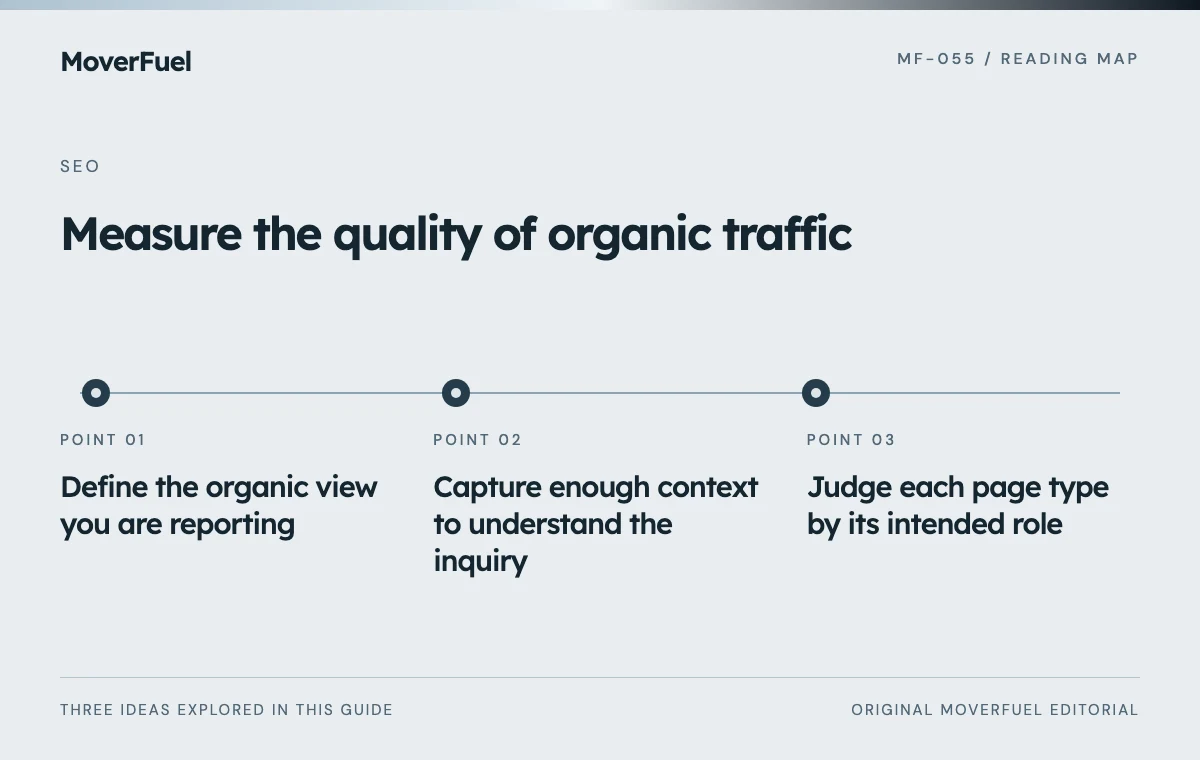
Define the organic view you are reporting
Specify whether the report describes organic search sessions, first known organic acquisition, inquiries attributed to organic search or jobs with an organic touch somewhere in the journey. These are different views. Do not add them together as though each were a unique customer.
Keep the original source evidence and later interactions when the approved system supports them. A person may discover a guide through search, return directly and then call. The final contact path does not necessarily describe the entire acquisition history.
Capture enough context to understand the inquiry
Scroll the table horizontally to compare all columns.
| Field | Decision it supports |
|---|---|
| First known landing page | Which answer introduced the customer? |
| Page type | Was the visit educational, service-focused or local? |
| Requested service | Does the inquiry fit the page’s offer? |
| Origin, destination and timing | Can the business serve the job? |
| Opportunity identifier | Can calls, forms and later stages be matched? |
| Outcome and reason | What happened after the inquiry? |
Use the company’s approved measurement and privacy setup. Do not collect extra customer information solely because a reporting tool permits it. The objective is a useful acquisition record, not an unrestricted history of every visitor.
Supermove’s marketing report documentation includes landing pages, referrer information and project-level attribution fields. That is an example of the kind of context a moving system can hold; it does not prove those fields are populated or integrated in a particular account. [1]
Judge each page type by its intended role
Scroll the table horizontally to compare all columns.
| Page type | Useful immediate outcome | Later business question |
|---|---|---|
| Service page | A suitable inquiry or clear service understanding | Does the service demand become retained work? |
| Coverage page | Confirmation of real geographic fit | Are the resulting routes appropriate? |
| Preparation guide | The reader completes a planning task | Does it assist a relevant service journey? |
| Comparison guide | The reader understands a decision | Does it attract the intended audience? |
A popular guide with low direct inquiry volume is not automatically poor content. It may serve an earlier task. But do not use its popularity to claim that the company has gained more ready-to-book demand. Keep educational usefulness and direct acquisition as separate questions.
Investigate who the traffic represents
A packing article might attract readers nationwide while the mover serves one region. That reach can be informative without being commercially equivalent to local service visits. Review the audience and page purpose before using traffic growth to justify a larger local acquisition forecast.
Follow unique inquiries through the sales stages
For a defined inquiry cohort, count unique opportunities, qualified requests, estimates, bookings, cancellations and completed jobs. Use the same qualification rules as other channels. Keep unresolved cases separate so recent inquiries are not unfairly compared with older, mature cohorts.
Scroll the table horizontally to compare all columns.
| Stage | Count | Interpretation |
|---|---|---|
| Unique inquiries | 40 | Known organic-attributed opportunities under the chosen rule |
| Suitable requests | 28 | Fit confirmed by the business |
| Estimates completed | 22 | Sales process progressed |
| Initial bookings | 10 | Reservation definition met |
| Retained bookings | 9 | One later cancellation remains visible |
The example yields a 70% qualification rate and a 22.5% retained-booking rate per inquiry. It says nothing about the number of visits required or the industry’s expected performance. Those would require additional real data and compatible definitions.
The qualified moving-lead guide explains why service fit should remain distinct from contact volume and later booking decisions.
Choose the next SEO repair from the loss pattern
If service pages attract unsuitable work, inspect the offer and search intent. If suitable visitors rarely inquire, inspect the mobile page, proof and contact path. If qualified inquiries fail to reach estimates, investigate sales coverage before rewriting every page.
If the report cannot match inquiries to outcomes, repair the measurement process first. A larger content budget will not resolve missing opportunity identifiers or inconsistent sales dispositions. Likewise, a technically correct source field is not useful if the team never records the final result.
Compare investment options using business relevance, confidence and effort. A page with modest traffic but useful retained jobs may deserve attention before a high-volume article serving a distant audience. Preserve the strategic role of educational content while keeping commercial claims proportional to the evidence.
Common questions
Is organic traffic growth a reliable lead-quality metric?
Not by itself. Separate page roles and follow inquiries through service fit and sales outcomes. More visits can reflect useful education without more suitable moving jobs.
Can every organic booking be attributed precisely?
No. Tracking permissions, cross-device behavior and incomplete records create gaps. Use a clear attribution rule and disclose unmatched or uncertain cases.
Your next step
Connect organic landing context to unique opportunities and mature outcomes. Use the resulting loss pattern to choose a specific content, conversion or sales improvement.
Sources & editorial notes
Platform claims cite the documents below. Operating frameworks and labeled examples are MoverFuel editorial analysis, not client results or industry benchmarks.
- Supermove: Marketing Milestones SummaryAvailable project-level landing/referrer attribution fields in documented moving software; actual account setup is not assumed. Reviewed .