
Clicks tell you that an advertisement or search result attracted an interaction. They do not tell you whether the moving company received suitable work. A useful performance system connects that early activity to inquiries, estimates, bookings and completed jobs while preserving the meaning of each stage. The objective is accountability across the funnel, not replacing every useful diagnostic with one revenue number.
 View full-size graphic ↗
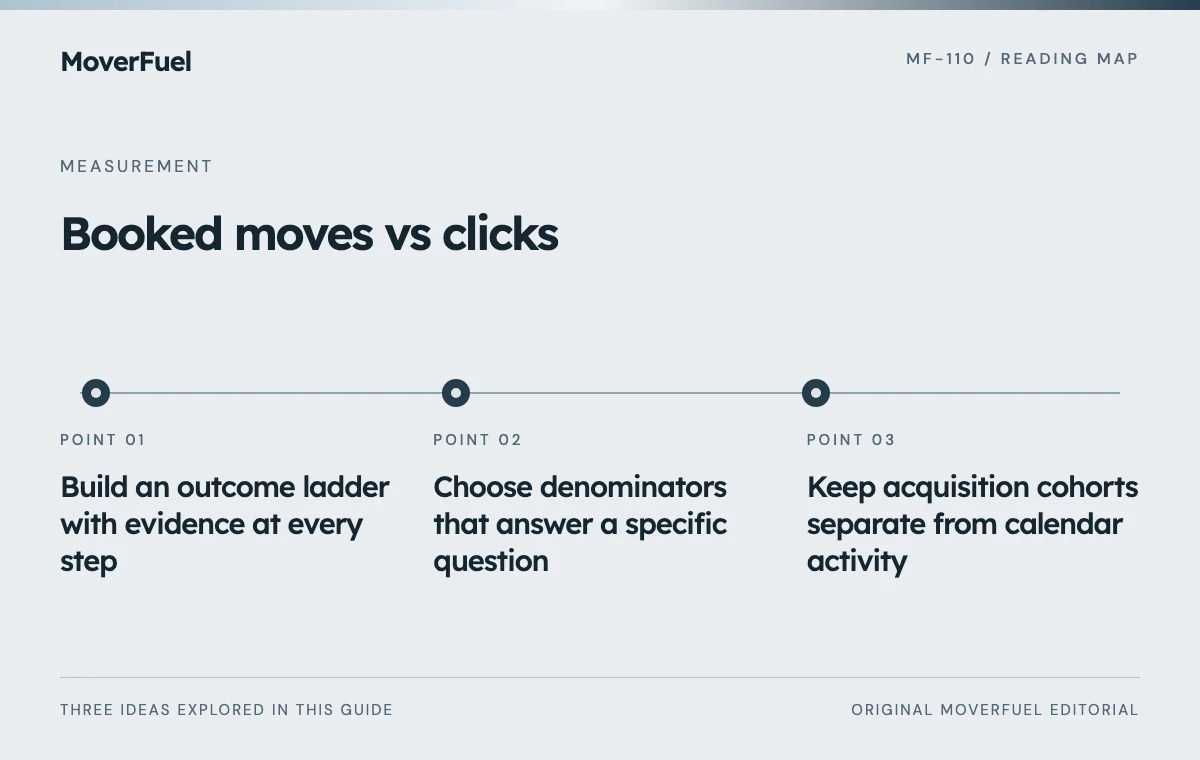
Build an outcome ladder with evidence at every step
Scroll the table horizontally to compare all columns.
| Stage | Evidence | Primary owner | Useful question |
|---|---|---|---|
| Exposure and click | Platform or search interaction | Marketing | Did the message reach relevant interest? |
| Inquiry | Unique request received | Intake | Did someone ask for service? |
| Qualified opportunity | Service, route and timing fit | Intake and sales | Can the business plausibly serve it? |
| Estimate delivered | Defined proposal reached customer | Estimator | Did the opportunity receive an offer? |
| Booked move | Company's booking criteria satisfied | Sales or coordinator | Was work committed? |
| Completed work | Service delivered and status confirmed | Operations | Did the booking become real work? |
| Economic result | Revenue and relevant cost records | Finance | What did the work contribute? |
Define the evidence required to enter each stage. A quote-form start is not a received inquiry; a proposal saved as a draft is not an estimate delivered; a verbal expression of interest is not automatically a booked move. Use the business's actual rules and document them.
Keep diagnostic metrics available. A sudden click decline can reveal a delivery problem before bookings mature. The mistake is treating that diagnostic as the final commercial result.
Choose denominators that answer a specific question
Every rate should name its numerator and denominator. Qualification rate may use unique inquiries; estimate progression may use qualified opportunities; booking rate may use delivered estimates. If the denominator changes, the interpretation changes too.
Scroll the table horizontally to compare all columns.
| Measure | Example definition | Common confusion |
|---|---|---|
| Qualification rate | Qualified opportunities ÷ unique inquiries | Using raw calls plus forms as unique people |
| Estimate progression | Delivered estimates ÷ eligible opportunities | Counting prepared but undelivered quotes |
| Estimate-to-booking rate | Bookings ÷ delivered estimates | Mixing different inquiry periods |
| Completion rate | Completed jobs ÷ bookings in the cohort | Ignoring cancellations or still-future moves |
Report counts beside percentages. A 50% rate from two opportunities does not carry the same practical weight as a stable pattern across many mature records. Avoid ranking small segments with false certainty.
For the intake portion, use the inquiry-to-estimate worksheet to distinguish legitimate exclusions from missed steps.
Keep acquisition cohorts separate from calendar activity
A calendar report answers what happened during a period: calls received, estimates issued or jobs completed. A cohort report follows inquiries acquired in a defined period through later outcomes. Both are useful, but they cannot be substituted without explanation.
Supermove's Marketing Milestones Summary documents several date filters, including creation and booking dates, and notes that projects can have multiple milestone rows. Those options illustrate why a report's date basis and row unit must be checked before interpreting totals. [1]
Allow outcomes to arrive later
A lead generated in October may book in November and move in December. If October spend is compared only with October completed jobs, the calculation can combine different populations. Preserve the acquisition date and update the cohort as outcomes mature.
Assign responsibility without turning measurement into blame
Marketing influences who arrives and what they expect. Intake influences whether a request is understood and routed. Estimating influences scope and proposal clarity. Operations influences availability and fulfillment. A weak booking result may involve several stages, so review the evidence together.
Use exception records to guide action: an ad attracted an unsupported service, a qualified inquiry lacked an owner or an available job was lost because the estimate was delayed. Name the repair and its owner rather than arguing about which department owns the entire funnel.
Preserve source and status history when a record changes. If a lead is reclassified after review, document why. A system that silently rewrites history cannot explain whether performance changed or only the reporting rules changed.
Create a decision view with diagnostics underneath
Lead the business review with qualified opportunities, mature bookings, completed work and economics. Place click, impression and page metrics underneath as diagnostic context. This keeps the commercial objective clear without losing the information needed to investigate a problem.
Segment by service and market when the data is sufficient. A commercial campaign with a longer cycle should not be judged against a local-moving campaign using an identical short window. Explain the maturity and operating differences before reallocating spend.
End the review with a small number of specific actions and an evidence requirement for the next review. Better performance reporting should change a decision, reveal a repair or confirm a stable process; it should not merely produce a more elaborate dashboard.
Common questions
Should we stop reporting clicks?
No. Clicks are useful diagnostics. Keep them connected to qualified and completed outcomes rather than presenting them as the business result.
Are booked moves enough to measure marketing success?
Bookings are important, but cancellations, fulfillment and job economics still matter. Follow mature cohorts through completed work where the data permits.
Your next step
Use an evidence-based outcome ladder with stable denominators and dates. Marketing performance becomes actionable when activity can be traced into suitable, completed work.
Sources & editorial notes
Platform claims cite the documents below. Operating frameworks and labeled examples are MoverFuel editorial analysis, not client results or industry benchmarks.
- Supermove: Marketing Milestones SummarySupermove report date filters and multiple milestone rows per project. Outcome ladder is vendor-neutral and does not imply a live MoverFuel integration. Reviewed .