
An inquiry can be suitable for your moving company and still never reach an estimate. The destination remains unknown, a survey is not scheduled or an estimator assumes someone else owns the record. Improving inquiry-to-estimate conversion starts by locating these missed steps and assigning a useful recovery action to each one.
 View full-size graphic ↗
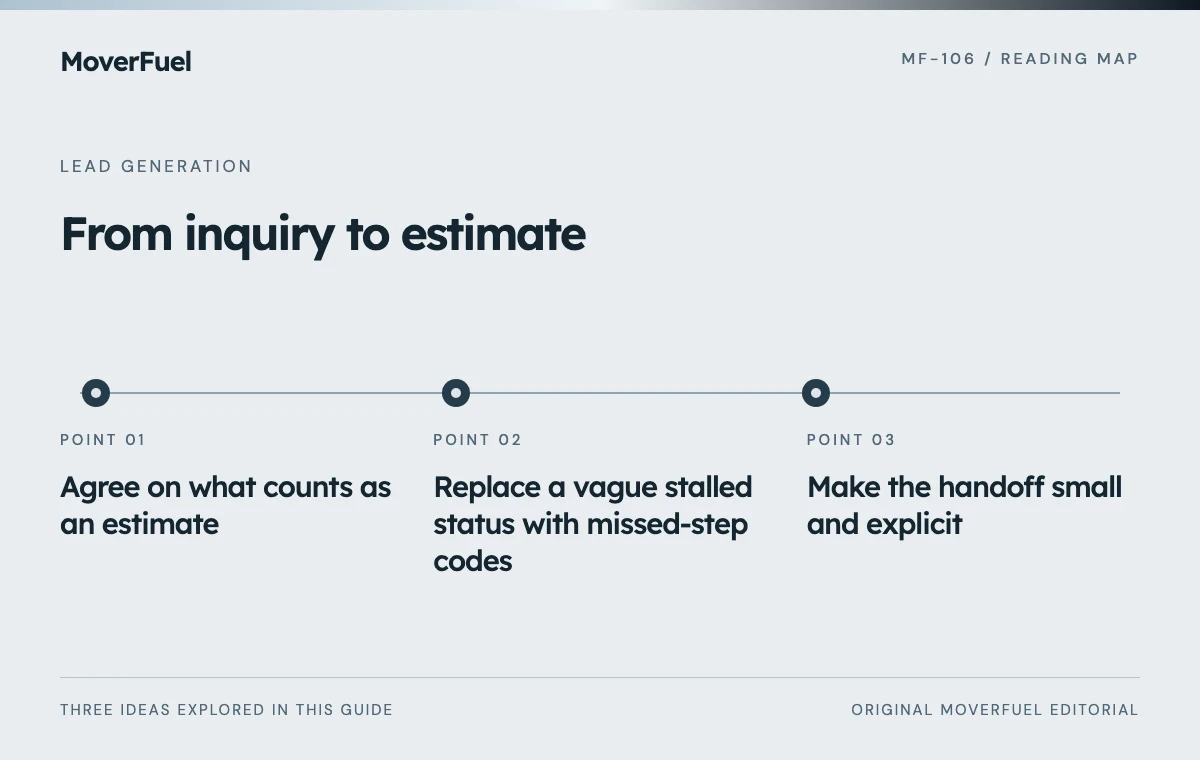
Agree on what counts as an estimate
Distinguish an initial price discussion, a survey appointment, a prepared proposal and an estimate actually delivered to the customer. If one branch counts a verbal range while another counts a documented proposal, their reported conversion rates cannot be compared directly.
Define the milestone appropriate to each service. A simple local inquiry and a complex commercial relocation may require different scoping steps. The common reporting rule should describe the evidence that the customer received the intended estimate, not force every service into an identical workflow.
Scroll the table horizontally to compare all columns.
| Stage | Evidence | Owner |
|---|---|---|
| Received | Unique inquiry record exists | Intake |
| Fit established | Service, route and timing checked | Intake or estimator |
| Scope ready | Required details or survey completed | Estimator |
| Estimate prepared | Proposal ready for review | Estimator |
| Estimate delivered | Document or explanation reached customer | Assigned sales owner |
Analytics systems can represent distinct lead lifecycle events; Google's recommended GA4 events include generation, qualification and working a lead. Your business still needs to define the operational evidence behind each stage. [1]
Replace a vague stalled status with missed-step codes
A record marked ‘pending’ does not tell the team what to do. Use a short set of reasons that distinguish customer information, internal work and genuine ineligibility. Keep the reason separate from the next action and its due date.
Scroll the table horizontally to compare all columns.
| Missed step | Recovery action | Do not do |
|---|---|---|
| Destination unknown | Ask what is known and when it will be confirmed | Invent an address to complete the record |
| Inventory incomplete | Explain the required scoping method | Send an unsupported precise quote |
| Survey not scheduled | Offer real available options | Mark the survey complete |
| Estimate awaiting internal review | Assign reviewer and deadline | Blame customer nonresponse |
| Delivery unconfirmed | Check destination and approved delivery path | Count preparation as delivery |
| Service mismatch | Explain limitation and close with a reason | Leave it indefinitely in the active queue |
Review a sample of stalled records with the people doing the work. If the same reason appears repeatedly, fix the process rather than asking staff to write longer notes. A missing destination prompt may require a form change; an internal approval backlog requires an operational decision.
Make the handoff small and explicit
A useful handoff includes the customer request, known move details, unresolved questions, source context and the agreed next step. The receiving person should know what they are responsible for without reconstructing a thread of calls and emails.
Give every active opportunity one accountable owner
Several people may contribute, but one person should ensure the next step happens. Define what occurs when that person is absent or the inquiry belongs to another branch. A record moved between queues should retain its history and not restart the customer's experience.
If a survey is required, tell the customer what it involves and what information to prepare. Confirm the appointment through the business's approved process. Do not promise an estimate deadline that depends on unavailable staff or missing scope.
Use the commercial quote-page framework when the first inquiry needs to lead into a project survey rather than an instant price.
Calculate conversion from a defined inquiry cohort
For a cohort of eligible inquiries, divide the number that received the defined estimate by the number eligible to reach that milestone. Also report the raw inquiry count and the reasons for exclusions. Otherwise a team can make the rate look better by silently removing difficult records.
Allow enough time for the service's scoping process. Compare cohorts at a similar age and show still-open records. Estimates issued this week may belong to inquiries from several earlier weeks, so a simple weekly division can mix unrelated populations.
Segment only where the counts support a useful decision. Service type, branch and source often explain different scoping requirements. Do not conclude that a low-volume commercial segment is broken merely because it has not matured as quickly as local residential work.
Turn the review into a bounded operational repair
Select one recurring missed step, name its owner and define the repair. Examples include a clearer inventory request, a visible survey queue or an alert for prepared estimates awaiting delivery. Test whether the change advances eligible opportunities without increasing inaccurate estimates.
Review quality as well as speed. More estimates are not helpful if scope is routinely wrong or the team cannot fulfill the promised schedule. Keep corrections, cancellations and customer confusion visible beside the progression rate.
Document what improved and what remains unresolved. The aim is a dependable path from suitable inquiry to a useful estimate, with fewer opportunities lost to ambiguity between teams.
Common questions
Should every inquiry receive an estimate?
No. Confirm fit and the information needed for the relevant service. Record legitimate exclusions instead of issuing misleading prices.
Is a survey appointment the same as an estimate?
Not necessarily. Define and report them separately when the survey is a step required before the estimate can be prepared.
Your next step
Find the missing step, assign an owner and measure progression with a stable denominator. Clear handoffs often reveal opportunities that more traffic alone cannot recover.
Sources & editorial notes
Platform claims cite the documents below. Operating frameworks and labeled examples are MoverFuel editorial analysis, not client results or industry benchmarks.
- Google Analytics: recommended eventsGA4 supports distinct lead lifecycle events. The estimate milestone definitions, recovery codes and example calculation are original operating guidance. Reviewed .