
The useful match-type question is not which label wins in every account. It is how much reach your company can evaluate without losing control of service fit and spending. A mover with reliable qualified-outcome data can investigate different coverage from one that counts every contact as a successful lead. Choose a starting scope, define the experiment and judge the resulting work.
 View full-size graphic ↗
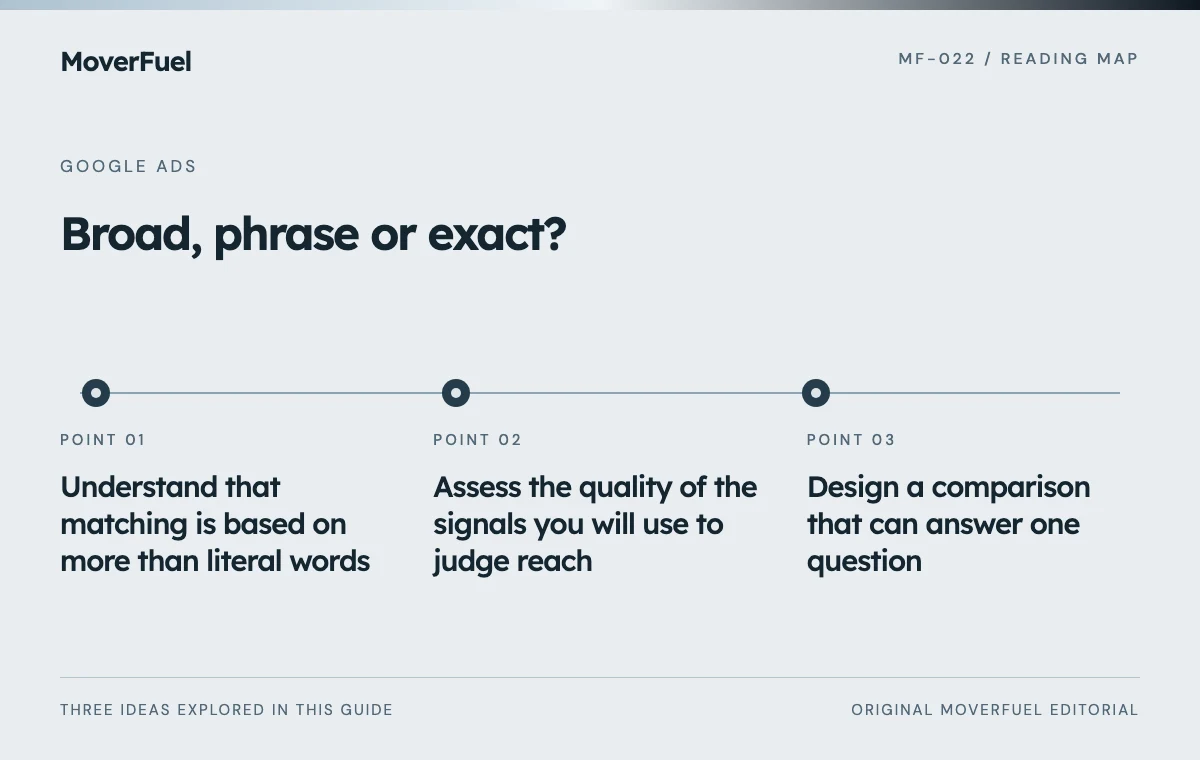
Understand that matching is based on more than literal words
Google’s matching system considers meaning and intent. Exact match is not a promise that the query will repeat your keyword word for word; phrase match is not merely a fixed phrase with extra words attached. Broad match reaches a wider set of related searches. Review actual queries instead of assuming punctuation fully describes the audience. [1]
Scroll the table horizontally to compare all columns.
| Type | Planning role | Question to monitor |
|---|---|---|
| Exact | A narrower starting set of intended meanings | Are matched requests still serviceable? |
| Phrase | Coverage around the keyword’s meaning | Which additional customer tasks appear? |
| Broad | Wider related-demand exploration | Does extra reach produce useful outcomes within the test boundary? |
These roles are a planning framework, not performance guarantees. None of the types can recognize every dispatch constraint, prevent every unsuitable inquiry or repair a misleading destination. The underlying service definition remains necessary.
Assess the quality of the signals you will use to judge reach
Before broadening coverage, sample recent conversion records. Are they real requests? Are repeat calls counted repeatedly? Can sales distinguish a qualified opportunity from an unanswered inquiry? Wider coverage makes weak definitions more costly to interpret.
Review campaign conversion goals as well as the event names. Standard primary actions used by the campaign can influence bidding, while secondary actions normally support observation; custom goals can include secondary actions for bidding. A label saying “qualified” does not establish that the event fires at the right business stage. [2]
Include human review capacity in the decision
Someone must inspect query patterns and qualification reasons. If the team cannot review the current campaign, a larger experiment creates more uncertainty. Set a practical review owner and a spending boundary before introducing additional reach.
Design a comparison that can answer one question
Write the hypothesis in business terms: “Broader matching may find additional serviceable apartment moves at an acceptable acquisition cost.” Specify the market, offer, page, outcome and observation period. If all of these change alongside match type, the result cannot isolate the coverage decision.
Scroll the table horizontally to compare all columns.
| Element | Decision to document |
|---|---|
| Population | Same service and geographic eligibility |
| Outcome | Unique qualified opportunities plus later bookings |
| Boundary | Approved test spend and stop conditions |
| Observation | Comparable acquisition periods with conversion delay allowed |
| Review | Query themes, qualification reasons and cancellations |
| Decision | Retain, repair, narrow or investigate further |
Where a supported platform experiment is appropriate, use it to reduce uncontrolled differences. Otherwise label a before-and-after review honestly and record confounders. Running overlapping campaigns without a clear allocation method is not automatically a clean experiment.
Judge incremental useful demand and its economics
Track absolute qualified opportunity counts alongside rates. A broader test might lower the qualification percentage while adding useful work; it might also add mostly unsuitable demand. The rate alone cannot distinguish those outcomes. Show spend, unique inquiries, qualified requests and mature bookings together.
Use cost per qualified opportunity as an intermediate measure and cost per booked move as a later measure. Neither alone captures contribution or capacity. If extra demand concentrates on already-full dates, more bookings may require an operational change before further expansion makes sense.
Repair the cause before choosing a permanent label
When broader coverage produces an incompatible service pattern, review exclusions and page wording. When suitable inquiries fail to receive responses, repair routing. When outcome imports are incomplete, repair measurement. Narrowing reach can be a prudent temporary boundary, but it does not identify which underlying issue caused the result.
Review the negative-keyword workflow before adding aggressive exclusions. An overly broad negative can hide useful demand in any positive match-type strategy.
Keep useful discoveries even when a test is stopped. A new service phrase may deserve a clearer page or a narrower keyword test. Conversely, do not keep a broader setting solely because it generates more activity. The decision should follow the company’s outcome definition and the evidence collected.
Write down why the next scope is appropriate
End the review with the evidence, uncertainty and next action. For example: the test reached a new serviceable theme, sales feedback is complete, but too few bookings have matured to change the acquisition target. That supports another bounded observation, not an unconditional rollout.
Revisit the decision when the offer, season, measurement or available capacity changes. Match type is a control within an operating system. It should not become an agency doctrine that ignores the work the moving company can sell and deliver.
Common questions
Does exact match prevent irrelevant moving inquiries?
No. Meaning-based matching, ambiguous customer language, geography and the landing-page offer can still produce unsuitable requests. Inspect real outcomes even in a narrow keyword strategy.
Should every mover use broad match?
There is no universal answer. Evaluate the service, goals, data reliability, budget boundary and review capacity. A controlled test is more useful than adopting a label without a measurable question.
Your next step
Choose the amount of reach you can measure and manage. Test a clear hypothesis, protect the spending boundary and use qualified outcomes to decide what deserves broader coverage.
Sources & editorial notes
Platform claims cite the documents below. Operating frameworks and labeled examples are MoverFuel editorial analysis, not client results or industry benchmarks.
- Google: how keyword matching worksMeaning-based keyword matching and relative reach distinctions. Reviewed .
- Google: primary and secondary conversion actionsCampaign use of primary/secondary actions and custom goals. Reviewed .