
Bidding strategy cannot resolve an unclear definition of success. If every form carries the same value, a value-based objective has little meaningful information about which jobs matter. If bookings vary in contribution but the values are unreliable, the system receives a distorted target. Choose between cost and value objectives only after examining the outcome data you can consistently supply.
 View full-size graphic ↗
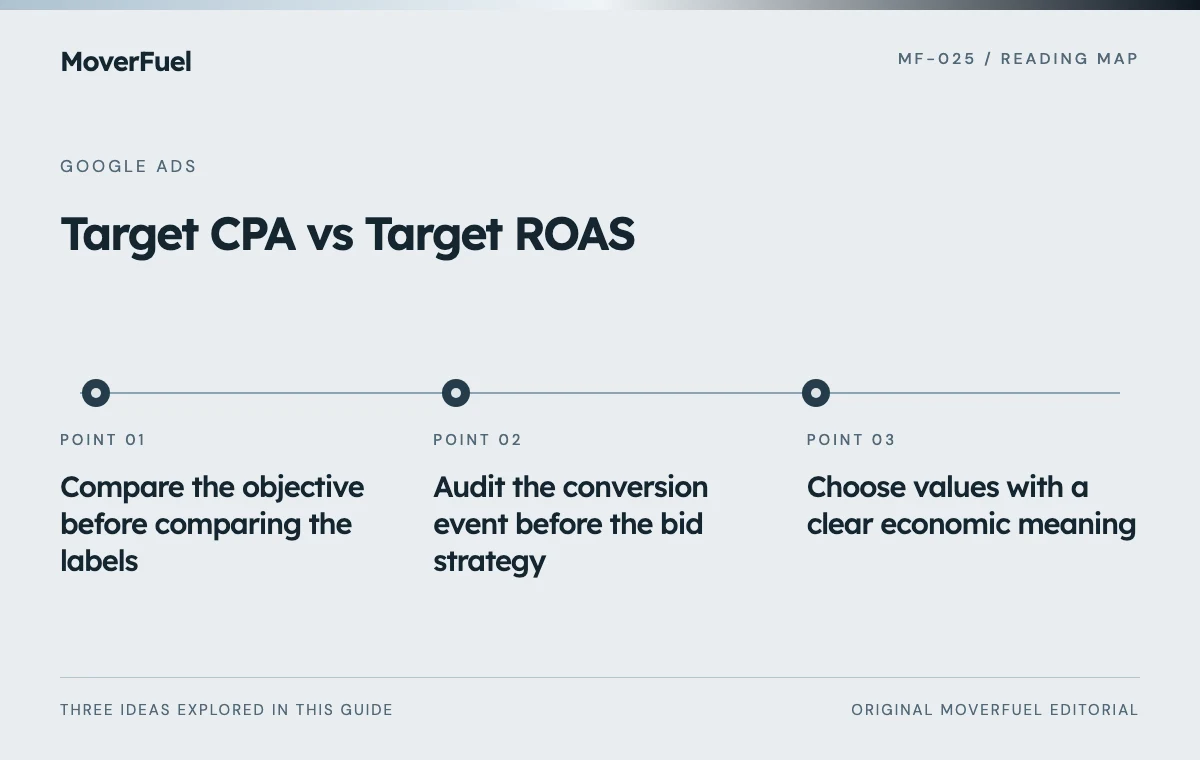
Compare the objective before comparing the labels
Target CPA aims for conversions at a desired average cost; it does not guarantee that each lead costs the target amount. Target ROAS uses conversion values to pursue a return objective. Google began changing the labels for target-based strategies in June 2026, so an account may show wording different from an older tutorial without a corresponding change in underlying behavior. [1] [2]
Scroll the table horizontally to compare all columns.
| Question | Cost objective | Value objective |
|---|---|---|
| What does the signal reward? | More defined outcomes at an average cost target | More reported conversion value relative to spend |
| What must be reliable? | Event definition, counting and timing | Those fields plus meaningful values |
| What can go wrong? | Cheap but unsuitable events dominate | Inflated or inconsistent values distort priorities |
| What must the owner still evaluate? | Booked work and contribution | Whether reported value reflects desirable work |
A target is not a substitute for an affordable acquisition model. Setting a very low CPA does not make every market capable of delivering suitable jobs at that price. Setting an ambitious ROAS does not prove that the uploaded values represent revenue or profit.
Audit the conversion event before the bid strategy
Take a sample of records counted as conversions. Check whether they are unique, correctly timed and at the intended stage. Look for repeat calls, spam submissions, premature qualification and booking events that survive cancellations without review.
Keep raw inquiries, qualified opportunities and booked jobs distinct. The company may use an earlier stage when later outcomes arrive slowly, but it should know what that stage predicts and where it fails. A long call is not necessarily a serviceable job, and a large quoted amount is not necessarily a confirmed purchase.
Use the qualified lead guide to establish the business definition before changing the optimization objective. Otherwise a bidding experiment can reward inconsistent sales labeling.
Choose values with a clear economic meaning
Possible signals include booked revenue, estimated contribution or a documented expected value for a qualified opportunity. These are not interchangeable. If you send contribution, name and report it as contribution. A return calculated from that value should not be described to the owner as revenue ROAS.
Scroll the table horizontally to compare all columns.
| Job | Booked revenue | Estimated variable fulfillment cost | Contribution before advertising and fixed costs |
|---|---|---|---|
| Local job A | $2,000 | $1,400 | $600 |
| Local job B | $1,500 | $750 | $750 |
In this invented example, the higher-revenue job contributes less before advertising and fixed costs. Whether contribution is practical as an optimization signal depends on how reliably the company can estimate and later correct costs. Do not use guessed precision to make a value strategy appear sophisticated.
Document proxy values separately
If a qualified opportunity receives an expected value, explain the underlying probability and job-value assumptions. Review them against mature outcomes and keep them separate from actual booked revenue. Avoid sending both a full proxy value and the full later job value as though they were unrelated sales.
Check current eligibility and sufficient value history
As reviewed in October 2026, Google lists a Search and Shopping requirement of at least 15 conversions in the previous 30 days at the conversion-tracking level for Target ROAS. It also recommends allowing one to two conversion cycles after introducing or changing values before adoption. Check the current guidance and your account because requirements vary by campaign type. [2]
A platform eligibility threshold is not an editorial guarantee that the business has enough reliable evidence. Fifteen inconsistently labeled events do not become good training data because a setting becomes available. Review missing values, unusually large entries, cancellations and time from inquiry to outcome.
Run a bounded test with mature comparisons
State what should improve: more qualified jobs within a cost boundary, or better value from comparable spend. Keep service coverage and the offer stable where possible. Record the target, budget, conversion goals and value definitions before the test starts.
Choose an observation period that accounts for the conversion cycle. A recent cohort with incomplete booking values should not be compared with an older fully matured cohort. Review the strategy report alongside CRM outcomes and record any sales or operational changes that could affect the result.
Monitor both total useful work and unit economics. A stronger reported return can accompany much lower volume. A lower CPA can accompany less valuable jobs. Decide whether that tradeoff serves the company’s capacity and financial objectives rather than declaring one metric an automatic winner.
Choose the simplest objective your data can support
When qualified outcomes are consistent but values are not, a cost objective may be easier to interpret while value tracking is repaired. When values differ meaningfully and are reliable, a value objective may support a more useful test. These are decision conditions, not promises about which strategy will outperform.
Revisit the choice when pricing, service mix, tracking or capacity changes. Keep the value model and event dictionary versioned. The long-term advantage comes from supplying accurate business outcomes and making explainable decisions, not from selecting the strategy with the more advanced-sounding name.
Common questions
Does Target ROAS require actual revenue values?
It requires conversion values, but their meaning must be explicit. Revenue, contribution and modeled lead value measure different things. Report the result consistently with the value supplied.
Is Target CPA a guarantee of lead cost?
No. It is an average cost objective. Individual outcomes and actual average performance can vary, and the quality of the selected conversion event remains the advertiser’s responsibility.
Your next step
First define the outcome, then verify counting and values, and only then select a bidding test. Reliable business signals matter more than the strategy label.
Sources & editorial notes
Platform claims cite the documents below. Operating frameworks and labeled examples are MoverFuel editorial analysis, not client results or industry benchmarks.
- Google: Target CPA biddingAverage-cost objective, current naming and no-history eligibility; not a performance guarantee. Reviewed .
- Google: Target ROAS biddingValue objective, current Search eligibility and value-history guidance. Reviewed .