
A negative keyword list is a statement about work you do not want to buy. That makes a universal moving-industry list risky: one company rents trucks, another supplies loading crews, and another accepts neither request. Build exclusions from your service definition and actual query evidence. The aim is to remove incompatible intent while retaining the language suitable customers use.
 View full-size graphic ↗
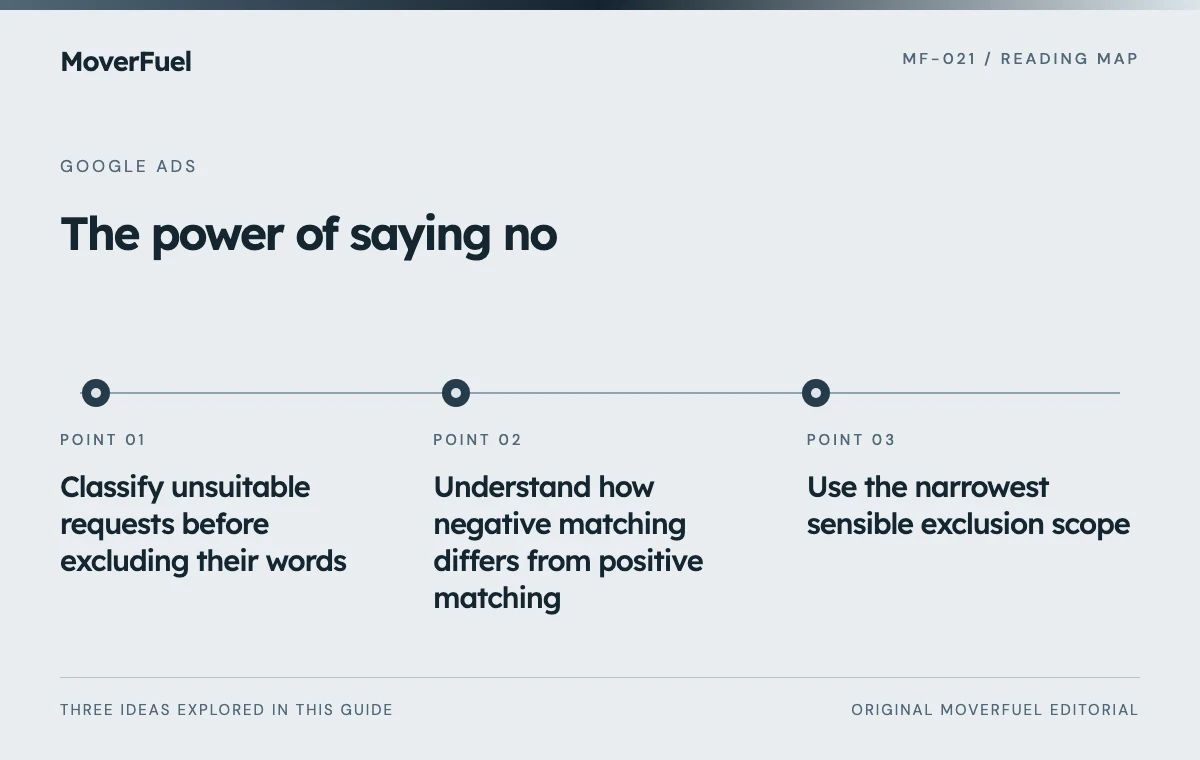
Classify unsuitable requests before excluding their words
Separate employment inquiries, incompatible services, unserved locations, unavailable dates and legitimate prospects lost on price. Only some of these failures are reliably addressed through keyword exclusions. An estimator who could not reach a customer has not proved that the query was irrelevant.
Scroll the table horizontally to compare all columns.
| Theme | Question before excluding | Possible action |
|---|---|---|
| Driver jobs | Is this a recruitment or customer campaign? | Exclude employment requests from acquisition |
| Rental truck loading | Does the business provide loading labor? | Retain if offered; exclude narrowly if not |
| Storage prices | Is storage part of the service? | Route to an appropriate offer or exclude |
| Small apartment move | Is there a minimum job scope? | Clarify the offer before rejecting the theme |
| Cheap movers | Are unsuitable budgets repeatedly documented? | Investigate; do not assume every price-conscious buyer is invalid |
Require a reason that another person can audit. “Bad lead” is too broad. “Customer requested vehicle rental; company does not rent vehicles” is specific enough to connect the lead feedback to a possible targeting repair.
Understand how negative matching differs from positive matching
For Search, negative broad match blocks a query containing all the negative terms, even in a different order. Negative phrase match requires the terms in the same order. Negative exact match blocks that exact sequence without additional words. These are exclusion rules, not the meaning-based expansion behavior of positive keywords. [1]
Negative keywords do not expand to synonyms or singular/plural variants as positive matching can. Google says casing and misspellings are handled automatically. Inspect the wording you need to exclude rather than assuming one negative will remove an entire conceptual category. [1]
Scroll the table horizontally to compare all columns.
| Negative type | Query: moving jobs | Query: moving jobs near me | Query: jobs moving |
|---|---|---|---|
| Broad | Blocked | Blocked | Blocked |
| Phrase | Blocked | Blocked | Not blocked by this negative |
| Exact | Blocked | Not blocked by this negative | Not blocked by this negative |
This simplified example isolates the negative rule. Actual ad eligibility also depends on other targeting, policies and settings. Avoid using the table to predict that an ad must show whenever this particular negative does not block it.
Use the narrowest sensible exclusion scope
An exclusion that is correct for one service can be wrong for another. A household-moving campaign may not need warehouse requests, while the company’s commercial campaign does. Account-wide exclusions deserve extra review because their effects can extend beyond the campaign where the issue was noticed.
Separate universal incompatibility from service routing
Maintain one set for requests that the entire acquisition program rejects and separate sets for service-specific boundaries. Name the lists in plain language. Include the business reason and the person responsible for reviewing them when the offer changes.
Do not use negatives as a substitute for clear campaign ownership. If two groups can genuinely fulfill a request, first decide which destination and budget should serve it. Adding increasingly elaborate cross-exclusions can make an account difficult to maintain without improving the customer experience.
Keep an exclusion change log with a reversal path
Scroll the table horizontally to compare all columns.
| Field | What to record |
|---|---|
| Observed pattern | Query theme and qualification evidence |
| Proposed exclusion | Exact text, match type and scope |
| Collateral risk | Suitable services that may share the words |
| Approval | Owner of the service definition |
| Review condition | What evidence would justify keeping or reversing it |
| Outcome | Quality and volume after a comparable observation period |
Check candidate negatives against the current keyword list, service pages and recent suitable inquiries. This is especially important for short words with multiple meanings. A broad exclusion for “labor” can block work a loading-only crew wants; an exclusion for “storage” can hide a profitable bundled request.
Review outcomes beyond the falling lead count
Fewer inquiries after an exclusion is not automatically success. Examine suitable opportunities, cost per qualified request and mature bookings. A list that removes both junk and valuable work can improve the apparent qualification percentage while reducing the total number of profitable jobs.
Compare similar periods and note other changes such as budget, crew availability or pricing. Where volume is limited, describe uncertainty rather than declaring a winner after a handful of calls. Maintain lead reasons consistently so a change in sales labeling does not masquerade as a targeting improvement.
Combine exclusions with the keyword research matrix. The positive list describes demand worth exploring; the negative log explains what the business has evidence to reject.
Common questions
Can I copy a moving-company negative keyword list?
Use it as a review prompt, not an automatic upload. Check every theme against your services, campaign purpose and desired customers. A competitor’s incompatible request may be work you want.
Should I exclude a keyword after one unbooked lead?
A clearly incompatible service may justify action quickly. One suitable prospect who does not book is different; investigate contact, estimate and sales outcomes before excluding the query theme.
Your next step
An effective exclusion has a specific business reason, deliberate match behavior, appropriate scope and a review record. Protect suitable demand as carefully as you remove incompatible requests.
Sources & editorial notes
Platform claims cite the documents below. Operating frameworks and labeled examples are MoverFuel editorial analysis, not client results or industry benchmarks.
- Google: negative keywordsSearch negative match rules, variant behavior and account-level scope. Examples and review workflow are original. Reviewed .