
A keyword is commercially useful when the person behind it could buy work your company wants to fulfill. High search volume does not establish that fit, and a phrase containing “quote” does not prove that the route or service is suitable. Build the list from your operating model, then test the uncertain parts. The result should be a set of decisions, not an impressive spreadsheet of unfiltered phrases.
 View full-size graphic ↗
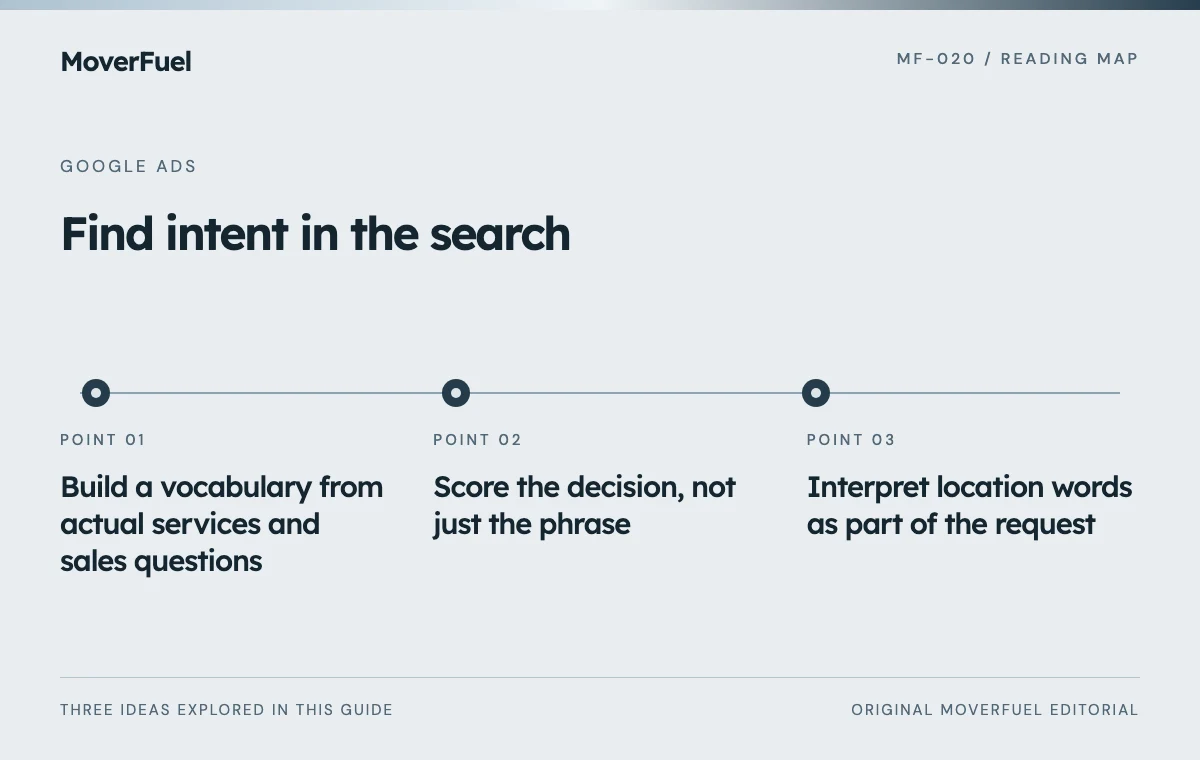
Build a vocabulary from actual services and sales questions
Ask estimators which words customers use for work the company provides. Apartment moves, packing help, office relocation and labor-only loading can represent different requests. Compare those phrases with your service pages and dispatch rules. A keyword tool cannot decide whether a piano move or a storage request fits your operation.
Google recommends organizing keyword lists around relevant products or services. Begin with that principle, then add the moving-specific qualification questions: where the move starts, where it ends, when it is needed and what work the customer expects. [1]
Use keyword research tools to discover language and estimate demand, but label estimates by source and date. Do not invent volume or cost figures for phrases that have no measured data. A low-volume specialist request can still be valuable; a broad popular term can be expensive and unsuitable.
Keep three inputs separate
Maintain a customer-language list from conversations, a tool-generated candidate list and a record of actual advertising queries. They answer different questions. Customer language explains need, tools suggest possible demand, and campaign queries show what your current targeting reached.
Score the decision, not just the phrase
Scroll the table horizontally to compare all columns.
| Candidate theme | Fit question | Initial decision |
|---|---|---|
| Apartment movers in the service area | Do we accept the building and job scope? | Include if service and page match |
| Movers from City A to City B | Can we serve both ends and the timing? | Investigate route fit |
| Moving truck rental | Do we rent vehicles or only supply crews? | Exclude if incompatible |
| Cost of office relocation | Can the page answer commercial scope questions? | Test separately if useful |
| Moving company jobs | Is this a customer acquisition campaign? | Exclude employment intent |
Add an owner and an evidence column. “Investigate” should lead to an answer from operations, a page requirement or a bounded advertising test. Without an owner, the research list becomes a queue of assumptions that silently enter campaigns.
Do not automatically reject every price-related phrase. People comparing a purchase often ask about cost. Instead, evaluate whether your destination explains the estimate process and whether the requests become suitable opportunities. Likewise, a prestigious-sounding service term can still attract work you cannot handle.
Interpret location words as part of the request
A location modifier can describe pickup, destination, a nearby provider or a place the customer is researching. Read the full phrase. “Movers in Austin” and “moving from Austin to Denver” are not interchangeable briefs, even if Austin appears in both.
Location words in keywords and the campaign’s geographic settings are separate controls. Review them together with the landing page and actual inquiry details. A well-written route phrase does not compensate for a campaign that reaches unsuitable audiences or a page that never asks for destination.
Group keywords by the explanation the customer needs
If two themes need the same service promise and estimate path, they may belong in the same ad group. If one needs an office survey and another a residential estimate, separate messaging is usually more useful. This is a customer-task decision before it is an account-organization decision.
Choose the destination while reviewing the keyword, not after the list is approved. Mark candidates whose pages are missing, unclear or inaccurate. A useful keyword with no credible destination is a development task, not automatically launch-ready inventory.
For the wider campaign boundaries, use the Google Ads campaign guide. Keep this research sheet focused on which requests deserve coverage and why.
Validate the list against actual search terms and lead outcomes
A keyword is an advertiser’s targeting input; a search term is the user’s query. They are not always identical. Google’s search terms report also omits some low-activity queries for privacy, so the visible rows are not a complete transcript of every search that reached the campaign. [2]
Review themes against qualification feedback using the attribution detail actually available. Do not invent a person-to-query connection when the systems cannot establish it. Campaign or ad-group patterns can still expose a mismatch without falsely claiming which exact phrase a named customer entered.
Classify a theme as useful, incompatible or unresolved. Useful themes may justify more relevant copy or a controlled expansion. Incompatible themes may justify exclusions. Unresolved themes need a better observation window or clearer sales dispositions. A single unbooked click rarely settles the question.
Maintain a small expansion backlog with clear boundaries
For each proposed addition, record the service, destination, test budget owner, expected qualification rule and review condition. Give changes dates so a later analyst can distinguish a new keyword test from seasonality or a pricing change.
Retire candidates that depend on services the business has stopped offering. Recheck exclusions when the company adds packing, storage or labor-only work. Keyword research is not finished when the first campaign launches because the company’s sellable capacity and offer can change.
The useful outcome is a prioritized, explainable list. An owner should be able to pick any theme and understand the customer task, the service fit, the destination and the evidence that supports spending more on it. That is a stronger foundation than ranking phrases solely by estimated traffic.
Common questions
Are “near me” keywords always the best moving keywords?
No. They can express local hiring intent, but service type, geography, page quality and actual qualification still determine whether the traffic is useful. Evaluate them alongside specific service and route requests.
Should cost-related keywords be negative keywords?
Not automatically. Price research can be part of a buying decision. Review the service fit, destination and resulting opportunities before excluding a whole cost-related theme.
Your next step
Prioritize serviceable customer requests. A keyword matrix with fit questions, destinations and evidence makes research usable for both the campaign manager and the moving-company owner.
Sources & editorial notes
Platform claims cite the documents below. Operating frameworks and labeled examples are MoverFuel editorial analysis, not client results or industry benchmarks.
- Google: build a keyword listGrouping keyword lists around relevant services. Reviewed .
- Google: search terms reportDifference between keywords and queries and privacy-related omissions in reporting. Reviewed .