
A wrong phone number on a listing can send a moving inquiry somewhere else. An old address can send a customer to a closed office. Those are concrete reasons to maintain local citations. Start with harmful identity conflicts rather than purchasing a large number of directory entries to improve an abstract consistency score.
 View full-size graphic ↗
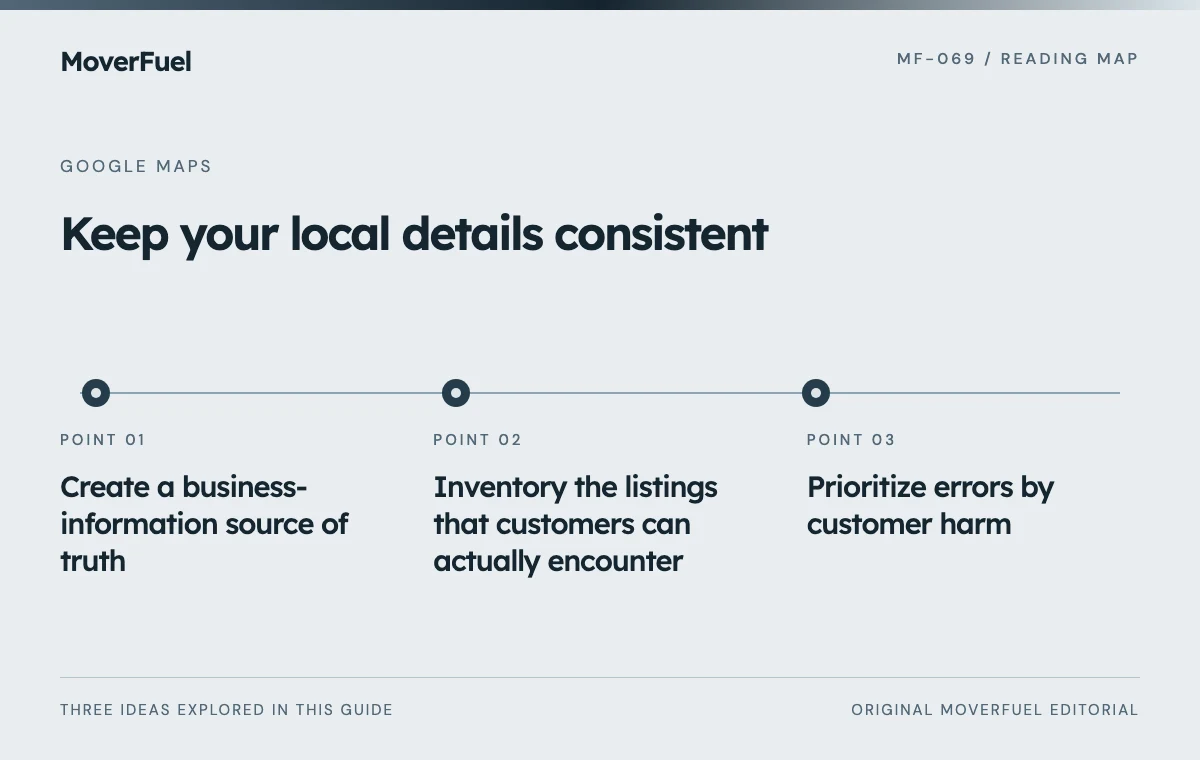
Create a business-information source of truth
NAP means name, address and phone number, but an effective master record needs more context. Include the public trading name, legal identity where relevant, genuine operating locations, public address-display rules, phone ownership, website destinations, hours and service scope.
Google’s business guidelines emphasize the real-world name and accurate location information. Use those principles when reviewing the profile rather than adding promotional phrases or creating an address merely to match a directory field. [1]
Scroll the table horizontally to compare all columns.
| Field | Decision to document |
|---|---|
| Public name | How customers know the business; legitimate brand variations |
| Address | Real base, customer access and whether the address is public |
| Phone | Primary contact, ownership and approved tracking arrangements |
| Website | Canonical business or branch page and tested inquiry path |
| Hours and services | Current facts approved by operations |
| Change owner | Who approves and distributes updates |
Keep legal records and public marketing fields distinct. A legal suffix or billing address may have a valid purpose without being the right label for every customer-facing listing. Document the reason for a variation so later audits do not repeatedly ‘correct’ it in opposite directions.
Inventory the listings that customers can actually encounter
Begin with major map platforms, relevant associations, local business organizations and directories already sending visits or inquiries. Search the business name with old phone numbers and former addresses. Ask staff where customers say they found outdated details.
Record each listing’s URL, account owner, visible information and correction method. A list of business names without accessible listing URLs is difficult to verify. Mark whether an entry is controlled by the company, a former agency or a third party that requires a correction request.
Distinguish duplicate listings from separate entities
An acquired company, a former branch and an unrelated mover with a similar name require different treatment. Investigate identity before requesting removal or merging records. A cleanup intended to simplify reporting should not erase a legitimate operating unit.
Prioritize errors by customer harm
Scroll the table horizontally to compare all columns.
| Priority | Example | Why it comes first |
|---|---|---|
| Immediate | Phone routes to another company | Inquiries are misdirected |
| High | Closed office shown as customer-facing | Customers may travel to the wrong place |
| High | Listing implies a service the mover does not provide | Requests arrive with a false expectation |
| Investigate | Duplicate with reviews or historical ownership | Identity and record continuity need review |
| Routine | Harmless abbreviation with otherwise correct details | Lower practical impact than broken contact data |
For each repair, retain the prior value, requested value, reason, submission date and confirmation. Revisit the public listing after the provider accepts the edit. An acknowledgment email is not the same as a live correction.
If a directory demands a public address for a service-area business that does not receive customers there, examine whether participation is appropriate. Do not disclose a private home or invent an office merely to complete the form. A directory’s fields should not determine the company’s operating story.
Handle tracking and relocation without losing identity
A tracking number is a deliberate measurement choice, not automatically an identity error. Keep a controlled register of numbers, destinations, providers and termination plans. Test routing and ensure the company can retain or replace the number without losing customer contact when a vendor relationship ends.
Do not replace every number at once simply to achieve textual uniformity. First determine why each exists and whether it connects callers reliably. Measurement changes should be coordinated with whoever maintains call attribution and the public profile’s current rules.
Build citation checks into business changes
Trigger a review after a rebrand, relocation, phone migration, acquisition or branch closure. Also review high-value listings on a recurring schedule chosen for the business. The responsible person should have access to the master record and know how to escalate ownership problems.
For multiple branches, use a shared Business Profile governance process while preserving the facts of each location.
Report completed corrections, unresolved ownership issues and customer-impacting errors. Avoid equating a count of directory placements with improved rankings. The defensible result of citation maintenance is clearer, more reliable business information; any search or lead impact needs separate observation.
Common questions
Must every listing use identical punctuation?
Prioritize whether the listing identifies the correct business and reaches the right destination. Harmless formatting differences are less urgent than wrong phones, false addresses or duplicate identities.
Should we buy hundreds of citations?
Evaluate the relevance and usefulness of each source. Correcting important existing records is often a more concrete task than adding a large volume of low-value entries.
Your next step
Maintain one approved business-information record, repair the errors that mislead customers first and verify changes in public. Citation work should preserve identity through real business changes.
Sources & editorial notes
Platform claims cite the documents below. Operating frameworks and labeled examples are MoverFuel editorial analysis, not client results or industry benchmarks.
- Google: representing your businessReal-world business naming and accurate location principles. Citation prioritization and tracking-number governance are original recommendations, not ranking guarantees. Reviewed .