
A Google Ads campaign can produce plenty of calls while sending a moving company the wrong work. The practical starting point is the job: where it begins, where it ends, what the customer needs and whether your team can fulfill it. Campaign structure, landing pages and conversion goals should all reflect that operating definition. Clicks and inquiries help diagnose the journey; suitable bookings tell you whether it is serving the business.
 View full-size graphic ↗
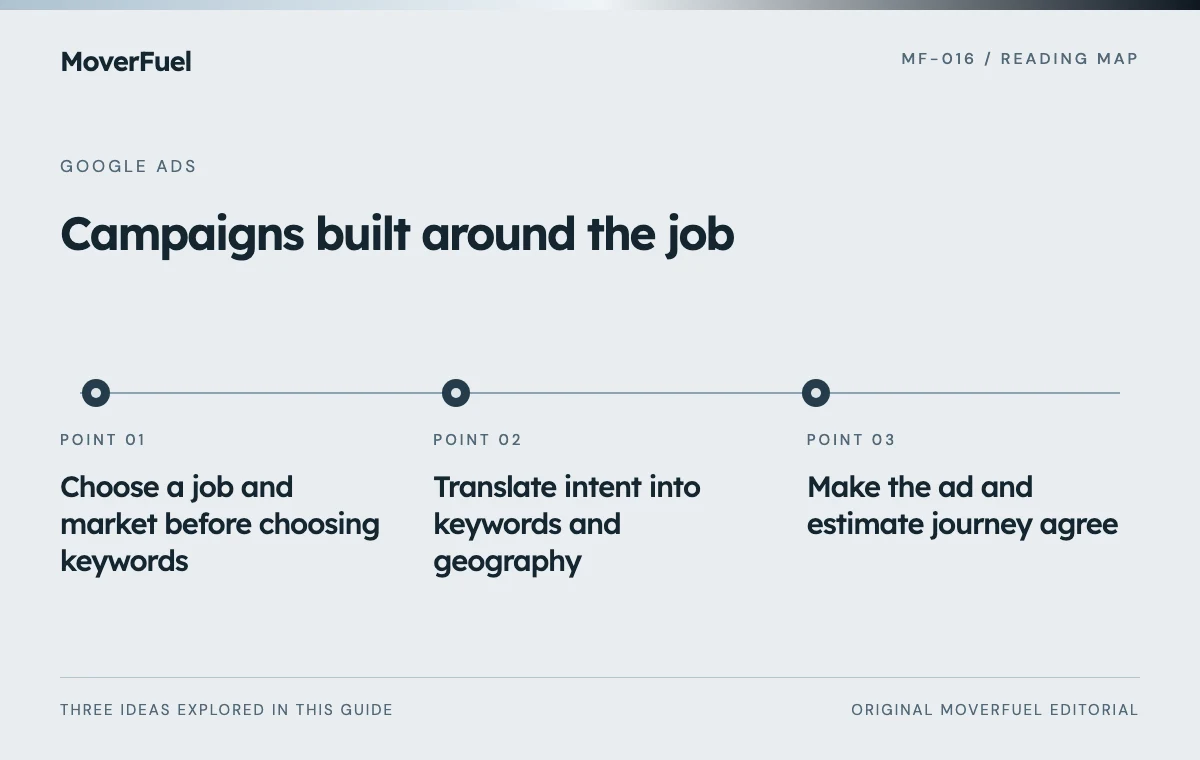
Choose a job and market before choosing keywords
Write down the work the campaign is meant to generate. A local residential mover may want full-service household jobs in a defined metro. An interstate operator may have capacity on particular origin-destination lanes. A commercial mover may be looking for office projects that require a site survey. Those are different offers, even when the same company provides all three.
Scroll the table horizontally to compare all columns.
| Service | Qualification to establish | Useful destination |
|---|---|---|
| Local residential | Origin, destination, date and service scope | Local service page with a clear estimate request |
| Interstate | Both ends of the route, timing and operational fit | Route-aware explanation of the service and estimate process |
| Commercial | Project size, facilities, schedule and buying stage | Office relocation page leading to a qualified project discussion |
Separate campaigns when budget control, geography, goals or operational responsibility need to differ. Do not fragment every keyword into its own tiny campaign simply to create a more elaborate account. Start with the decisions the structure must support, then create the fewest sensible boundaries.
Check the calendar and sales coverage
Confirm who can answer the resulting inquiries and which dates remain saleable. A campaign advertising weekend flexibility should not run on an assumption that dispatch has not approved. If the operation temporarily cannot accept a service, update the advertising and destination together.
Translate intent into keywords and geography
Build keyword groups around the service a customer is trying to hire. ‘Office movers’ and ‘apartment moving company’ may need different explanations and qualification questions. Google recommends organizing keyword lists around relevant products or services. The moving-specific application is to group searches by the promise the destination can actually fulfill. [1]
Review search terms against real lead feedback. Employment requests, vehicle transport or do-it-yourself equipment may be irrelevant to your offer, but an exclusion should follow your service list rather than a borrowed universal negative-keyword spreadsheet. A mover offering labor-only loading could lose appropriate inquiries by indiscriminately excluding every rental-truck term.
Location options distinguish physical presence from interest in a place. Presence can suit a business seeking people in its current service area; interest may matter when someone is planning a relocation from elsewhere. Neither setting understands your complete dispatch rules, and Google's location signals are not perfectly accurate. Inspect actual origin and destination details after the inquiry. [2]

Make the ad and estimate journey agree
The destination should answer the questions created by the ad: do you offer this move, do you serve this route, what happens after the request and what information is needed next? A generic homepage can be adequate only if it clearly fulfills that task. A focused service page is often easier to align when the campaign targets a distinct job.
- State the actual service and coverage without invented locations or unavailable offers.
- Explain whether the next step is a phone conversation, virtual survey or another estimate process.
- Use genuine operational proof: approved crew photos, accurate business identity and authentic customer feedback.
- Test the mobile form, validation, confirmation, call routing and CRM record before launch.
Keep the initial request proportional to the decision. Origin, destination, moving date and basic scope may be enough to start. More complex jobs can need additional detail before an estimator can help. Explain that submitting a request does not reserve a truck or confirm a binding price unless your actual process supports that commitment.
If suitable visitors abandon the inquiry path, review website conversion for moving companies before treating more traffic as the answer.
Choose a conversion that represents progress
Give each stage a precise meaning. A raw call is an interaction; a qualified lead has passed your service-fit checks; a booking has reached your defined acceptance event. Google supports qualified and converted lead outcomes, but it does not determine whether a particular moving request fits your crew capacity or service boundaries. [3]
Review goal configuration as carefully as the tracking tag. In Google's standard-goal setup, primary actions can inform bidding when their goal is used; secondary actions are generally observational. Custom goals are an important exception because included actions can be used for bidding regardless of that label. Check the actual campaign goal rather than assuming a secondary label always prevents optimization toward an event. [4]
Return reliable outcomes before relying on automation
Offline conversion workflows can connect later lead outcomes with advertising interactions. Implementation depends on supported identifiers, data permissions and the integration in use. Keep stable record IDs, defined event times and a single owner for each conversion action. Verify imports and diagnostics against known records; an accepted upload does not by itself prove the business definition is correct. [5]
Do not count a form, a CRM-created lead and the same lead's imported event as three separate acquisitions. Equally, do not switch a campaign to a deeper event that your staff record inconsistently. Repair the event definition and data collection before making it the principal optimization signal.
Compare cost at the same funnel stage
Use a bounded test budget that the company can afford to learn from. There is no universal monthly spend that makes every moving market viable. Competition, service mix, margins, coverage and the sales process all affect what a useful test looks like. State the assumptions and the point at which you will review the evidence.
Scroll the table horizontally to compare all columns.
| Measure | Campaign A | Campaign B |
|---|---|---|
| Advertising spend | $3,000 | $3,000 |
| Unique inquiries | 60 | 40 |
| Qualified inquiries | 24 | 28 |
| Booked moves | 8 | 10 |
| Cost per inquiry | $50 | $75 |
| Cost per booked move | $375 | $300 |
These invented scenario inputs illustrate the calculation, not an expected result. Campaign A has the lower inquiry cost; Campaign B has the lower booked acquisition cost. Even that comparison is incomplete without job contribution, cancellations and fulfillment costs. If Campaign B sells less profitable work, the apparent advantage may disappear.
Keep your calculation definitions consistent with the moving-company marketing budget guide. Do not compare this month's spending with unrelated jobs completed this month.
Run an optimization routine the operator can use
Review search terms, geographic mismatch, contactability, estimates and bookings together. Start with a specific failure pattern. If many requests are for a service you do not provide, inspect terms and page promises. If appropriate inquiries never reach an estimator, inspect routing and workload. If estimates stall, examine the offer and follow-up before blaming the search query.
Record material changes and allow for the sales cycle when judging them. A fresh interstate inquiry may not mature as quickly as a local last-minute request. Changes to pricing, staffing or available dates can affect bookings even when campaign settings are unchanged.
Increase investment only when the business can absorb more suitable demand and measurement is reliable enough to explain the decision. A successful first test can justify another bounded test; it does not prove that doubling spend will double completed jobs. Use the next review to evaluate the additional work and its economics.
If you would rather have a team run this routine with you, see our Google Ads management for movers.
Common questions
Should local and interstate moving campaigns be separate?
Separate them when geography, budgets, service promises or qualification differ materially. Shared branding does not require shared targeting. Avoid unnecessary fragmentation when the same decision rules genuinely apply.
Is a phone call a qualified conversion?
Not automatically. Duration and connection can help describe a call, but serviceability and customer intent require a clear business definition. Keep raw interactions and qualified outcomes distinct.
Can a low cost per lead hide poor performance?
Yes. The hypothetical comparison shows how inquiry cost and booked acquisition cost can move in different directions. Examine lead fit, mature booking outcomes, cancellations and job contribution before deciding which campaign is better.
Your next step
Start with a service-market brief, verify the estimate journey and define the outcome you want to buy. Then use actual qualification and booking evidence to improve the campaign. The account should help the company sell suitable work, not merely produce an attractive activity report.
Sources & editorial notes
Platform claims cite the documents below. Operating frameworks and labeled examples are MoverFuel editorial analysis, not client results or industry benchmarks.
- Google: build a keyword listGrouping keywords around relevant services. Reviewed .
- Google: advanced location optionsPresence and interest options and the limits of location signals. Reviewed .
- Google: qualified and converted leadsQualified and converted lead stages. Reviewed .
- Google: primary and secondary conversion actionsPrimary/secondary actions and the custom-goal exception. Reviewed .
- Google: offline conversion importsOffline conversion workflows. No fixed API setup or UI instructions are asserted here. Reviewed .